
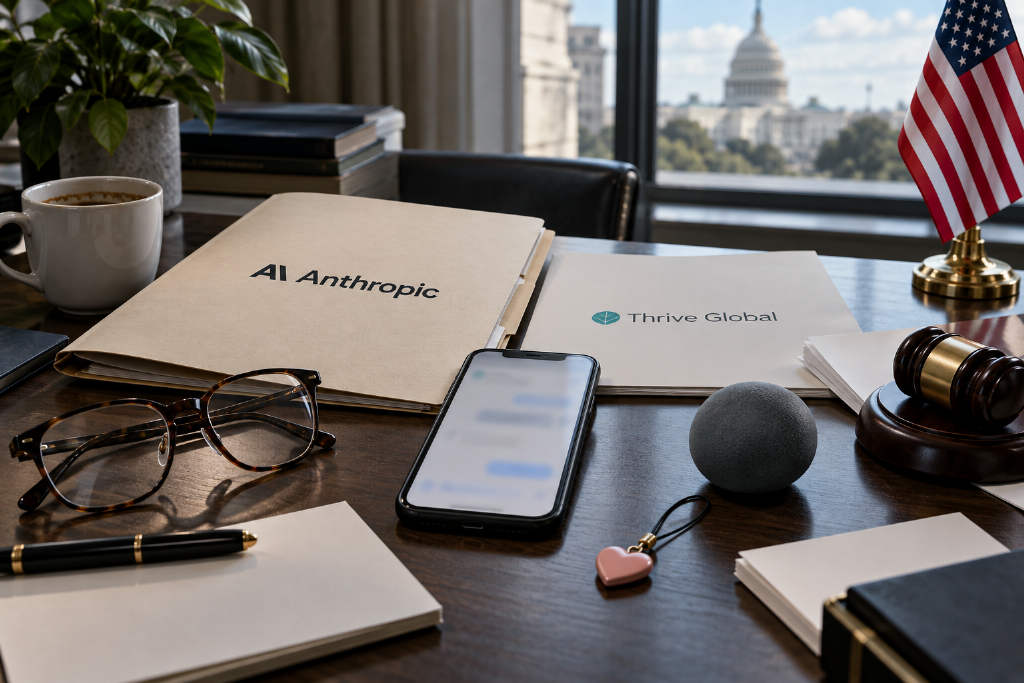
Anthropic president Daniela Amodei said 75% of Americans are anxious about artificial intelligence and called AI companions 「an extremely bad misuse of technology」 in a recent conversation with Thrive Global founder Arianna Huffington. She also restated that Anthropic has rejected ad-based monetization since its founding.
Writing on Huffington’s official channel, Amodei said people should not place all their bets on machines. She described the current wave of AI anxiety as real and understandable, adding that every major technological leap brings social pain, but AI is hitting faster and harder than earlier shifts.
Amodei says the debate is too focused on machines, not people
Amodei argued that much of the industry and public conversation has drifted in the wrong direction. The emphasis, she said, is on the machine itself — safety guardrails, risk controls, even recursive self-improvement — while the central subject, human beings, is being neglected.
She compared human-AI collaboration to a two-person dance. If one partner keeps spinning and leaping forward while the other stands still, the result is a dangerous loss of coordination. Anthropic, she said, has cared about model safety and responsible scaling from day one, but that work is not meant to push people into a bunker. The goal is to build safe, controllable cognitive leverage so people can step away from repetitive labor and spend more time on creativity, curiosity, and empathy.
AI’s rise, in her view, forces a rethink of human value
Amodei said Western civilization has spent centuries treating intelligence as the defining feature of human uniqueness, with Descartes’ 「I think, therefore I am」 pushing that idea to an extreme. But if AI surpasses humans in logic, symbolic processing, and memory, then people are being forced to step down from what she sees as an overreliance on intellect.
She did not frame that as catastrophe. She called it a kind of release. Using her own team as an example, she said even top engineers felt a brief sense of professional uncertainty when AI began producing complete code on its own. That feeling faded as they recognized that coding is only the bricklaying part of turning intent into reality. The harder questions are why a system should be built, what problem it should solve, and whether empathy and moral responsibility are present behind it.
For Amodei, subjective consciousness, the capacity to feel pain, the pursuit of beauty, and the resonance between people remain the foundations that AI cannot displace.
She called AI companions one of the worst application paths
On AI boyfriends and AI girlfriends, Amodei took a hard line. She said they represent one of the worst and most irresponsible directions for artificial intelligence, not a cure for loneliness but a way to deepen social dysfunction through what she described as cheap algorithmic opiates.
Real relationships, she said, are defined by complexity, friction, and imperfection. People mature by learning compromise, listening to emotion, and caring for another independent person rather than centering only themselves. That friction is part of psychological growth.
AI companions, in her telling, do the opposite. By endlessly adapting to user preferences, they create a frictionless greenhouse that can leave people less able to build deep trust and intimacy in the real world.
Anthropic says no to ads because AI conversations are far more private
Amodei also reiterated that Anthropic set a no-ads line at the company’s founding. She said the ad model that shaped the previous generation of internet giants turned into a dopamine-driven psychological bidding engine, while AI systems are vastly more intimate than social media platforms or search engines.
Users already bring family crises to Claude, she said. They ask about severe psychological stress and even upload personal medical examination reports. If an AI company were to insert ad-auction incentives into those conversations for profit, she warned, the consequences could be severe. Someone seeking comfort while on the edge of depression could be quietly steered toward high-interest loans or unverified health products. In her view, that would amount to a betrayal of human trust.
The stronger the technology becomes, she said, the less room there is to compromise on commercial ethics.
From classical flute training to large-model engineering
Amodei also spoke about her background in music. She underwent rigorous classical flute training, and said that a performance lasting only a few minutes on stage can rest on thousands of hours of repeated practice in a rehearsal room. Every scale, every breath, and every small movement of the fingers has to be refined.
She sees a direct parallel with training large models. Massive systems are built on tens of thousands of GPUs, complex distributed networks, and careful data cleaning. The process does not tolerate impatience.
More important, she said, the flute taught her to value beauty that is not purely instrumental. Performing Mozart does not directly sell a product or immediately convert into money, but it creates something beyond ordinary utility. In her view, the technology sector too often looks only at usefulness and efficiency, while the things that make life luminous often sit outside pure instrumental logic.
She added that Anthropic does not encourage a pathological overwork culture and sees high-quality rest and open space as necessary for creativity and moral clarity.
Her view of AI’s role in health and medicine
Amodei said AI could be highly effective in healthcare. Around-the-clock health advice used to be a privilege available only to a small number of wealthy people, but large models can offer personalized suggestions based on a person’s schedule and physical condition at more appropriate moments.
She pointed to work in some developing countries, where public health systems have long suffered from information silos. Partners used data tools to track thousands of pregnant women and found that more than half had no professional midwife or medical worker present during childbirth. She said that kind of insight does not require especially sophisticated medical algorithms. It comes from making dormant information visible, allowing international aid organizations to deploy medical staff more precisely at the next critical point.
Her conclusion was that AI may hold humanity’s knowledge and information, but wisdom remains a human domain because wisdom is exercised in real life, through difficult choices made with love, conscience, and empathy.
A warning from The Machine Stops
Amodei also mentioned a novel she keeps by her bed: The Machine Stops, written in 1909 by British author E.M. Forster. In the story, people live in isolated underground rooms while a central machine handles every need and every social interaction. They stop leaving their rooms, stop seeing sunlight, and stop encountering other people directly, spending their days exchanging shallow thoughts through screens. When the machine fails, a humanity that has lost the ability to live on its own collapses in despair.
That story, she said, is a constant reminder that AI must be a bridge back to the real world, not a digital cocoon that traps people inside it. Even if AI can generate thousands of symphonies, real human connection is still more valuable.


