

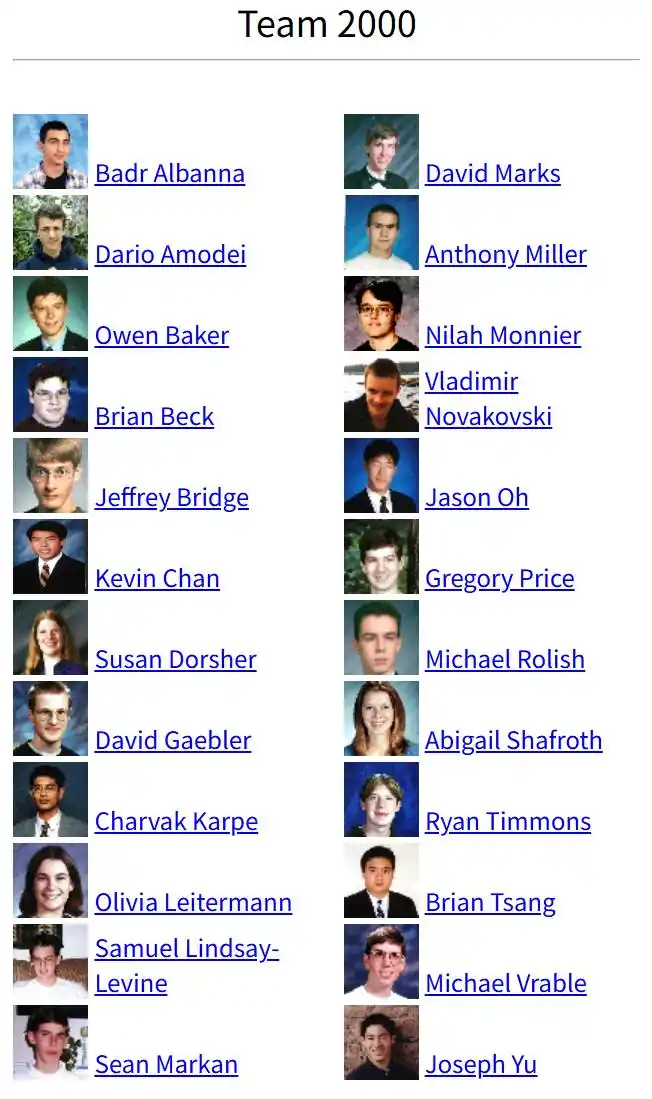
An archived roster from the 2000 U.S. Physics Olympiad training camp is circulating again online, and one name on the list has drawn immediate attention: Dario Amodei, now the chief executive of Anthropic.
The list is preserved by the American Association of Physics Teachers, or AAPT, and still appears on a static webpage from that period. The renewed interest stems from how many of the 24 students later surfaced in major roles across AI and other technical fields. The article identifies not only Amodei, but also Lighter founder Vladimir Novakovski, Duolingo AI research engineer Badr Albanna, and UC Berkeley computational biology faculty member Nilah Monnier Ioannidis.
How the 2000 team was selected
The selection process took place in May 2000 at the University of Maryland. According to the process published by AAPT at the time, roughly 1,100 eligible students usually sat for the first round each year. The top 200 moved on, and 24 were then chosen for the training camp.
The final cut came through a five-hour exam. Those 24 students had to solve three physics problems in conditions close to actual competition and compete for five spots on the U.S. team.

The five selected students were Anthony Miller, Jason Oh, Gregory Price, Michael Vrable and Joseph Yu. They later traveled to Leicester in the United Kingdom for the 31st International Physics Olympiad, or IPhO.
U.S. results at the 31st IPhO
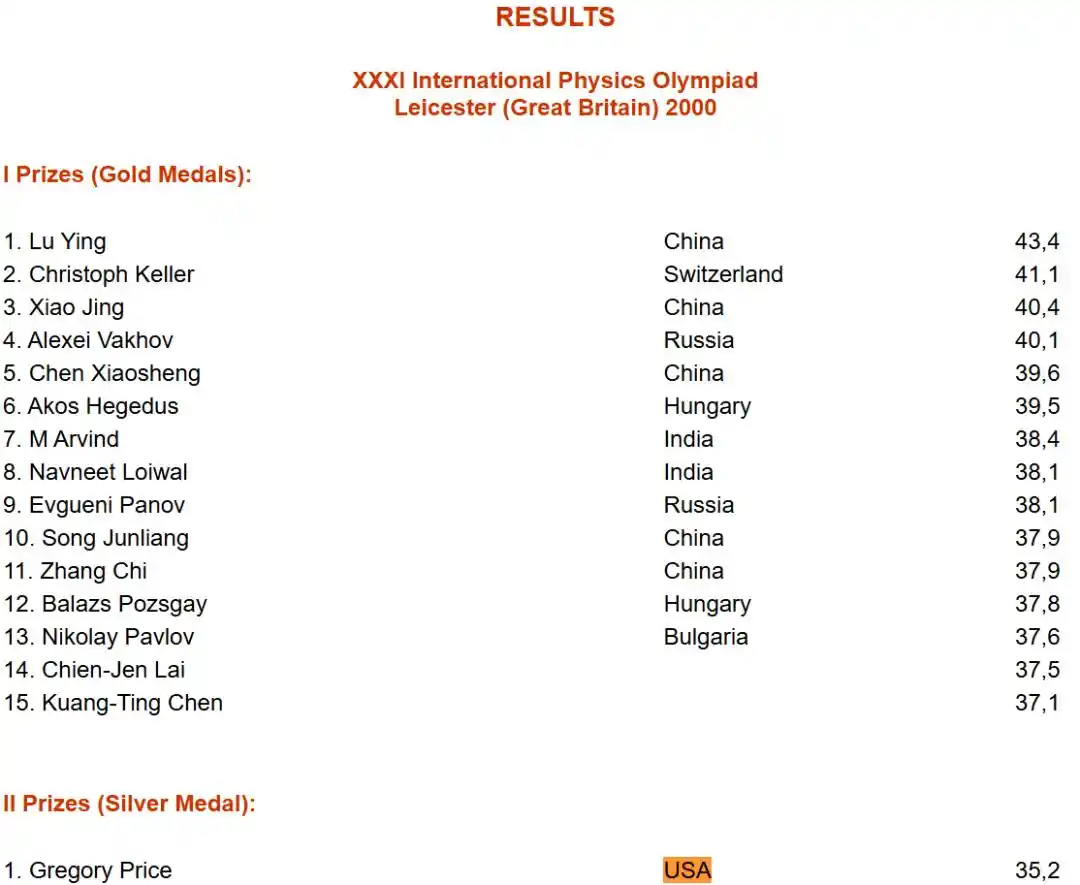
The competition included 300 contestants from 62 countries and regions. All five U.S. team members won medals.
Gregory Price posted 35.2 points, the highest score on the U.S. team, and took silver while ranking 16th overall. The other four members all won bronze medals. The U.S. team placed seventh overall.
The article also notes that China led that year. Lu Ying scored 43.4 points to finish first individually, and China also ranked first in team score.
Amodei’s path after missing the final five
Amodei did not make the final five-person team in 2000, but he stayed in physics. He went on to earn a PhD in physics from Princeton, studying statistical mechanics models and neural circuits.
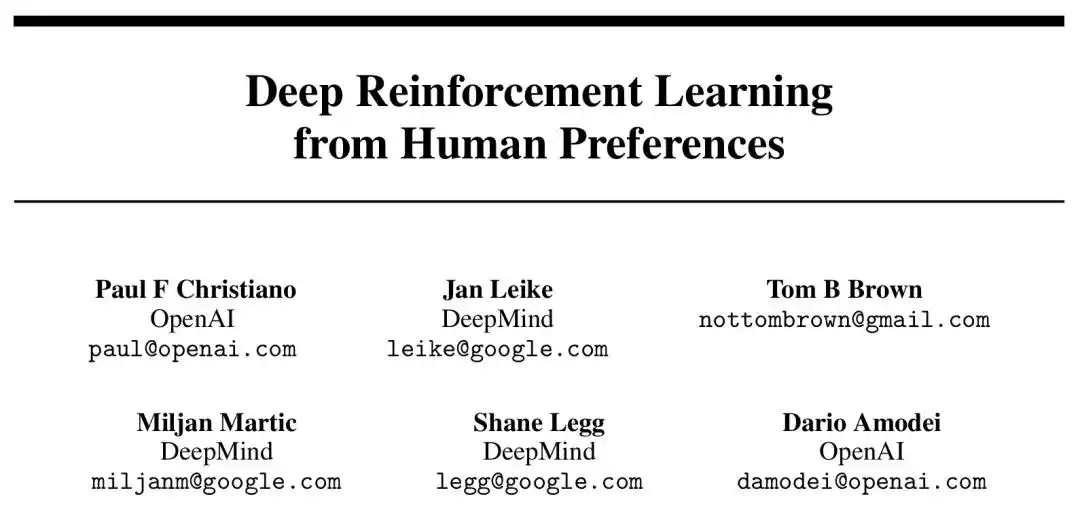
In 2014, he left academia and joined Baidu’s AI lab in Silicon Valley, where he worked on the speech recognition system Deep Speech 2. He later moved to Google Brain. In 2016, he joined OpenAI, rose to vice president of research, and helped lead work on GPT-2 and GPT-3. The article also says he was among the authors of an early paper tied to reinforcement learning from human feedback, or RLHF, and links to https://arxiv.org/abs/1706.03741.
In 2021, Amodei co-founded Anthropic with six other co-founders and became chief executive. The company later released Claude.
Other names on the same roster
Vladimir Novakovski missed the team in 2000, then returned in 2001, made the U.S. squad, and won silver at the International Physics Olympiad that year.

He later entered Harvard and graduated early. After that, Citadel founder Ken Griffin recruited him into the firm for quantitative trading. Novakovski then became head of machine learning at Quora and later vice president of engineering at fintech company Addepar. In 2017, he co-founded the AI social platform Lunchclub, which was later renamed Lighter.
The article says Lighter raised $68 million in 2025 in a round led by Founders Fund and Ribbit Capital, giving the company a valuation of about $1.5 billion.
Badr Albanna followed a different route. He earned a PhD in physics at UC Berkeley and later taught at universities including Fordham, where he used statistical mechanics and information theory to model the brain’s auditory cortex. He later joined Duolingo as an AI research engineer and applied multi-armed bandits and causal models to personalized notifications and monetization systems.
Nilah Monnier Ioannidis moved into computational biology. She pursued a biophysics doctorate at Harvard, carried out research at MIT using hidden Markov models and Bayesian inference to analyze particle motion inside cells, completed postdoctoral work at Stanford, and now teaches at UC Berkeley. The article says she helped develop REVEL, which has been used to predict the pathogenicity of missense variants.
What happened to the five who made the team
Silver medalist Gregory Price was a sophomore at Thomas Jefferson High School for Science and Technology in Virginia at the time. The article says he had not even taken a formal physics course and prepared with mathematical ability and an old college physics textbook.
His competition year did not end there. He also represented the United States at the International Olympiad in Informatics, or IOI, that same year, won bronze, and placed 91st out of 278 contestants. The report adds that he also took first place in the 10th-grade division of the largest math competition in the United States.
Bronze medalist Jason Oh took a sharply different path. After the Olympiad, he first studied physics and mathematics at Caltech, transferred to Harvard two years later, and graduated with highest honors in both subjects. He then entered Harvard Law School. He is now a professor at UCLA School of Law and holds the Lowell Milken chair, with research focused on tax policy and public finance.
Another bronze medalist, Michael Vrable, went from Harvey Mudd to a PhD in computer science at UC San Diego, where he focused on cloud storage backup and produced the backup system Cumulus. After finishing his doctorate in 2011, he joined Google as a security researcher.
Less public information is available on the other two bronze medalists. The article says Anthony Miller interned at the Princeton Plasma Physics Laboratory during the summer after his freshman year in high school and worked on a gas analysis system for a new reactor. Joseph Yu, meanwhile, led both his school’s math club and science club.
From Olympiad ties to startups and capital
The report argues that one lasting output of elite training camps is a network of trust that can reconnect many years later.
One example it gives is Robinhood co-founder Vlad Tenev, described as an old acquaintance of Novakovski from the Olympiad circle. More than two decades later, Robinhood became one of the investors in Lighter’s latest funding round.
Scott Wu, who co-founded Lunchclub with Novakovski, is described in the article as a multiple-time gold medal winner in informatics competitions and now leads Cognition, the company behind the AI coding product Devin.

Beyond the 2000 class
The article says the “notable alumni” section on the USAPhO Wikipedia page runs from Chris Hirata in 1996 through 2014, covering nearly two decades. Hirata won IPhO gold at age 13 and later became a well-known astrophysicist.
Another name listed alongside Amodei is Alexandr Wang for 2014. The article describes him as the founder of Scale AI and says Meta later spent $14.3 billion to buy shares in his company and brought him in to lead a superintelligence lab.
Twenty-six years ago, that five-hour exam chose the five students who performed best that day. In the AI era, attention has shifted back to all 24 names on the list.