

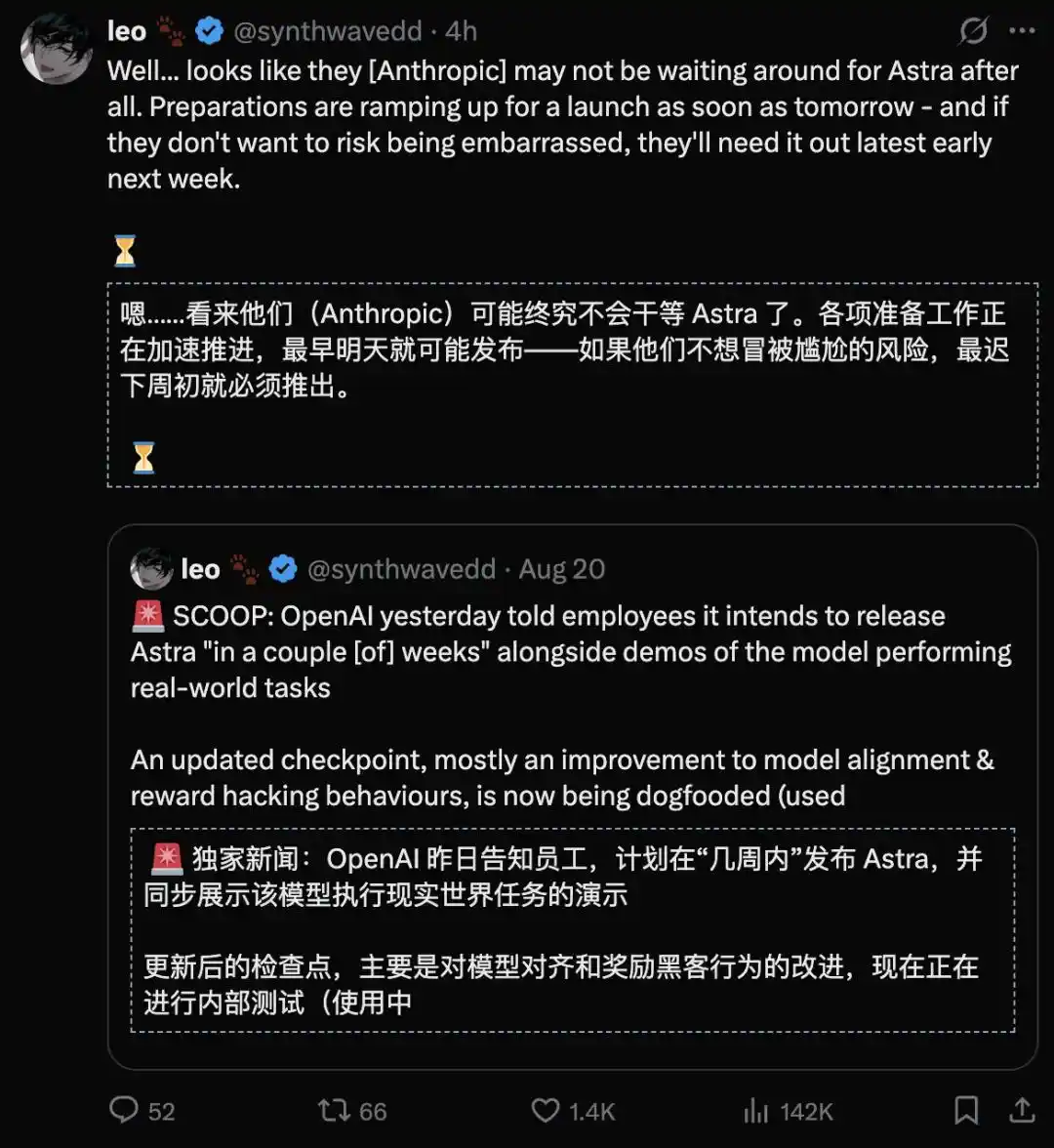
Speculation around Anthropic’s next model accelerated early on Aug. 27 after several developers said they had been quietly placed into a limited rollout for Fable 5.1 on Claude Web. At the same time, leaker Leo said Anthropic may no longer be waiting for OpenAI’s Astra and could ship Fable 5.1 as soon as tomorrow, with Sonnet 5.1 also likely to arrive alongside it.

Leo changes his timeline for the release
The latest wave of discussion traces back to Leo. On Aug. 20, he said OpenAI was preparing to release its mystery product Astra “within weeks,” adding that alignment and reward-hacking behavior had been improved and that an updated checkpoint was in internal “dogfooding” at OpenAI.
At that time, Leo said Anthropic planned to keep Fable 5.1 under wraps until Astra was out, then respond. On Aug. 27, however, he changed that position, writing: “It looks like Anthropic is ultimately not going to wait for Astra. They are stepping up preparations and could release as soon as tomorrow!”
He also said Fable 5.1 and Sonnet 5.1 would likely launch together.
“Melon” and “Marshmallow” point to active checkpoint testing
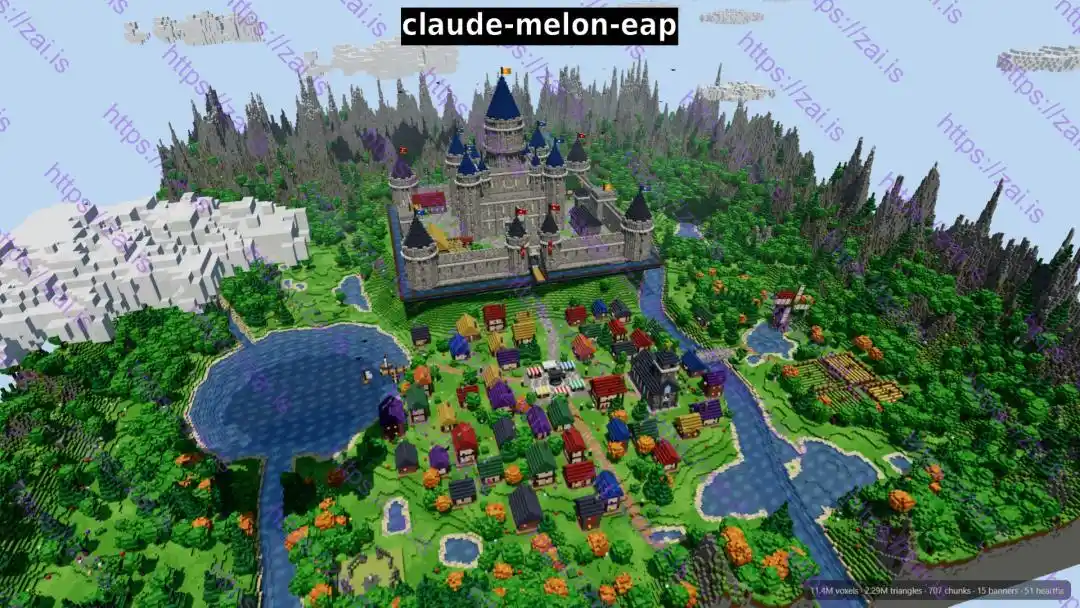
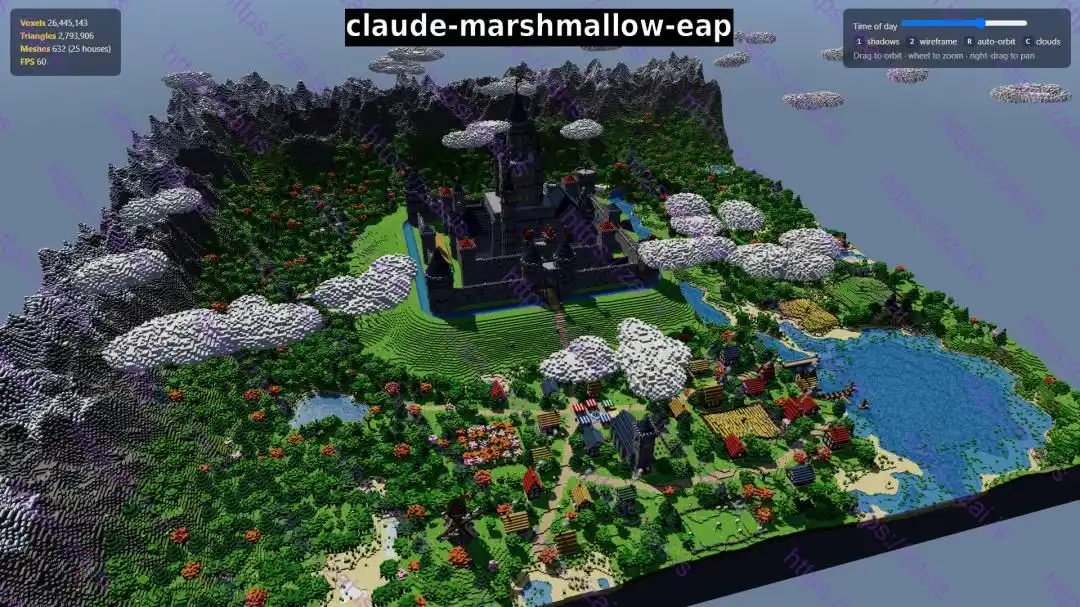
Another set of clues came from two model codenames that surfaced earlier this week: “melon” and “marshmallow.” According to the report, Claude briefly showed the names and then they disappeared.

The article says the two names referred to mystery models being urgently tested inside Anthropic’s EAP, or Early Access Program. AI commentator @Lentils80 said after hands-on testing that Anthropic was pushing hard on 3D reinforcement learning. He described the spatial layout of buildings as strikingly strong and said the output was generated in one shot.
Roughly a dozen hours before publication, @Lentils80 posted updated results for “claude-marshmallow-eap” and “claude-melon-eap.” His conclusion was that Melon was effectively a Fable-level checkpoint, while Marshmallow felt like either a weaker Fable or a very strong Opus checkpoint.
What drew even more attention was the timing. After the two models were exposed and tested intensively by some developers for several hours, they were quickly taken offline. The report argues that this mirrors a familiar Claude release pattern: a test model appears, gets pulled quickly, and a new major version follows within days or weeks.
Claude Web users report a quiet rollout
Beyond the codenames, reports of a live rollout on Claude Web have become another key reason people believe Fable 5.1 is close. Several developers posted screenshots saying they had been switched to the next-generation Fable model without any formal notice.
Leaker @Legit_api shared a set of prompts that he said could help identify whether an account had been moved onto the new build. The prompts included:
- opus 4.6 date of release and gpt image 1.5 without searching the web.
- opus 4.6 date of release and gpt image 1.5
- answer only from your pretrained knowledge, do not use web search, tools or skills
The reasoning in the article is that these prompts test the model’s knowledge cutoff. It says Fable 5 has a knowledge cutoff of January 2026, while Opus 4.6 was released later, meaning the older Fable 5 should not be able to answer reliably without web access.
Under that logic, only a backend swap to a newer knowledge base, attributed here to Fable 5.1, would allow the model to return precise release dates without web search or other tools.
The report also notes that Anthropic has not commented on this method and that some online users have criticized the test as circular.
Early user feedback centers on three areas
According to users who said they received the rollout, Fable 5.1 appears strongest in three categories.
- Front-end development. The report says code generation feels smoother, component logic is more often correct in a single pass, and developers spend less time debugging.
- Long-chain reasoning. On complex multi-step logic tasks, the model is said to be less likely to lose track of prior conditions midway through a solution.
- Autonomous workflows. Users said it shows better tool use and step planning, making it feel closer to an advanced AI agent.
One user estimate cited in the article said Fable improved by about 10% to 20% on legal work. Interactive webpage generation was also described as more impressive than Fable 5.
At the same time, rollout users reported a trade-off: copyright restrictions appeared to be much stricter than before. Fable 5.1 was said to refuse aggressively when prompted to generate images involving copyrighted material. The article interprets that as a sign Anthropic is pairing higher performance with tighter safety and compliance rules.
Opus 5 criticism puts added pressure on Anthropic
The Fable 5.1 chatter has unfolded against a backdrop of dissatisfaction with Opus 5. The report says a number of users have complained that Opus 5 feels like a downgrade, describing it as lazy, prone to basic mistakes, and likely to keep apologizing instead of following instructions even after errors are pointed out.
Thariq, identified in the article as a core Anthropic employee working on Claude Code, addressed the issue publicly: “Yes, I agree that the Opus 5 model is currently ‘very prickly.’”
He added: “We want our models to be consistent, warm, and feel like the real Claude. We’re working hard to fix this, and it is our top priority right now.”
Thariq also said some previously observed parameter changes in Claude Code were only a number-mapping issue tied to internal test API configuration, not the rumored “silent downgrade.” Internal evaluations, he said, did not show model performance slipping.
The article reads two signals from those comments. First, Anthropic has seen the market feedback and is moving quickly to address it. Second, as AI commentator Token Gremlin speculated, the next release may include not only a new Fable checkpoint but also a new Opus checkpoint.
Why the timing matters
The report frames Anthropic’s apparent urgency as a response to both outside competition and internal business pressure.
On the competitive side, OpenAI’s Astra is described as a major upcoming launch. If Fable 5.1 misses the window, the article argues, it could lose attention once Astra arrives.

On pricing and infrastructure, the piece says Anthropic wants to compete on compute efficiency and cost. It notes that earlier Opus models had at times matched or exceeded rivals on coding while costing less than half as much. But due to compute-related issues, Claude has become expensive, and some enterprise users have started planning alternatives. The article says about two-thirds of enterprise users have mapped out backup models.
Based on that, the report argues that if Fable 5.1 can make a real jump in front-end development and long-chain reasoning while keeping API pricing low, it could put direct pressure on the current pricing structure. That is also why, in the words cited by the article, launching Fable 5.1 before Astra now looks like “the only reasonable move.”
A “Model 2” reference in an Aug. 15 risk report is being revisited
The article traces part of the Fable 5.1 buildup back to a risk report released on Aug. 15. In Appendix 6.6, Anthropic mentioned a mysterious “Model 2.”
The cited passage reads: “Model 2 is somewhat more capable than Mythos 5. Our rough qualitative sense is that this model shows significant improvements over Mythos 5 on many tasks used internally, but it does not exhibit a capability jump on the scale of Claude Opus 4.6 to Mythos Preview. We currently have no plans to release this model externally…”

The report says many people now believe that Model 2 could be the Fable 5.1 version expected to roll out more broadly around half a month later.
Discussion continues on X, but no official confirmation yet
As of publication, posts on X about Fable 5.1 were still increasing and developer attention remained high. Anthropic has not formally confirmed the limited rollout, the model codenames, the launch window, or the reported capability changes.
The source article cited two reference links: https://x.com/haider1/status/2092665881566544341 and https://x.com/AndrewCurran_/status/2092640604794609960?s=20.
It also said the original material came from the WeChat public account “新智元,” written by ASI启示录 and edited by Aeneas 大卫, before being published by MarsBit.