
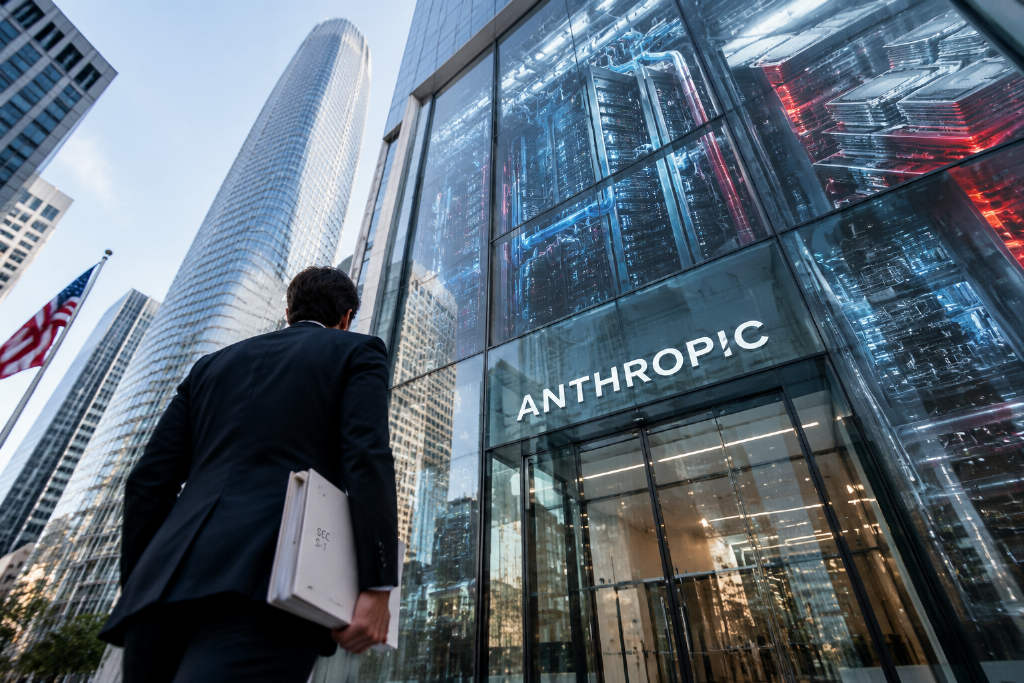
Anthropic’s draft IPO filing, reviewed by Reuters, shows the Claude developer generated about $4.6 billion in revenue in 2025, up roughly 12 times from 2024. The same filing shows operating losses of more than $8 billion, while compute and infrastructure spending hit $7.33 billion, already above annual revenue.
Anthropic said on June 1 that it had confidentially submitted a draft S-1 registration statement to the U.S. Securities and Exchange Commission. What is confirmed at this stage is that the company has started the listing process, along with the historical financial and risk data described by the media. A potential valuation above $2 trillion, the final size of the offering, and the exact listing schedule could still change.
Key figures in the draft filing
According to Reuters, Anthropic’s total operating expenses in 2025 were about $12.65 billion. Of that, compute and infrastructure spending accounted for about $7.33 billion, up roughly threefold year over year and representing more than half of total operating expenses.
The company posted an operating loss of more than $8 billion in 2025. GAAP net loss came close to $42 billion, including roughly $34 billion in accounting charges tied to increases in the fair value of liabilities such as convertible financing. As of the end of 2025, Anthropic held about $20.28 billion in cash, cash equivalents and short-term investments.
The filing also disclosed about $518 billion in cloud, compute and infrastructure payment obligations over the coming years. That figure is not a single year of capital spending. It reflects contractual commitments spread over multiple years.
On customer concentration, two customers contributed close to one-quarter of Anthropic’s 2025 revenue. The company also warned that some large customers were not bound by long-term contracts.
Anthropic said in February this year that its annualized revenue run rate had reached $14 billion, while Claude Code passed a $2.5 billion annualized revenue run rate. Reuters added that Anthropic’s potential IPO valuation could exceed $2 trillion. The listing could also slip until after the U.S. midterm elections in November, with timing still dependent on SEC review and market conditions.
Anthropic also recently signed a seven-year cloud computing capacity agreement with Akamai worth about $11.6 billion.
MSX: a public-market test of the frontier AI model business
MSX said the most important takeaway from the filing is not just the scale of Anthropic’s losses. It is the operating formula it reveals for frontier AI companies: secure large compute contracts first, use that capacity to train stronger models, attract enterprise customers and developers with better model performance, then try to use revenue growth to cover rising inference, training and research costs.
In MSX’s view, Anthropic has already shown that the first half of that formula can produce very fast revenue growth. What it has not shown yet is that revenue can rise faster than compute and operating costs.
Commercial traction is real
MSX said Anthropic’s business expansion has been rapid. Revenue increased about 12 times in a year, suggesting Claude is no longer just a research product. The company has built actual revenue streams across enterprise APIs, Claude Code, Claude for Work and cloud-platform distribution.
Anthropic also said the number of customers spending more than $100,000 annually increased sevenfold in a year. More than 500 customers now spend above $1 million on an annualized basis, and eight of the top 10 Fortune 500 companies use Claude.
MSX said Claude Code in particular is shifting Anthropic away from the profile of a general chatbot company and toward that of an enterprise software and developer-tools provider. Code generation, software testing and agent development are all use cases with high frequency and stronger enterprise willingness to pay, and they are better suited to recurring revenue tied to token consumption.
The cost problem is just as visible
The financial data also exposes the core tension in the business. Anthropic recorded about $4.6 billion in revenue in 2025, but compute and infrastructure spending alone reached $7.33 billion. Before counting research and development, sales, administration and other expenses, spending on compute was already equal to about 1.6 times annual revenue.
MSX said that points to a business still buying growth with large amounts of capital. Revenue growth can improve that relationship, but only if the unit cost of model calls keeps falling, customer usage continues to rise, and price competition does not erase the margin benefit that lower inference costs might bring.
Anthropic also faces a separate issue: as AI models become more capable, a single task may run longer, call more tools and consume more tokens.
Traditional software can often serve more users with relatively stable server costs. Agent products may do the opposite, generating higher inference costs as usage becomes deeper. If enterprise pricing does not rise faster than per-unit compute consumption, revenue expansion does not automatically improve gross margin.
What the $518 billion obligation means
MSX said the $518 billion in compute and infrastructure obligations magnifies that risk. The number should not be read as a one-year outlay. It refers to multi-year contractual obligations, with some payments dependent on data centers being completed on schedule, computing capacity being delivered, and services meeting agreed standards.
Even spread across years, it still represents an extremely large fixed-commitment structure. The logic behind it is straightforward: Anthropic expects AI demand to keep growing quickly, so it is locking in chips, power and data center resources in advance.
If future Claude usage meets expectations, those contracts could secure enough capacity. If competition intensifies, prices fall, or customer demand comes in below expectations, the compute reserved ahead of time could turn into a heavy burden.
Implications for related U.S. stocks
MSX said an Anthropic listing would also affect a wider group of companies. Amazon and Alphabet are both Anthropic investors and major cloud suppliers. Nvidia provides GPUs and related networking equipment. Akamai, data-center operators, power suppliers and server manufacturers could benefit from infrastructure expansion if related orders continue.
If the market accepts a valuation above $2 trillion, that would imply investors are willing to pay a premium of hundreds of times current revenue for future AI platform status and sustained high growth. That could lift valuations for OpenAI and other AI companies, and could also reshape pricing across cloud computing, chips and data-center names.
If investors focus instead on operating losses, customer concentration and long-term compute obligations, Anthropic could become a starting point for a broader reassessment of returns on AI capital spending.
MSX’s view
MSX said Anthropic has already shown that enterprises are willing to pay for Claude, and that a frontier AI company can build multi-billion-dollar revenue in a short period. The next task is to prove to public-market investors that this growth can eventually break its dependence on repeated large financing rounds and become self-sustaining.
If that happens, Anthropic could become the first truly large pure-play AI company in public markets. If it does not, the filing could still mark a point at which investors reassess the broader generative AI investment cycle.
About MSX
MSX described itself as a platform focused on access to global financial markets. It said it has built a digital financial service system covering U.S. stock spot trading, perpetual contracts, crypto-to-crypto trading, Pre-IPO offerings and research services. The platform said it currently offers spot and derivatives trading for nearly 400 tokenized stocks and Pre-IPO assets.
The original article also carried a risk notice saying macroeconomic conditions and U.S. equity markets can be highly volatile, and that the content was for academic and research observation by MSX Research only and did not constitute investment advice.