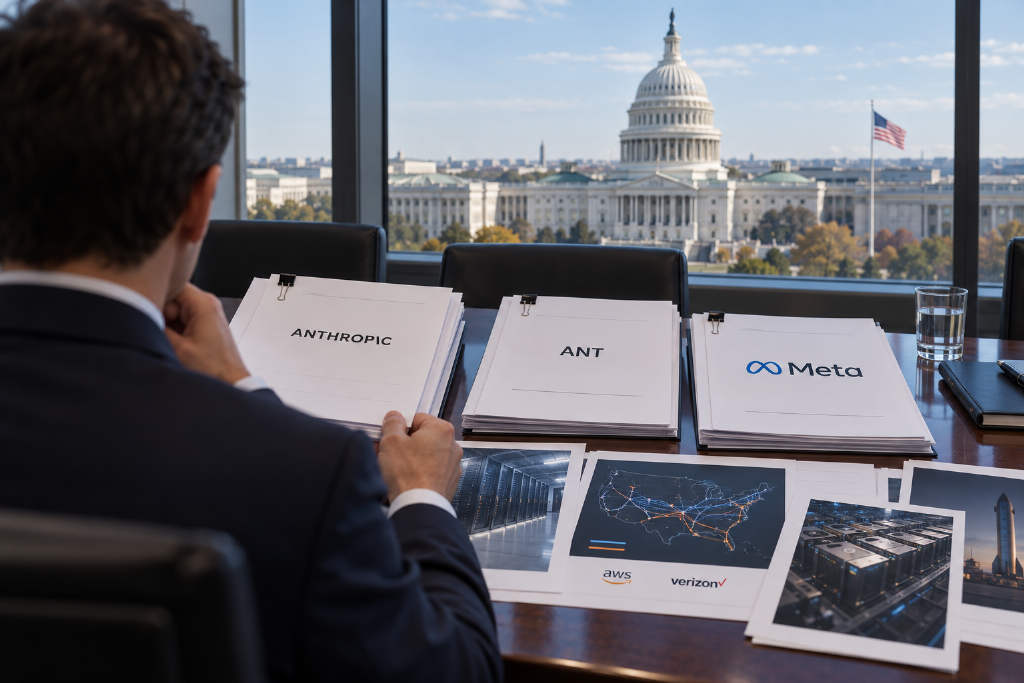
WuBlockchain’s WhiteLine Daily said a new wave of AI infrastructure expansion is drawing funding through IPO plans, equity issuance, network contracts and equipment lease financing, with Anthropic, Meta, AWS, Verizon and SpaceX all moving on separate transactions.
Anthropic files IPO registration with the SEC
Anthropic said it has submitted IPO registration documents to the U.S. Securities and Exchange Commission and plans to list on Nasdaq under the ticker ANT. The number of shares to be offered and the price range have not been determined.
The filing showed first-half 2026 revenue of $16.29 billion, up from $1.16 billion in the same period last year. Operating loss narrowed from about $2.14 billion to $693 million.
Net loss for the same period was about $80.7 billion, including roughly $72.4 billion tied to non-cash fair value changes in financing instruments such as convertible notes.
According to a Reuters review cited by WhiteLine Daily, the company has more than $600 billion in compute-related spending commitments with partners over the next decade. Some of those contracts cannot be canceled, or require payment even if the related resources are not used. Anthropic’s revenue mainly comes from enterprise customers paying based on model usage, as well as subscription services.
WhiteLine Daily said growth in enterprise spending is improving Anthropic’s operating performance, but usage-based revenue will need to keep covering the company’s long-term compute commitments.
Meta launches about $35 billion stock offering and outlines another $60 billion plan
Meta said it has launched a public stock offering worth about $35 billion, including about $22.5 billion of Class A common stock and $12.5 billion of mandatory convertible preferred stock.
The company also plans to introduce an at-the-market share sale program worth about $60 billion after its non-voting Class C shares begin trading. That would bring the potential fundraising total to about $95 billion. WhiteLine Daily noted that no related agreements have yet been signed for the $60 billion plan, and the timing, size and terms remain undecided.
Meta expects 2026 capital expenditures of $135 billion to $145 billion and said it will support AI infrastructure expansion through operating cash flow, debt, strategic partnerships and equity financing.
Reuters reported that Nvidia, AMD and Broadcom have expressed interest in subscribing for up to a combined $5 billion of Class A common stock, though those indications do not amount to binding commitments.
WhiteLine Daily said the stock sale adds funding for Meta’s AI buildout, while the effect on per-share returns for existing shareholders will depend on whether profit from the new investment can offset the impact of a larger share base.
AWS and Verizon sign AI infrastructure deal worth more than $2 billion
U.S. telecom operator Verizon said it has signed an AI infrastructure agreement worth more than $2 billion with Amazon Web Services, the cloud computing arm of Amazon. Under the deal, Verizon will provide high-capacity fiber connectivity for AWS data centers to support computing demand from agents and generative AI.
Verizon CEO Dan Schulman said the company’s AI Connect business has signed contracts totaling about $4 billion, covering fiber connectivity and edge computing. Revenue tied to those contracts is expected to begin showing up in 2027. He also said Verizon is in talks with other large cloud providers, newer cloud service providers and enterprise customers.
Management said the contracts will make use of existing fiber and real estate assets, with relatively limited incremental capital spending, and that the spending is matched to already secured contracts. Verizon’s 2026 capital expenditure budget remains unchanged.
WhiteLine Daily said Verizon can use its existing fiber footprint and network sites to take on AI-related orders, with less dependence on new capital spending and better utilization of existing assets.
SpaceX secures about $40 billion in GPU lease financing commitments
According to an announcement from alternative asset manager Apollo and SEC filings, Elon Musk’s SpaceX has signed binding commitments for a GPU and related equipment lease financing arrangement with Apollo-managed entities. Total principal payments over the lease term are expected to reach about $40 billion.
The lessor will buy GPU clusters and related equipment and then lease them to SpaceX to support ground-based compute capacity for Grok and cloud services. The equipment package includes Nvidia Vera Rubin chips.
Deliveries are expected to be made in batches. Each batch will carry a lease term of about five years to five years and three months. Rent will be prepaid quarterly and will include installment repayment of equipment financing costs, charges calculated at a fixed annual interest rate and other related costs.
The transaction is still subject to closing conditions and is expected to be completed by the end of 2026. Equipment deliveries and the related leases are expected to begin in the first half of 2027.
WhiteLine Daily said the arrangement locks in financing for next-generation GPU deployment, while the ongoing lease payments after the equipment is put into use will need support from revenue generated by Grok and cloud services.
Main takeaway from WhiteLine Daily
WhiteLine Daily said large-scale AI construction is still attracting outside capital, with financing now spanning equity issuance and equipment leasing, while procurement is also spreading into supporting areas such as network connectivity.
The report added that financing commitments and long-term contracts can be secured in advance, but how much revenue new compute capacity will generate, and how much profit existing networks can contribute, will only become clear after the equipment and services are in use.
It also said model revenue mainly changes with usage, while long-term cloud service contracts and equipment leases carry continuing payment obligations. For that reason, the stability of revenue growth and the financing structure both matter when judging how much expansion a company can absorb. Beyond comparing the size of financings and contracts, the report said investors still need to examine whether long-term spending can match revenue, how much capital new business requires and how much cash the expansion ultimately leaves behind.