
Anthropic has filed an IPO registration statement with the U.S. Securities and Exchange Commission and plans to list on Nasdaq under the ticker ANT. With the filing now public, investors have a clearer look at the financial profile behind Claude and the trade-offs between rapid growth, heavy infrastructure spending, and accounting losses.
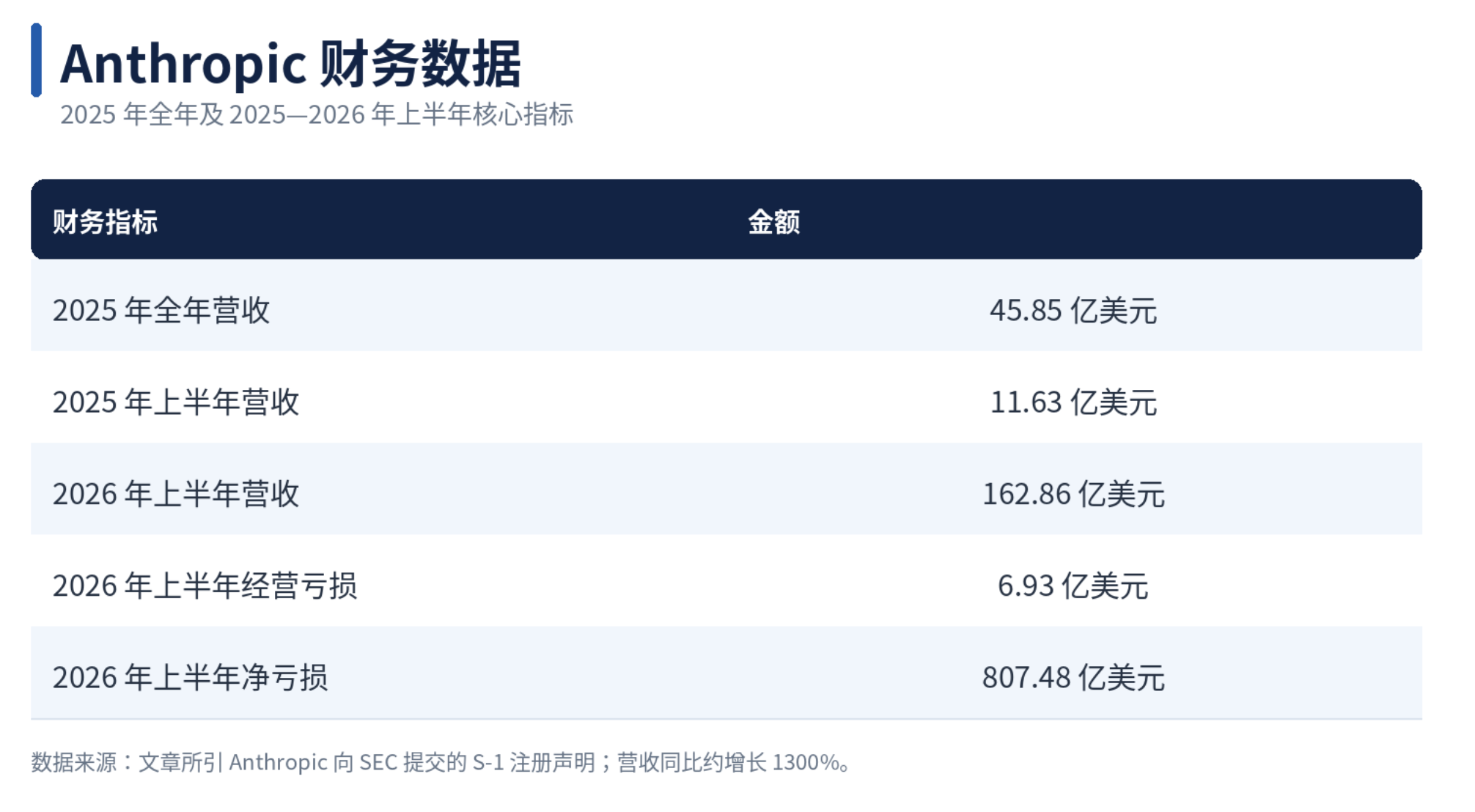
The headline figures are stark. In the first half of 2026, Anthropic reported revenue of $16.286 billion, about 14 times the level from a year earlier. Over the same period, net loss reached $80.748 billion. Market discussion had previously floated a possible valuation of roughly $1.5 trillion to $2 trillion, though the final IPO price and valuation have not been set.
That combination of fast revenue growth, very large reported losses, and rising compute spending sits at the center of the investment case. For investors looking at AI and U.S. IPO opportunities, the key questions are not simply whether AI demand is growing, but why Anthropic could command a premium valuation, whether the $80.7 billion loss points to operating stress, and which listed companies may be exposed if the offering moves ahead.
Why enterprise customers are paying for Claude
The value of an AI company is not determined only by benchmark performance. It also depends on whether its models become part of real business workflows and whether customers keep paying over time.
Anthropic’s core product, Claude, is no longer framed only as a chatbot. As AI coding, knowledge processing, and enterprise workflow tools expand, the model is being used in software development and day-to-day operations. Products such as Claude Code push the model from answering prompts toward handling more complex tasks.
That matters commercially because companies are not buying a one-off technical demo. They are paying for repeatable work capacity. If AI can shorten development cycles, process large volumes of documents, or reduce repetitive work, businesses have a reason to place that spending into longer-term budgets.
Anthropic’s revenue model reflects that. According to public filings, the company mainly charges based on model usage while also offering subscriptions. In the first half of 2026, usage-based revenue was about $13.1 billion, or roughly 80% of total revenue, while subscription revenue was about $3.2 billion.
That means growth depends not only on adding new customers, but also on how often existing customers call the model, how complex those tasks are, and how much they are willing to spend.
Customer figures point in the same direction. As of Sept. 30, 2026, Anthropic had more than 11,900 customers that generated at least $100,000 in revenue over the prior 12 months. More than 1,900 of them contributed at least $1 million.
Still, willingness to pay is not the same as a durable moat. OpenAI, Google, and other model providers are competing for the same enterprise accounts, and customer decisions can shift with model performance, pricing, data security, and product experience.
Whether Anthropic’s growth case holds up will depend on its ability to keep expanding enterprise use while preserving customer stickiness and pricing power.
Revenue growth has been unusually fast
Anthropic’s first-half 2026 revenue rose about 1,300% year over year, reaching roughly 14 times the level from the same period in 2025. The company’s revenue for the first six months of 2026 also exceeded its full-year 2025 revenue by more than three times.
That is more than a low-base effect. It also points to rapidly expanding demand for enterprise AI.
Even so, the quality of that growth still needs to be judged through the business mix. A usage-based model can scale as customer calls increase, but demand can also be affected by budget changes, pricing, and business cycles. For enterprise buyers, spending is more likely to continue only if the value created by the model exceeds the cost of using it.
Another figure in the filing drew attention. Anthropic posted about $974 million in operating profit in the second quarter of 2026, but because the first quarter still carried an operating loss, the company’s operating loss for the first half remained about $693 million.
That suggests operating performance improved at the quarterly level. It does not show that Anthropic has reached a stable profit phase. Future revenue growth and the company’s ability to control costs as it scales will still determine whether that improvement lasts.
For investors, revenue growth helps explain why the market may assign a high expectation. It does not, by itself, prove that any valuation is justified. The more important issue is whether growth can continue and whether revenue can turn into profit and cash flow.
The $80.748 billion net loss needs to be read carefully
This may be the easiest part of the filing to misread. The $80.748 billion net loss looks far larger than first-half revenue, but the S-1 says about $72.388 billion of that amount came from fair-value changes tied to financial instruments, including convertible notes, derivative liabilities, and simple agreements for future equity.
In practical terms, the book value of some financing instruments changes as the company’s valuation and contract terms change. Under accounting rules, those changes can run through current-period earnings without meaning the company paid out the same amount of cash during that period.
So the $80.7 billion net loss should not be read as Anthropic having burned $80.7 billion in cash in six months.
Operating loss and cash flow give a different view of the business. In the first half of 2026, Anthropic’s operating loss was about $693 million, down sharply from about $2.135 billion in the same period a year earlier. Analysis of its public financial data also indicated that operating cash flow was positive in the same period.
That points to two things at once: a large accounting item inside net loss, and a narrower loss in the core business. It does not mean financial risk has disappeared. Operating loss is not the same as cash flow, and positive cash flow in one period does not mean the company will avoid future financing needs or capital spending.
Investors need to separate three measures:
- Net loss, which reflects total profit and loss under accounting rules and can be affected by valuation changes in financial instruments.
- Operating profit or loss, which more directly shows the relationship between core revenue and operating expenses.
- Operating cash flow, which shows whether the business is generating or consuming cash, but still needs to be assessed alongside capital expenditures and long-term payment obligations.
The real question is whether Anthropic can keep improving operating profit and cash flow, not whether one loss figure looks smaller in isolation.
Compute costs remain central to the margin story
AI companies differ from traditional software businesses in one important way: serving models requires ongoing compute consumption.
Anthropic spent about $8.945 billion on compute and infrastructure in the first half of 2026, equal to roughly 55% of revenue. That shows how central compute remains to profitability even when revenue is rising quickly.
As customers use models more often, revenue can grow. But training, inference, and more complex task execution also require more computing resources. For Anthropic, the issue is not only how much revenue expands, but how much additional cost is needed for each incremental unit of revenue.
If model efficiency improves, the compute needed per task falls, and customers are willing to pay for higher-value services, margins could improve. If service prices fall faster than costs decline, revenue may keep growing without producing the same pace of profit growth.
Long-term compute contracts are another factor. Media reports previously said Anthropic’s commitments for cloud services, compute, and infrastructure over coming years could reach into the hundreds of billions of dollars. Some reporting cited an estimate of at least $518 billion, though the scope of those long-term contracts, minimum payment obligations, and optional purchase arrangements may differ, and the figures should not be treated as cash already paid.
Locking in compute early can help support model development and future customer demand. But if actual demand falls short of expectations, or if newer models reduce the need for some resources, those contracts could limit financial flexibility.
Anthropic also said in public filings that spending on newly added compute capacity may show up before the revenue supported by that capacity is fully realized. If demand exceeds the capacity already locked in, the company may also need to buy short-term compute at a higher unit cost.
That is why investors will need to track more than top-line growth. The ratio of compute expense to revenue, changes in operating margin, and whether long-term contracts are absorbed by real demand will all matter.
What a trillion-dollar valuation would imply
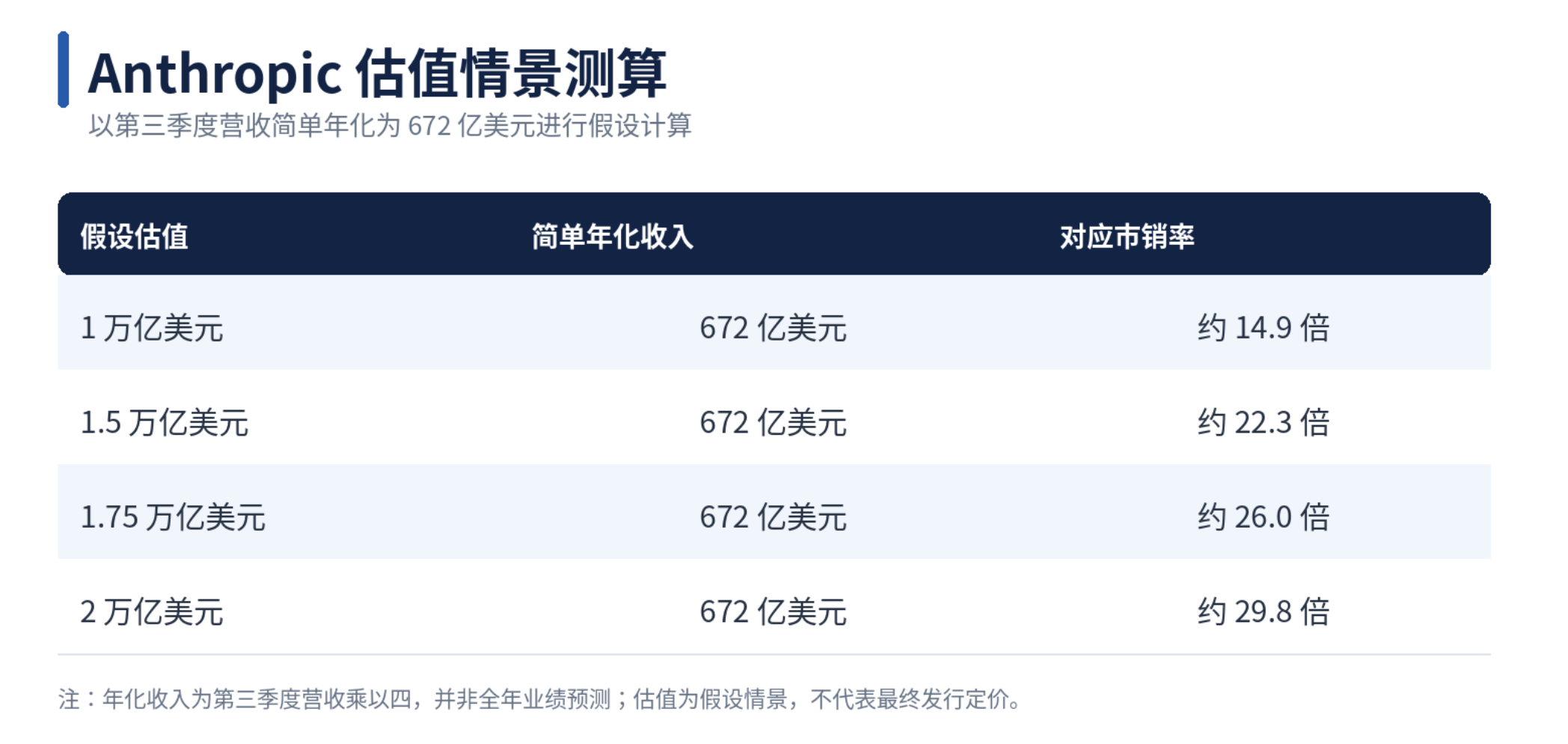
Market discussion previously placed Anthropic’s potential valuation at roughly $1.5 trillion to $2 trillion, but that does not mean the IPO will be priced there.
To frame what that range could imply, the original report referenced a simple scenario analysis. Media reports previously said Anthropic generated about $16.8 billion in third-quarter revenue, up from $11.6 billion in the second quarter, for roughly 45% sequential growth. That figure came from media coverage of information shared at an investor meeting and should not be mixed directly with the first-half financials disclosed in the S-1.
If third-quarter revenue were simply multiplied by four, annualized revenue would come to about $67.2 billion. Comparing that figure with different valuation assumptions gives a sense of the growth expectations embedded in market pricing.
The point of that exercise is not to declare Anthropic cheap or expensive. It is to show that if the final valuation lands in that range, investors would be paying not only for current revenue, but also for expectations around multi-year growth, market share, and future profitability.
High-growth companies often trade at richer valuations than mature businesses. But the higher the valuation, the higher the bar for execution. If growth slows, cost declines disappoint, or competition pushes down model pricing, the market may reassess the company’s value.
There is also a practical issue for retail investors: a high company valuation does not mean the stock will necessarily rise after the IPO. Performance will also depend on the offering price, the supply of tradable shares, market sentiment, lock-up terms, and post-listing financial results.
Until the final offer price, deal size, and trading arrangements are disclosed, any valuation figure remains a scenario for analysis rather than a basis for buying.
Which listed companies may be worth watching
Anthropic’s IPO could become an important pricing event for the AI sector, but it does not automatically mean every AI-linked stock benefits. Revenue sources, business ties, and risk exposure differ from company to company.
Amazon (AMZN) and Alphabet (GOOGL) stand out because they have multiple links to Anthropic through cloud services, investment, and commercial distribution. Cloud platforms can capture business from model training, inference, and enterprise customer service, while equity stakes may also be affected by changes in Anthropic’s valuation.
Those ties are not one-way positives. Large cloud platforms provide compute to Anthropic while also building their own AI models and products. They can be suppliers and investors, but also competitors. Whether Anthropic’s growth turns into actual profit for those companies will depend on contract terms, resource costs, and revenue recognition.
NVIDIA (NVDA) and other AI chip and networking infrastructure suppliers are more directly tied to industry-wide compute demand. Expanding training and inference demand could support accelerated computing, storage, and high-speed interconnect demand, but actual results will still depend on customer capital spending, supply-chain competition, in-house chip development, and product cycles.
AI cloud providers and data-center-related companies may also benefit from sector expansion, but heavy capital spending does not automatically produce high returns. The market still has to judge whether new compute capacity will be fully used, whether contract pricing covers costs, and how long infrastructure investments take to pay back.
That makes a company-by-company approach more useful than broad AI labeling. Investors need to ask what business link each company has to Anthropic, how large that revenue exposure is within the broader business, and whether new spending adds profit or simply raises capital pressure.
BiyaPay was mentioned, but formal trading details are still pending
The original report said investors following AI and U.S. IPO opportunities may also track related stock information in advance. It added that the BiyaPay app already supports searching for Anthropic’s stock code, ANT, so users can look up and follow the name once formal trading opens.
The same report also drew a distinction between company fundamentals and trading access. Researching growth, valuation, and risk comes first. Trading services, currency exchange, and cross-border payments are separate issues tied to how investors manage funds across markets.
According to the original article, BiyaPay positions itself as a global one-stop multi-asset allocation platform covering U.S. stocks, Hong Kong stocks, digital assets, commodity futures, and foreign exchange, while also offering fiat exchange, cross-border remittance, related wealth services, and a virtual Visa card.
The article further said that for users focused on U.S. and Hong Kong equities, BiyaPay provides digital-asset exchange and related trading services for those markets, real stock trading, dividend rights, and zero commission, with multiple services gathered on one platform to reduce switching costs.
At the same time, the report said any Anthropic-related stock trading service should be judged by formal announcements and actual trading pages. Before service availability, instrument type, and trading rules are confirmed, it should not be described as already tradable, and non-listed equity, IPO subscriptions, and post-listing common stock trading should not be treated as the same thing.
The IPO is also a test of AI business efficiency
Anthropic’s IPO process gives the market a deeper look at how a frontier AI company is turning model capability into revenue.
Fast revenue growth shows enterprise AI demand is expanding. Narrower operating losses suggest some improvement in the core business. But the large accounting loss, rising compute costs, and long-term infrastructure commitments also show that revenue growth is not the same as durable profitability.
The next phase will be shaped by the final offering structure, valuation, operating margins, cash flow, and the return on compute spending.
For investors, the most important issue is not a single revenue figure or the phrase trillion-dollar valuation by itself. It is whether Anthropic can keep converting model capability into customer payments, and then convert that revenue into sustainable operating returns.
Competition in AI is moving beyond model performance and into commercial efficiency. Anthropic’s listing process is not only a financing event. It is also becoming a public-market test of the AI business model.




