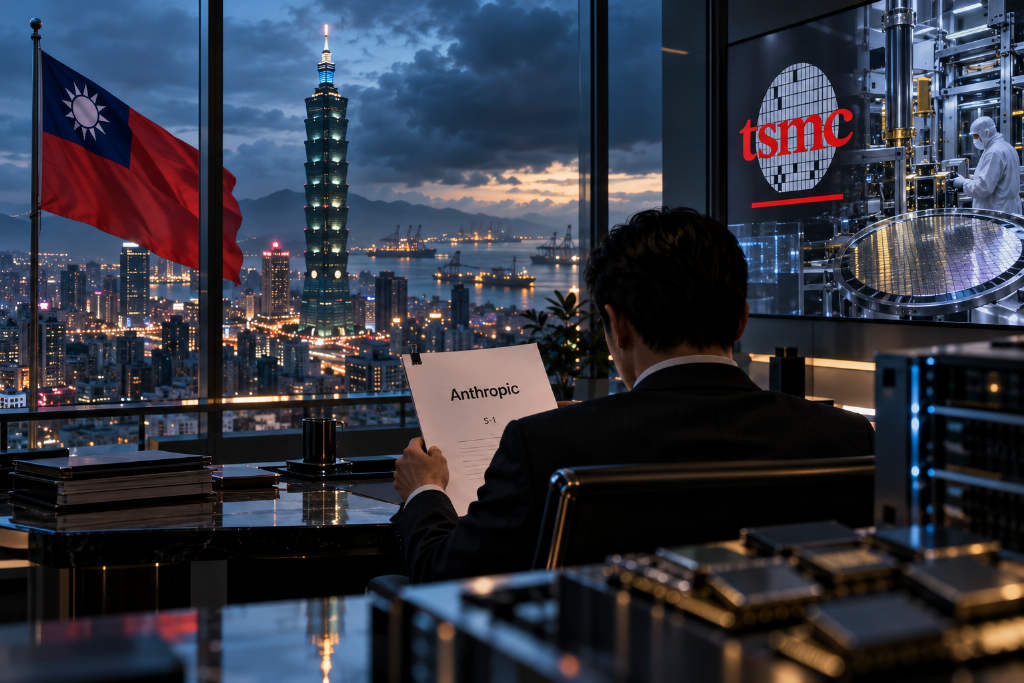
Anthropic said in its S-1 filing with the U.S. Securities and Exchange Commission on Oct. 26 that global advanced chip production is concentrated in Taiwan and largely depends on Taiwan Semiconductor Manufacturing Co. The company warned that a military conflict, blockade, or natural disaster affecting Taiwan could severely disrupt advanced chip supply worldwide, and that the impact could last for years.
Filing lists geopolitical and infrastructure risks tied to Taiwan
In the prospectus, Anthropic listed several risk factors tied to Taiwan, including geopolitical tensions between Taiwan and China, earthquakes and typhoons, disruptions to infrastructure such as the power grid and water supply, and changes in trade rules and restrictions.
The company wrote: "Any military conflict, tariffs and trade restrictions, economic coercion, blockade, or natural disaster affecting Taiwan could severely disrupt the global supply of advanced chips. Because building and qualifying alternative fabs takes time, the effects could last for years."
The filing also said: "Any situation that restricts or delays the supply of advanced chips from Taiwan or TSMC would adversely affect our business, financial condition, and results of operations."
Anthropic says it has at times been unable to secure enough chips
Anthropic said that while advanced chip capacity is being expanded in the United States and other regions outside Taiwan, those efforts are still in the early stages and may not provide enough output in the foreseeable future to materially reduce concentration risk.
The company also said TSMC has previously been unable to fully meet demand for advanced chips, which at times left Anthropic unable to obtain enough chips on time.
Bloomberg says TSMC expansion outside Taiwan is still limited
Bloomberg reported that TSMC has committed $265 billion to build advanced semiconductor facilities in Arizona and is considering a new production base in Texas, but that most of its operations and supply chain remain in Taiwan.
Bloomberg also said advanced chips designed by Nvidia and Advanced Micro Devices are manufactured by TSMC, and that AI chips designed in-house by Amazon and Google also rely on TSMC production. The report added that Nvidia has previously expressed concern about the situation in Taiwan, while Marvell Technology and Broadcom have also disclosed risks tied to their reliance on TSMC.
Bloomberg Economics estimated in 2024 that a war involving Taiwan could cause as much as $10 trillion in global economic losses.
HBM supply named as another bottleneck
Anthropic also said in the filing that high-bandwidth memory, or HBM, and other high-performance memory used in AI accelerators are mainly produced by SK Hynix, Samsung Electronics, and Micron Technology.
Those companies are expanding capacity, Anthropic said, but there is no guarantee supply growth will be enough to meet demand. The filing added that shortages could become more severe if large customers or competitors lock in substantial capacity in advance.