

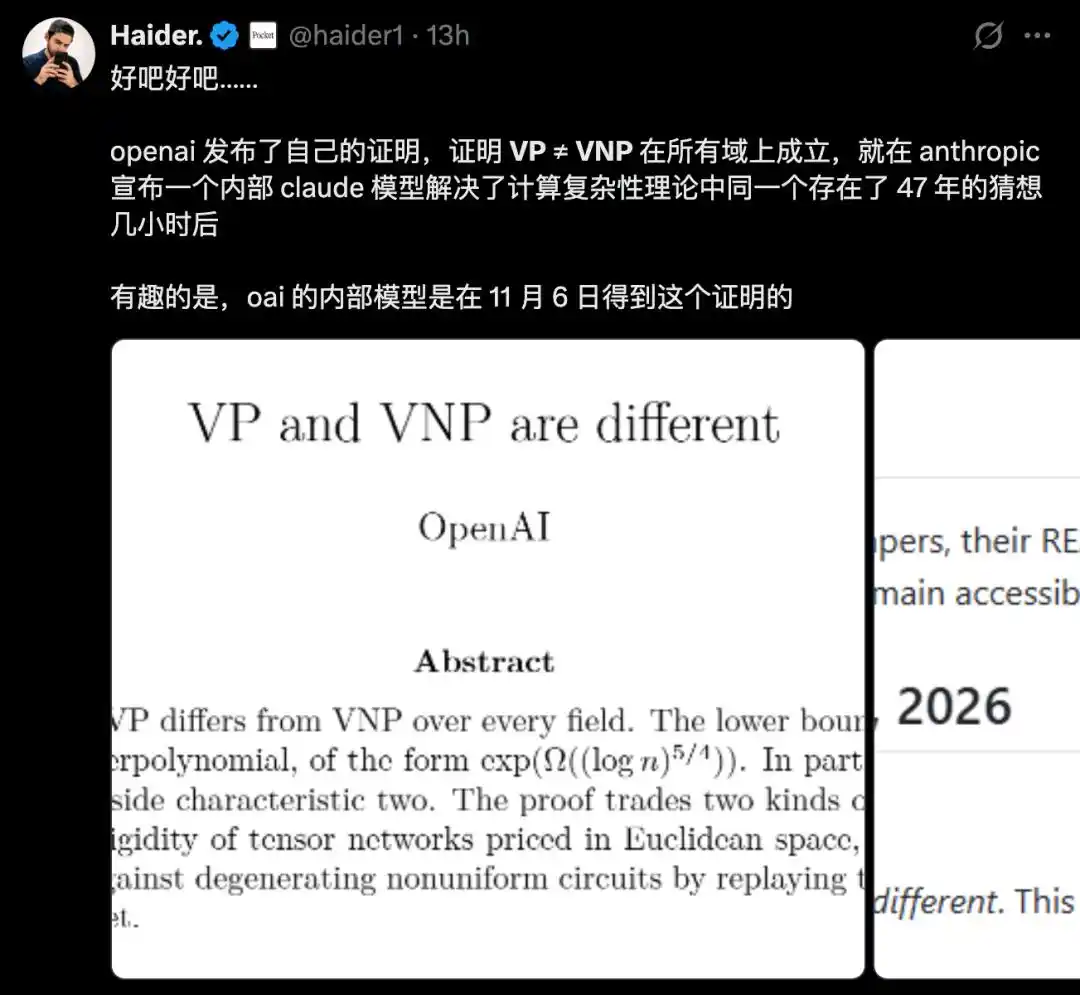
Anthropic and OpenAI published separate papers on Nov. 24 claiming to prove VP ≠ VNP, a separation in algebraic complexity often called the algebraic version of P versus NP. Their repository updates landed 3 hours and 47 minutes apart. Anthropic’s paper credits “CLAUDE · ANTHROPIC” and comes with about 73,000 lines of Lean code. OpenAI’s paper names the company but not its model, which it calls an unnamed internal model; its repository contains 440,000 lines of Lean.
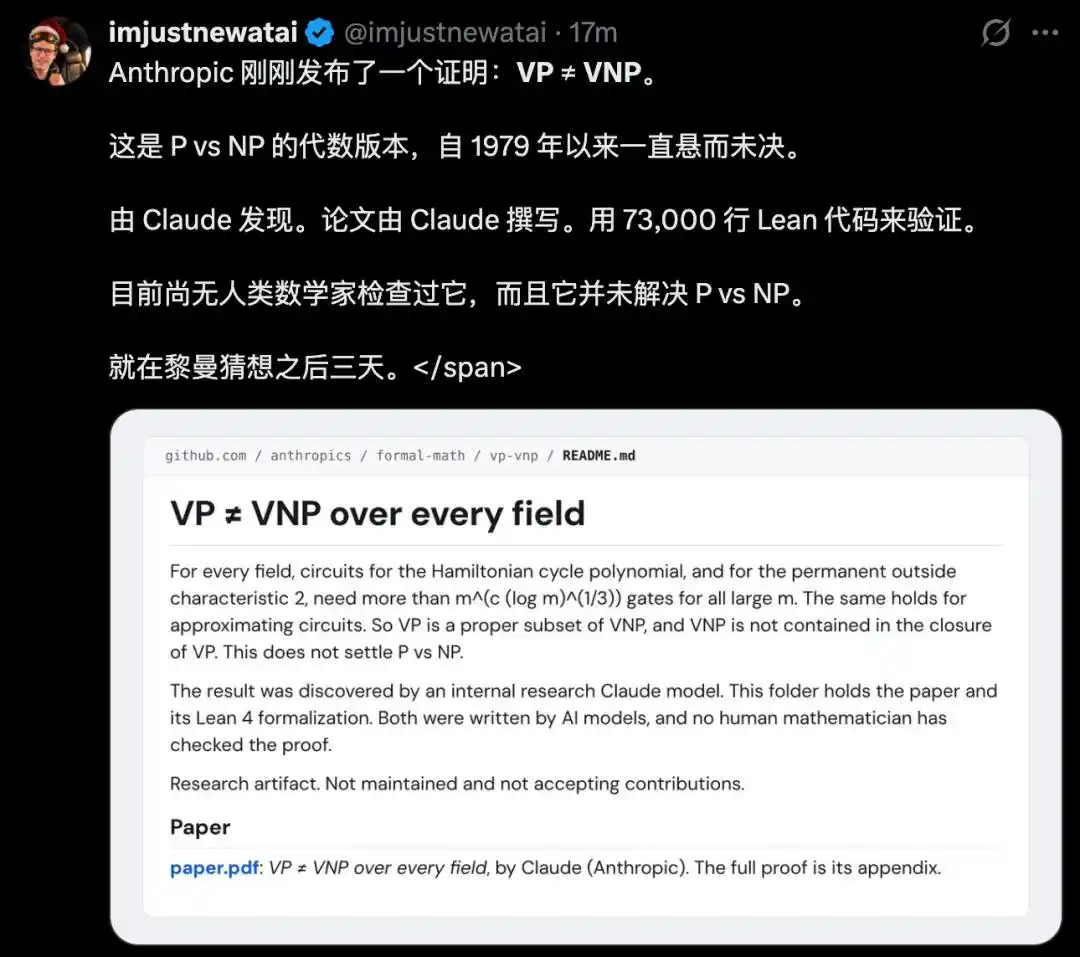
The claims do not resolve whether P equals NP. The work addresses algebraic complexity, and the papers have not been peer-reviewed. Human mathematicians also have yet to check whether the formal statements in Lean match the theorems claimed in the papers.
From P versus NP to VP versus VNP
The intellectual history reaches back to 1956, when Kurt Gödel wrote to the ailing John von Neumann. Gödel asked whether, if a machine could find a proof of length n in n steps or n² steps, mathematicians’ work on yes-or-no questions could be handed over to machines.

Stephen Cook’s 1971 paper, “The Complexity of Theorem-Proving Procedures,” helped establish P versus NP as a central question in computational complexity: if a proposed answer is easy to check, is it also easy to find? Proofs are a familiar example of answers that can be checked.
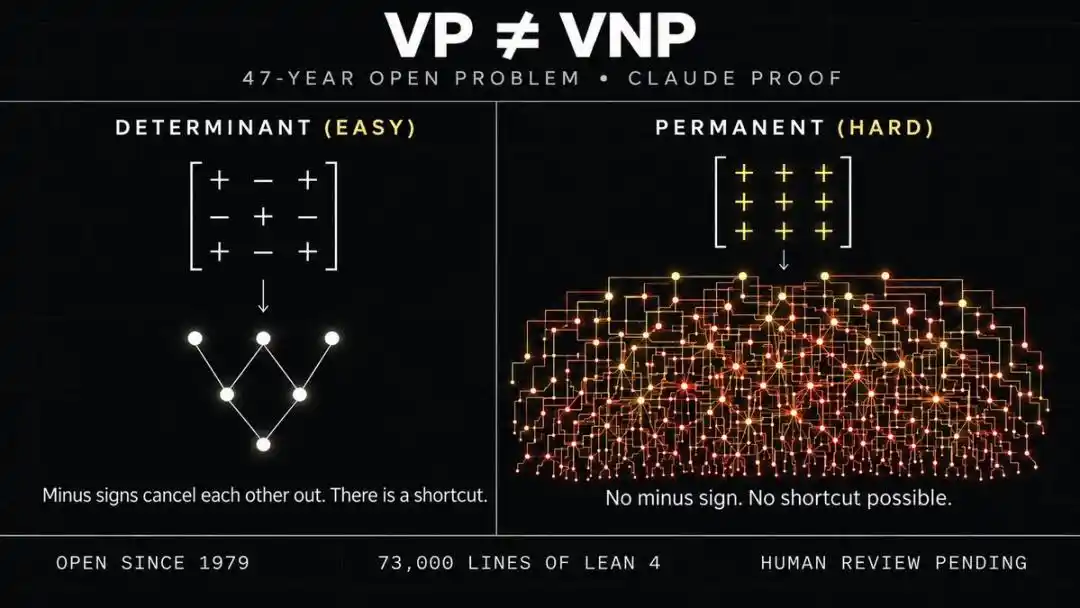
In 1979, Leslie Valiant introduced VP and VNP in algebraic complexity. The problem is not one of the seven Millennium Prize Problems and carries no prize, but the article describes it as a major barrier on the way to P versus NP. The central objects include the determinant and the permanent. Their expressions look similar, with signs distinguishing them.
Over a field of characteristic 2, positive and negative signs are indistinguishable, so the permanent and determinant coincide. In that setting, mathematicians need another polynomial to prove a separation between VP and VNP. The determinant has a fast algorithm. Valiant conjectured that the permanent has no comparable shortcut: circuits built from additions and multiplications would eventually require more than polynomially many steps.
The conjecture proved difficult to advance. For general circuit lower bounds, the article says the strongest results remained at the level established by Volker Strassen in 1973 and Walter Baur and Volker Strassen in 1983. For the permanent, no one had proved a lower bound beyond the m²·log m level in more than four decades.
Anthropic submits a 70-page paper and Lean proof
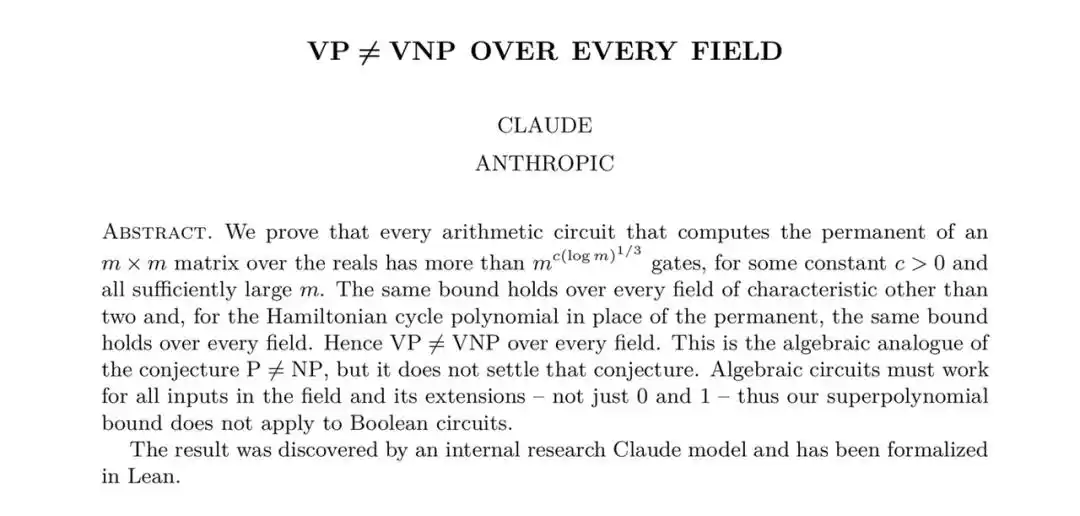
At 05:43 Beijing time on Nov. 24, Anthropic’s GitHub repository merged the paper. It runs 70 pages, lists “CLAUDE · ANTHROPIC” as its author, and contains about 73,000 lines of Lean formalization. The article says the work pushes a lower bound that had remained at the m²·log m level for more than 40 years into the superpolynomial range.
The paper’s abstract limits the result to algebraic complexity; it does not solve P versus NP itself. Lean checked the formal derivations written in the code, but the article says no human mathematician has yet verified whether the formalized theorem precisely matches the paper’s claim, whether any assumptions were omitted, or whether definitions changed. A proof assistant checks the derivation it is given. It cannot, on its own, establish that the formal statement is exactly the theorem described in a paper.
OpenAI presents a different route
At 09:30 Beijing time that morning, OpenAI’s repository merged its paper, 3 hours and 47 minutes after Anthropic’s. The paper is 30 pages long and names OpenAI as its author. It refers to the model behind the work only as “an unnamed internal model” and does not say whether it was GPT. OpenAI’s Lean submission contains 440,000 lines, compared with Anthropic’s roughly 73,000.
The papers use different methods and establish different bounds. OpenAI reports a lower bound of exp(Ω((log n)^{5/4})) and also considers “border circuits,” which can be approximated arbitrarily closely. Its Lean formalization, however, verifies only the exact-circuit result; the border-circuit bound appears in the paper but is not formally checked in Lean. Neither company disclosed how long its work took.
The chronology drew attention as well. In an update log, OpenAI said it had obtained the result on Nov. 6, but supplied no evidence for that date. Its README said the mathematical community should decide who came first.
Formal verification and priority remain open questions
The two papers appeared less than four hours apart and concern a problem described as having been stalled for 47 years. The article argues that AI systems are now taking on the work of finding and writing proofs. For the immediate question of priority, repository merge timestamps are among the first pieces of information available to observers. Human mathematicians still need to check whether the formalized statements correspond to the papers’ claims.
The article also looks back at a separate development involving the Riemann hypothesis, first proposed in 1859. Claude and mathematician Alpöge worked on it from Oct. 6 to Nov. 16, a span of 41 days. On Nov. 21, the Lean and Mathlib communities jointly announced that the result had been verified. The article sets that episode alongside the new VP and VNP claims.
A century of research lies behind the claims
Anthropic’s paper cites more than 100 references. The oldest, from 1918, is by G. H. Hardy and Srinivasa Ramanujan. The bibliography also includes work by Valiant, Strassen, Raz, and Mulmuley. Among the more recent items is a manuscript credited to OpenAI.
One major research program in this history is geometric complexity theory. In 2001, Ketan Mulmuley and Milind Sohoni proposed using representation theory to tackle the problem. After more than two decades of work, the article says researchers found that the tool they had hoped would help could not open the route to a superpolynomial lower bound. Even an unsuccessful path can inform later work by showing which approach need not be tried again.
P versus NP remains unsolved
The claimed result does not prove P ≠ NP in Boolean complexity. The papers say they have crossed an outer barrier in algebraic complexity, but the central P-versus-NP question remains unanswered. Neither Anthropic’s roughly 73,000 lines of Lean nor OpenAI’s 440,000 lines has been peer-reviewed.

The article cites theoretical computer scientist Scott Aaronson, who said in an interview a few days earlier: “If I saw a superpolynomial-time lower bound for the permanent, I’d believe it more — AI solving P versus NP may really be just around the corner.” The article says the kind of result he described arrived that week. It closes by noting that P versus NP remains unresolved.
This report is adapted from an article by the WeChat account Xinzhiyuan, republished by MarsBit. The original byline gives the author’s name as 约翰亚当.



