
Anthropic’s pre-IPO contracts produced a rare cross-platform arbitrage opportunity as exchanges applied different valuation methods and share-conversion rules. The spread narrowed from roughly 30% to about 2% over two weeks, and the traders behind the analysis eventually closed all positions.
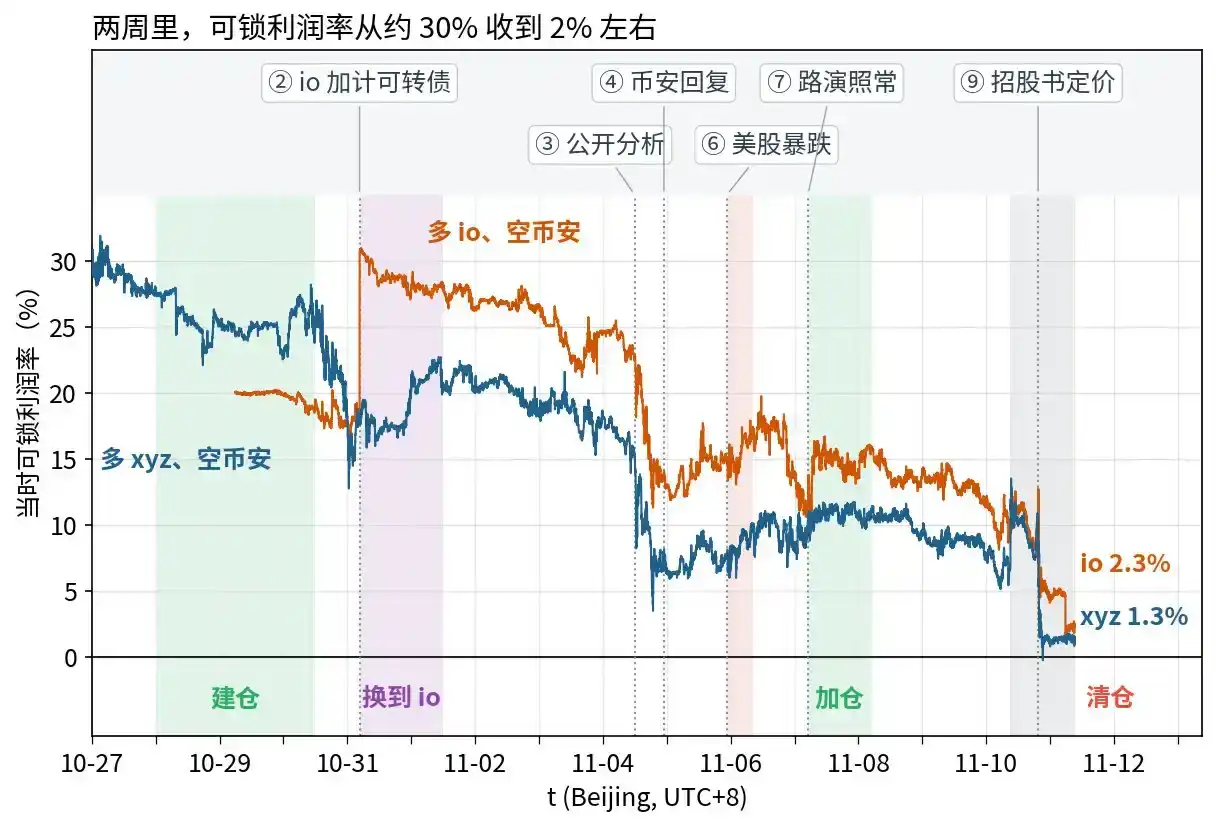
The trade did not depend on predicting whether Anthropic’s shares would rise or fall after listing. It depended on the number of shares each platform would assign to its contract. Before the strategy was made public, the traders saw almost no peers monitoring the opportunity. After publication, two notable entry windows appeared: the first few hours after the posts went live, and the period after Nov. 7, when Anthropic’s roadshow was confirmed to be proceeding as planned.
The share-count mismatch behind the trade
Several exchanges launched pre-IPO contracts before Anthropic was listed. Once the IPO took place, those contracts would continue trading through a conversion into stock exposure. The key variable was how many shares each contract would represent.
- Binance quoted its contract using implied valuation divided by $1 billion. If the market valuation was $1.3 trillion, Binance would quote about $1,300. At conversion, however, it planned to use the post-issuance share count, with one contract representing about 13.1 shares.
- Market valuation estimates generally used a fully diluted share count. That count included the issued shares as well as options, restricted stock units and convertible debt that could later become shares, for a total of roughly 17.5 billion shares. A $1.3 trillion valuation implied about $74 per share. The 13.1 shares represented by a Binance contract would therefore be worth about $970, even though the contract traded at $1,300. The share count was roughly one-quarter lower, making the contract about one-third more expensive on that basis.
- Hyperliquid offered two stock-based contracts. xyz:ANT on trade.xyz quoted the price directly on a per-share basis. io:ANTH on Entropy used the fully diluted share count and was expected to convert into about 17.5 shares per contract. Neither product showed the same mismatch as Binance.
The strategy was to buy the Hyperliquid contract and short Binance, sizing the positions according to the number of shares each contract would represent. Holding the positions through conversion would lock in the share-count difference regardless of whether Anthropic’s stock rose or fell.
The long xyz and short Binance trade was called the “xyz route.” The long io and short Binance trade was the “io route.” The lockable return referred to the gain that could be secured by opening the position and holding it until conversion, measured against the amount used to buy the Hyperliquid contract. At the opening of the trade, the xyz route offered roughly 30%.
Before publication: an early lead from rule research
Entering the trade before it became public required a close reading of the prospectus and the rules of four exchanges, including confirmation that Binance would use the issued-and-outstanding share count. Based on the monitoring at the time, the author and collaborators were almost the only participants visibly working on the trade.
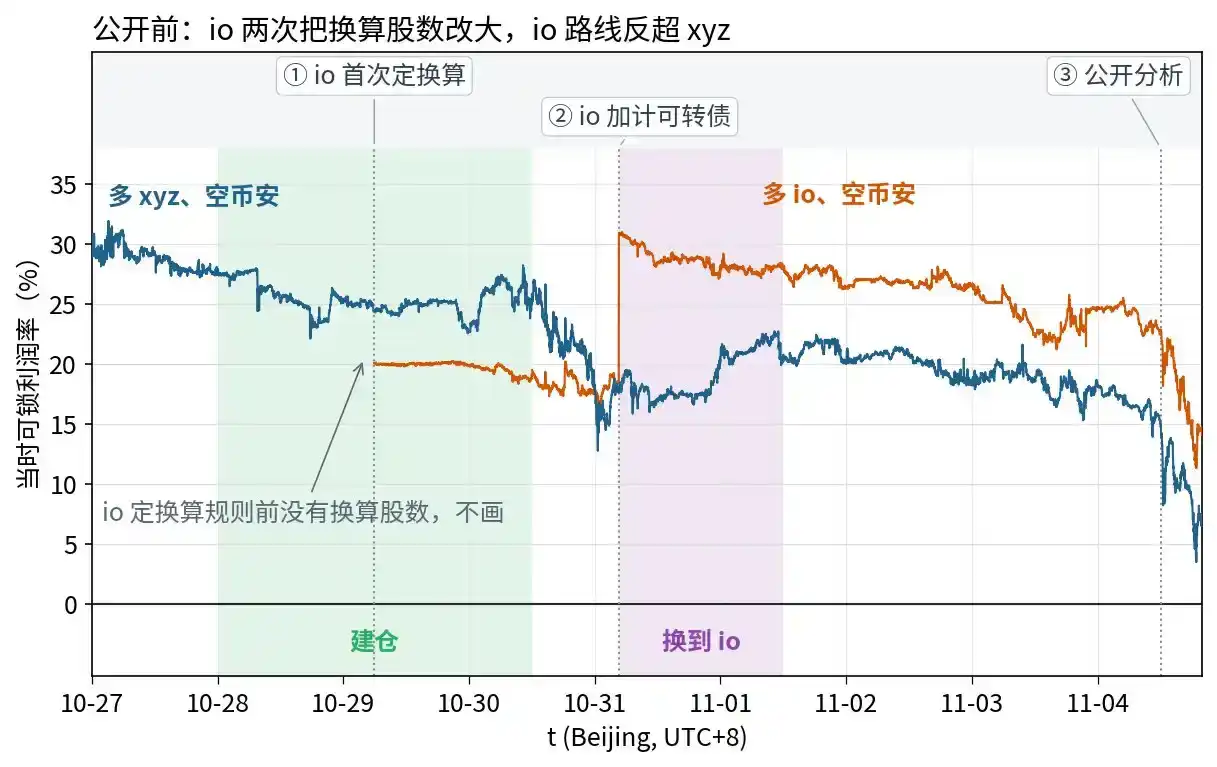
The team initially built the xyz route. Entropy then changed its conversion rules twice.
Oct. 29: Entropy publishes its first conversion method
On Oct. 29, Entropy first wrote that conversion would use the total share count plus options and RSUs. That produced an estimated 15.3 billion shares, leaving the io route with a return of about 20%, below the roughly 24% available through the xyz route. The position therefore remained in xyz.
Oct. 31: Convertible debt is added
On Oct. 31, Entropy added Amazon’s convertible debt in full. The estimated count rose to about 16.9 billion shares, bringing the calculation closer to a complete fully diluted basis. The number of shares represented by each io contract rose from about 15.3 to 16.9, and the io route’s return jumped to roughly 31%, more than 10 percentage points above the xyz route.
The first position adjustment was a switch between routes. The io return depended on both Entropy’s rules and the prices on the two sides, so the higher-return route was preferred. On the day the new rule was published, the team moved the long position from xyz to io. The portion moved to io ultimately earned about 11% more than it would have earned by remaining in xyz.
Publication day: half the spread disappears within hours
At midday on Nov. 4, the author, collaborator Longwang, Ray and others published analyses of the arbitrage from their own perspectives.
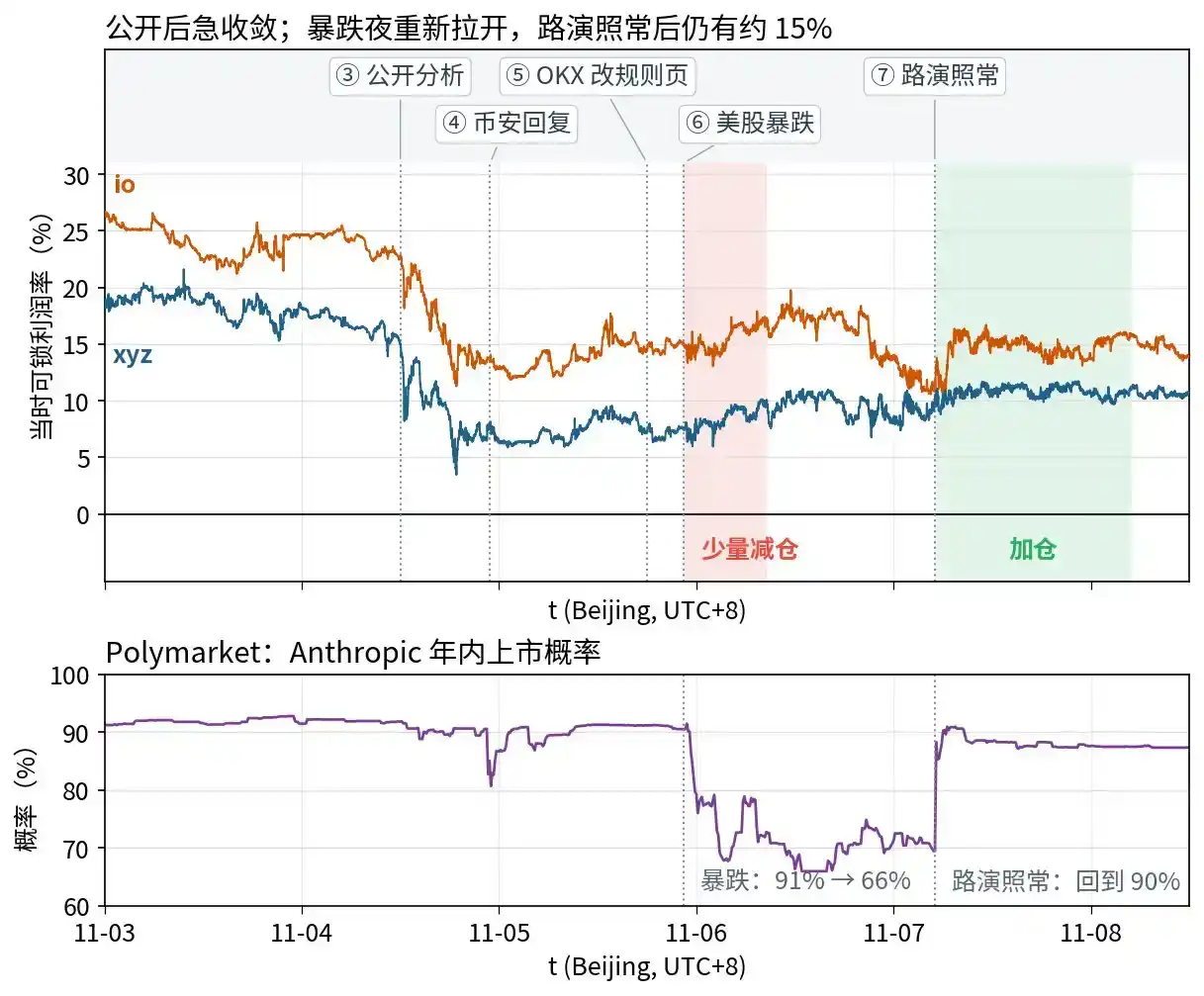
Within 40 minutes, the xyz route fell from a 15.3% return to 10.5%. The io route fell from 22.7% to 19.6%. On an hourly basis, the lows were roughly 6% for xyz and 12% for io.
The speed of the move reflected two flows. New arbitrage traders entered by placing orders on both sides. Traders who had previously taken the opposite position—long Binance and short Hyperliquid—closed their trades. Those who acted as soon as they saw the posts could capture substantial returns. Missing the first move did not eliminate the opportunity: some participants later took profits and allowed the spread to widen again. During the following day, the xyz route still offered 7% to 8%, while the io route offered 13% to 15%.
Exchange confirmations turn assumptions into official rules
Within a day of the public analysis, all three relevant platforms had made their positions clear. The share-count rules were no longer based on interpretation.
Binance counts issued and outstanding common shares
A Binance employee responded under Longwang’s post to clarify the rule. In substance, the employee said the contract tracked the price of one Anthropic common share and that the share count included only common shares already issued and outstanding. Unexercised options, unsettled RSUs, unconverted convertible debt, the underwriters’ over-allotment and shares reserved under incentive plans were not common shares at that point and would not be counted. Binance also said the rule was not an ad hoc decision: Article 8 of the contract specifications had stated it when the contract launched on June 2.
OKX and Entropy use fully diluted figures
OKX’s Anthropic contract belonged to the same category as Binance’s and quoted implied valuation. OKX then revised its rules page to explicitly state “the total number of common shares immediately outstanding after completion of the IPO,” confirming that it would not use the fully diluted count.
Entropy’s rules page stated that conversion would follow the “fully diluted total” in the prospectus. Entropy’s CEO also publicly said the platform would use the fully diluted share count.
At that point, the exchanges’ share-count methodologies were officially confirmed. The main remaining risk was whether Anthropic’s IPO would be delayed.
The selloff night: delay becomes the main risk
On the night of Nov. 5, U.S. equities sold off sharply. The Nasdaq 100 fell about 6.4%, a semiconductor index fell about 12%, and the VIX rose roughly 70% in one day. The market began speculating that Anthropic could delay or cancel its listing. On Polymarket, the probability of a listing before year-end fell from about 91% to a low near 66%.
Some traders closed positions in response, widening the spread. The io route moved from about 15% back to roughly 18% and approached 20% intraday.
The team’s view was that Anthropic would probably proceed as scheduled. A contact at an investment bank had not heard that the roadshow was being canceled. A delay by itself would not change the strategy’s basic economics; it could widen the spread by a few points if other arbitrage traders closed early.
The second position adjustment followed the news. The team sold a small portion as insurance but left the core position intact. The risk had shifted from whether the rules were valid to whether the timeline would move.
Roadshow proceeds: the highest certainty with a 15% return still available
At 9:12 p.m. on Nov. 6, the night before the roadshow update, Bloomberg reported that some potential investors were willing to offer only a $1.2 trillion to $1.3 trillion valuation. Earlier market talk had pointed to $1.4 trillion to $1.5 trillion. That night, the Binance contract fell about 11%, while io fell about 7%, bringing the io route temporarily down to around 11%.
In the early hours of Nov. 7, the Financial Times and CNBC reported that Anthropic would continue with its planned process and begin the roadshow the following week. The Polymarket probability of a listing before year-end recovered from about 69% to 90% within an hour.
The spread did not immediately close. Instead, io was sold down after the reports while Binance barely moved. The io route widened from about 11% back to roughly 15% and stayed near that level for more than a day.
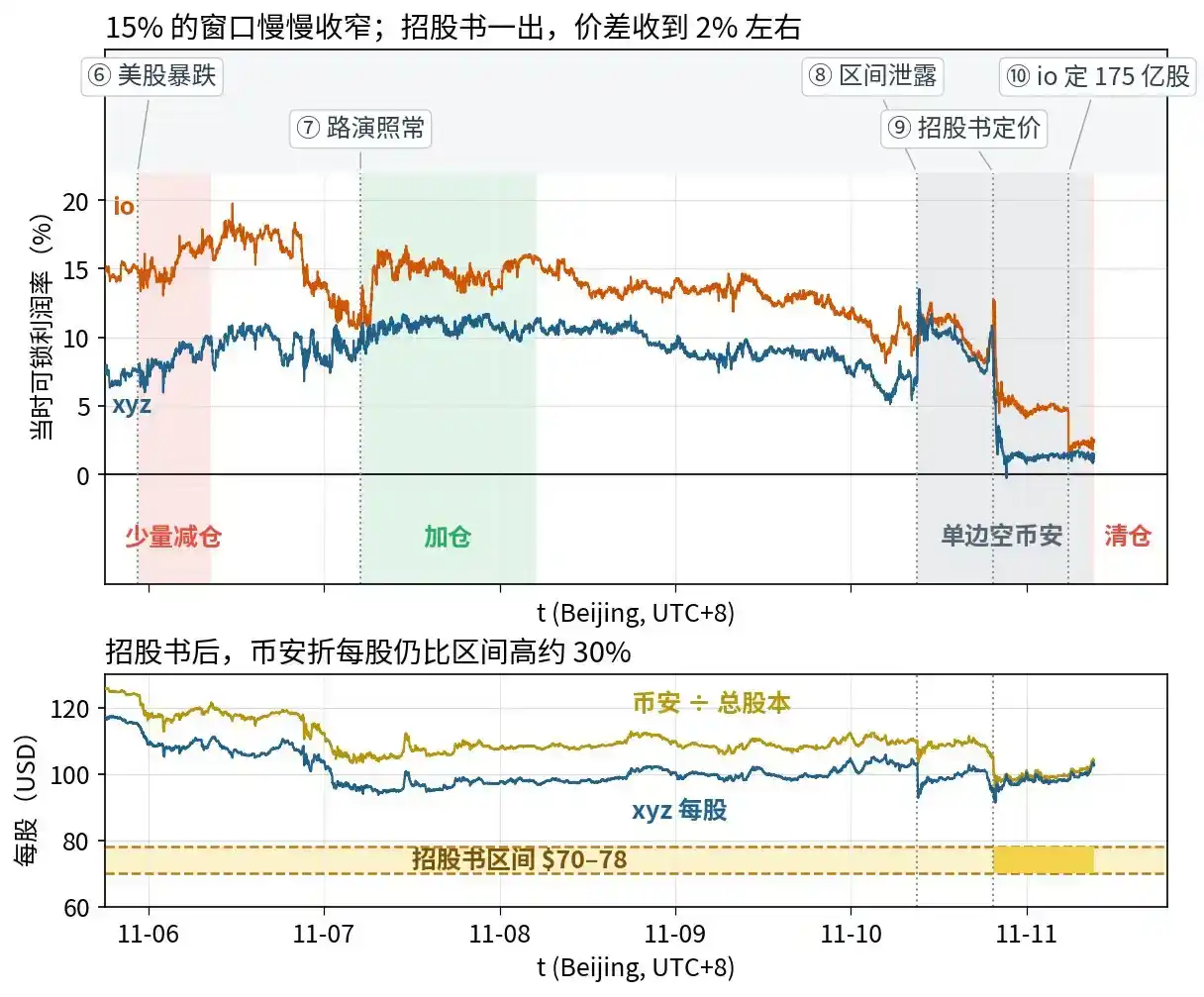
This was the team’s third major position adjustment. All three exchanges had confirmed their conversion rules, concerns about a delay had eased, and certainty was at its highest point in the two-week period. Yet the return remained around 15%. The team added back the position as soon as it saw the reports and used existing unrealized gains to increase exposure. The window lasted two or three days. The spread then narrowed gradually, reaching about 9% for io and 6% for xyz on the morning of Nov. 10.
Offering range, price-range prospectus and the exit
Nov. 10 morning: offering range leaks
On the morning of Nov. 10, the offering range leaked. Reuters reported a price of $70 to $80 per share, followed by reports that the terms had been withdrawn. The team judged that the range was probably genuine: multiplying $75 by the fully diluted share count produced the $1.2 trillion to $1.3 trillion valuation that had circulated earlier.
The team also expected a formal price-range prospectus that night because the terms had already leaked. After the report, the xyz contract fell from about $104 to $95, more than Binance, and the xyz route widened to roughly 11%. Because xyz quoted a per-share price, traders could compare it directly with the $70 to $80 offering range.
At that point, the team added to its one-sided Binance short. The reasoning was developed in the next part of the trade review.
Nov. 10 night: the price-range prospectus arrives
That night, the price-range prospectus showed an offering range of $70 to $78 per share and about 13.09 billion shares outstanding after issuance. The spread narrowed sharply. The xyz route moved from around 10% to just above 2%, while the Binance contract fell about 4% within an hour.
Nov. 11 early hours: Entropy sets an estimated 17.5 billion shares
In the early hours of Nov. 11, Entropy set its estimated conversion count at about 17.5 billion shares, slightly below the roughly 18 billion shares estimated under the previous methodology. The io route fell from approximately 5% to about 2%.
The team closed everything on the morning of Nov. 11. The xyz route was around 1% and the io route around 2%, ending the arbitrage.
Why the team kept an additional Binance short
Alongside the arbitrage position, the team maintained an extra one-sided short in Binance without a matching long. The reason was that the share-count error belonged only to Binance, while Hyperliquid contracts were the instruments that actually moved higher as the spread closed.
In theory, a Binance-specific error should have been corrected mainly through a decline in Binance. The actual price action was different.
- Before publication, Binance was indeed the main decliner, falling 12.6% while xyz fell only 1.9%.
- After publication, arbitrage traders bought both sides. Binance had the better liquidity, so the same amount of capital moved its price less. The xyz and io contracts on Hyperliquid rose more. From the posts to the market selloff, Binance fell 3.6% while xyz rose 3.4%. After the roadshow was confirmed, Binance rose 3.6% while xyz rose 6.8%.
- It was not until the night of the prospectus that Binance caught up with a 5.0% decline. xyz barely moved.
Binance’s premium had two components. Using the $1.2 trillion to $1.3 trillion valuation range and a fully diluted count, the implied per-share value was about $71. On Nov. 7, Binance’s price based on the issued-and-outstanding share count was about $105, roughly 50% higher. About 10 percentage points came from the share-count mismatch, which existed only in Binance and represented the arbitrage spread itself. Arbitrage flows were expected to close that portion. The remaining roughly 40 percentage points reflected broad market optimism about the valuation, and xyz carried that premium too, trading near $97 per share.
The one-sided Binance short therefore took exposure to both premiums. The first was likely to close through the arbitrage. The second required the market to reassess the valuation.
Why the short was increased when the range leaked
The team added to the Binance short when the offering range appeared for two reasons.
First, the range was probably real. A $75 price multiplied by the fully diluted share count matched the $1.2 trillion to $1.3 trillion valuation that had been circulating.
Second, the range offered a direct benchmark for the broader valuation premium. xyz used the same per-share unit as the offering price. If xyz traded at $100 while the range was $70 to $80, the premium was visible without an additional calculation. As xyz moved toward the range, the arbitrage link between Binance and xyz could pull Binance lower as well.
The final mistake: staying short after the prospectus
After the prospectus was released, the team kept the Binance short. Its working view was that Binance, converted using the issued-and-outstanding share count, still implied about $98 per share—roughly 30% above the $70 to $78 range disclosed in the prospectus. The expectation was that media coverage showing a market value of around $1 trillion would make the pricing issue clear and begin to close the premium.
That did not happen the next morning. The premium failed to narrow. Binance rose instead, and xyz rose with it. The Financial Times also reported that underwriters were preparing to raise the valuation above $1.5 trillion.
At that point, the team concluded that its assumption was wrong. Long holders did not capitulate simply because coverage referenced a market value of about $1 trillion. The short had shown a substantial unrealized gain on the night of the prospectus, but ended with a loss. The team stopped out and closed all remaining positions.
Source: X account @Billy0xFF; edited by MarsBit.



