
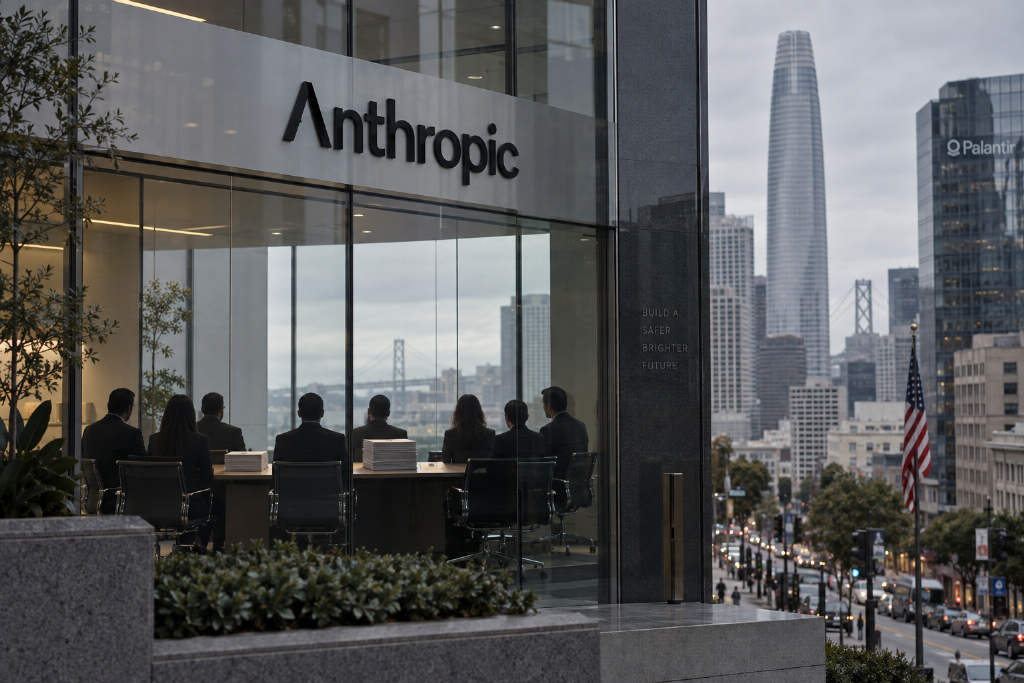
Anthropic wants sign-off on a new governance setup before it goes public, one that would hand seven co-founders 50.1% of the company’s voting power even though together they own only about 14% of the equity. The Information first reported it exclusively, and Reuters later picked it up. According to that reporting, Anthropic has asked shareholders to vote in the next few days on a plan that would give Chief Executive Officer Dario Amodei and six other co-founders a special share class covering most corporate matters.
Special shares would preserve control, not add economic value
These proposed shares would not give founders any extra economic rights. That’s the whole point. They are meant only to keep the founders in charge after Anthropic lists and outside investors start trading the stock.
The setup is pretty direct. It remains active so long as at least three of the seven founders keep a minimum ownership threshold, though that threshold has not been disclosed. So even if four founders later leave the company or sell their stakes, the last three could still hang on to majority voting control. The seven founders would hold the special shares through an independent limited liability company, or LLC, instead of owning them one by one.
These shares fit the super-voting stock model, where a single share can carry multiple votes while keeping the same economic rights as ordinary shares.
Board control would remain with Anthropic’s Long-Term Benefit Trust
There is one big exception: the founders would not control board elections. Anthropic’s Long-Term Benefit Trust would keep the power to appoint a majority of the board. The board has seven seats total, with one seat currently vacant, and founder representation would increase from two seats to three.
Anthropic also intends to issue a separate class of special shares to employees, giving them tie-breaking power on certain company matters. How those three layers of authority — founders controlling most matters, the Long-Term Benefit Trust choosing a majority of directors, and employee shares breaking ties on some issues — would actually function day to day is still not clear from the reporting so far. More specifics are expected only when the formal prospectus becomes public.
Report compares the structure to Palantir, but Anthropic goes past the halfway mark
The Information said the proposal looked like a Palantir-style voting control structure. Reuters used that same comparison in its follow-up report.
When Palantir went public through a direct listing in 2020, founders Alex Karp, Peter Thiel and Stephen Cohen held Class F shares through a founder voting trust that locked their voting power at 49.999999% of the total, as long as their combined ownership stayed above a certain threshold. Governance specialists attacked that arrangement at the time as a kind of permanent control.
The numerical gap here is tiny. The practical gap is not. Palantir stopped at 49.999999%, which meant it still needed some outside support to clear 50%. Anthropic is targeting 50.1%, which would give the founders an outright majority by themselves. Super-voting arrangements are common enough in Silicon Valley — Meta’s Mark Zuckerberg and Snap’s Evan Spiegel have both used dual-class structures to stay in control — but Anthropic’s model spreads that power across seven founders instead of piling it onto one person.
Founder wealth estimates vary with valuation assumptions
The report also turned the ownership stakes into rough wealth estimates. With each of the seven founders holding about 2%, and about 14% combined, each founder would be worth around $19 billion at Anthropic’s May valuation of $965 billion. At an August secondary-market valuation of about $1.5 trillion, that would climb to roughly $30 billion for each founder.
In a January essay titled The Adolescence of Technology, Dario Amodei wrote, “All of Anthropic’s co-founders have committed to donate 80% of their wealth.” Based on that statement, each founder would keep only about 0.4% of the company’s economic interest after donating 80% of their wealth, while the group could still hold majority voting control through the special shares.
Public investors may face a governance discount
Not everyone is likely to buy that trade-off. The report said public-market investors could wind up paying a valuation above $1 trillion while getting no decision-making power on most company matters, a governance discount that could show up in the eventual IPO pricing.
And the rule requiring at least three founders to maintain the ownership threshold makes the control structure fairly durable. Even if the founding team changes over time, majority voting power would stay in place as long as three core founders remain above the line.
The report pointed to a recent example of what murky governance can do inside an AI company: OpenAI’s board removed Sam Altman in November 2023 and then brought him back.
Shareholder vote is expected within days as IPO preparations continue
Anthropic did not immediately respond to Reuters’ request for comment. Reuters also reported earlier this month that the IPO could be pushed back until after the November midterm elections, though the election itself is not expected to have a material effect on the offering.
Shareholders are expected to vote on the governance plan in the coming days. Anthropic confidentially filed a draft S-1 in June, and market expectations cited in the report suggest the company could eventually seek a valuation of as much as $2 trillion. That would top SpaceX’s $1.77 trillion valuation at its June listing and could make Anthropic’s deal one of the biggest initial public offerings ever recorded.