From $5 to $50: A Viral Post Exposes Apple's Price-Squeezing History
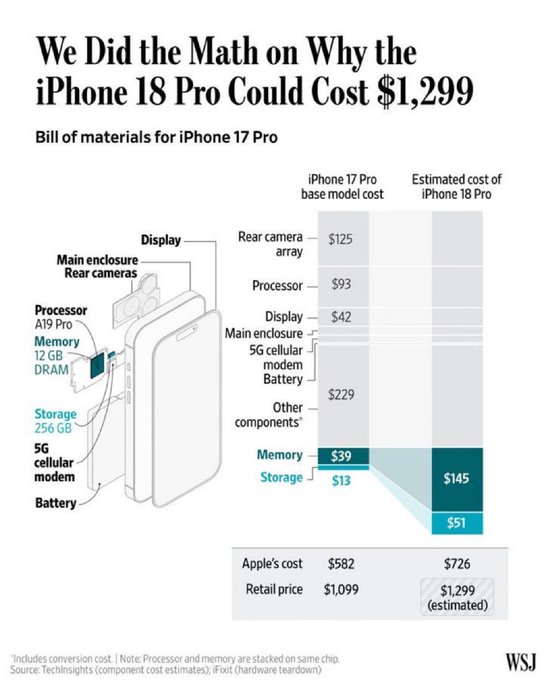
Overseas tech blogger @BluthCapital posted a satirical monologue in the voice of Micron's CEO: 'For over a decade, Apple bought chips from us for $5, put them in a metal box, and sold them for $99. When we tried to raise the price to $7, they laughed at us. Now that we charge $50, they've raised their product price by $250.' The tweet quickly went viral, and the blogger later shared an estimated cost breakdown for the iPhone 18 to support his point. Sumit Sadana, Micron's chief commercial officer, told the Wall Street Journal earlier that during the memory industry trough, some customers (including Apple) squeezed prices so hard that memory makers posted negative profits. Now, with surging AI demand, memory vendors have regained pricing power, flipping the power dynamic in the supply chain.
iPhone Profit Breakdown: Apple Takes a Quarter, Memory Gets a Thirtieth
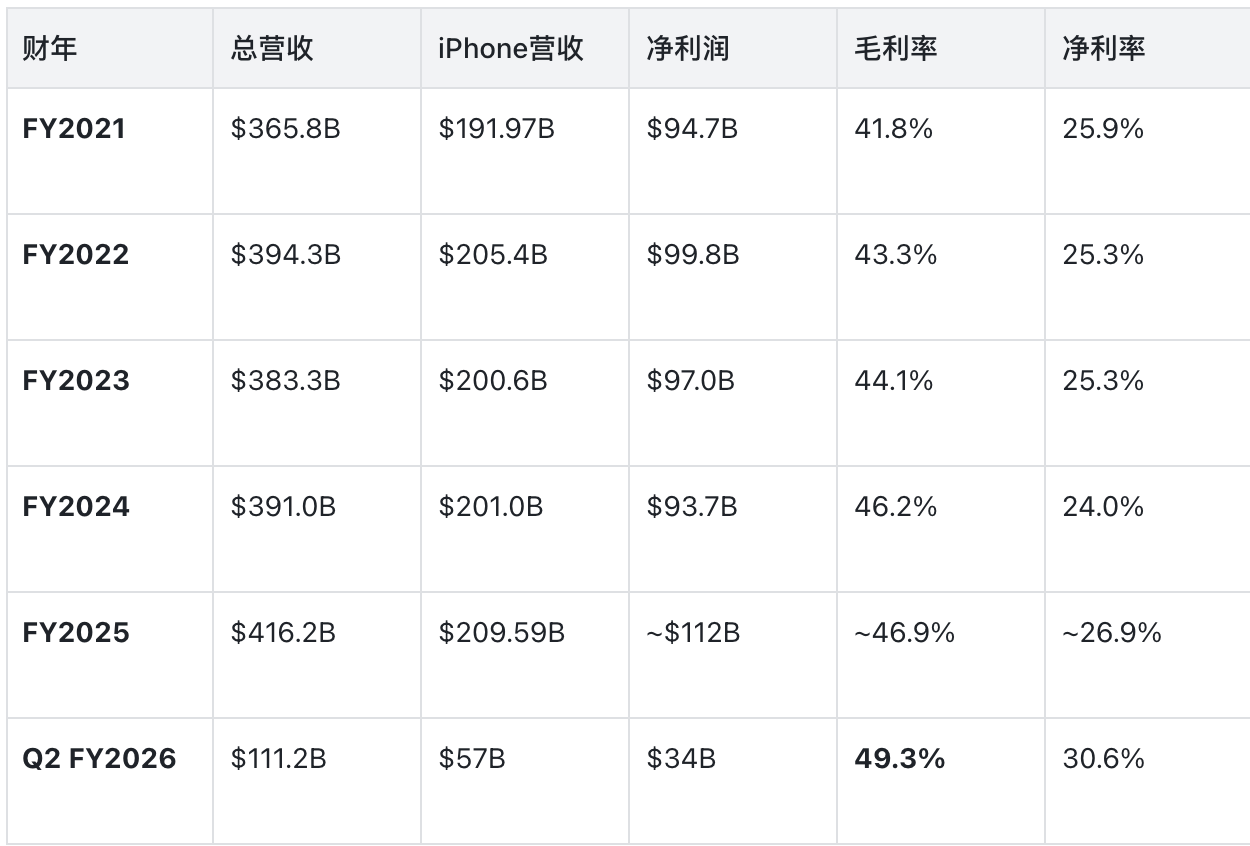
According to Counterpoint, Apple has consistently captured nearly 50% of global smartphone operating profits. In 2025, IDC data showed that with an 18% market share, Apple took about 75% of total industry profits. Based on Apple's Q2 2026 earnings, iPhone revenue was $57 billion, net profit $34 billion, implying shipments of approximately 61 million units. Per-unit net profit is estimated at $320-340, with a net margin of 33-36%. Breaking down the profit pool: Apple keeps about 25%, TSMC (due to its monopoly) takes 4-5%, and memory giants (Samsung, SK hynix, Micron) collectively receive only about 3% (roughly 1/30). The remainder covers other hardware, distribution, R&D, and taxes.
Memory Cost's Three-Stage Leap: From 'Negligible' to 'Critical Component'
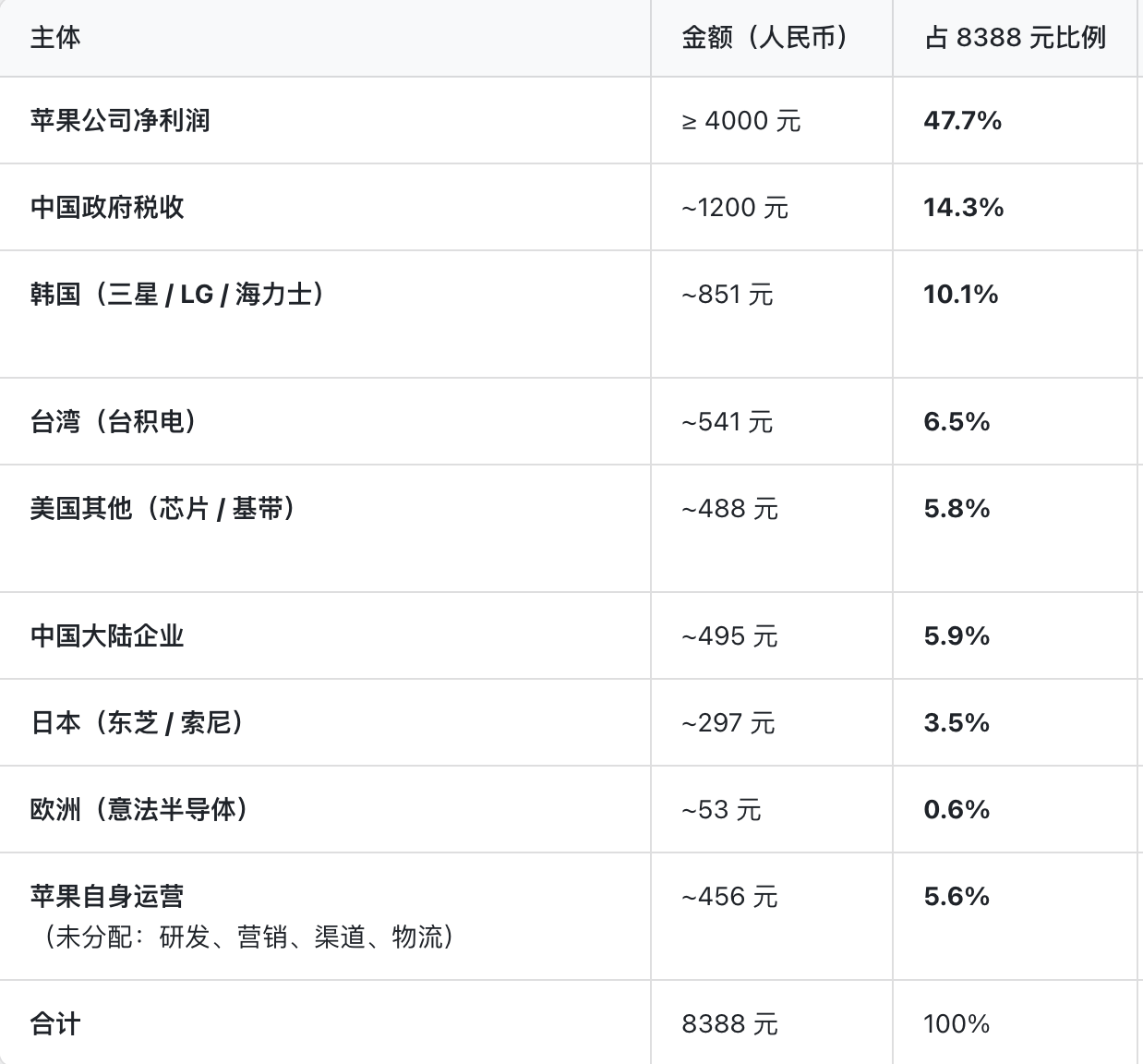
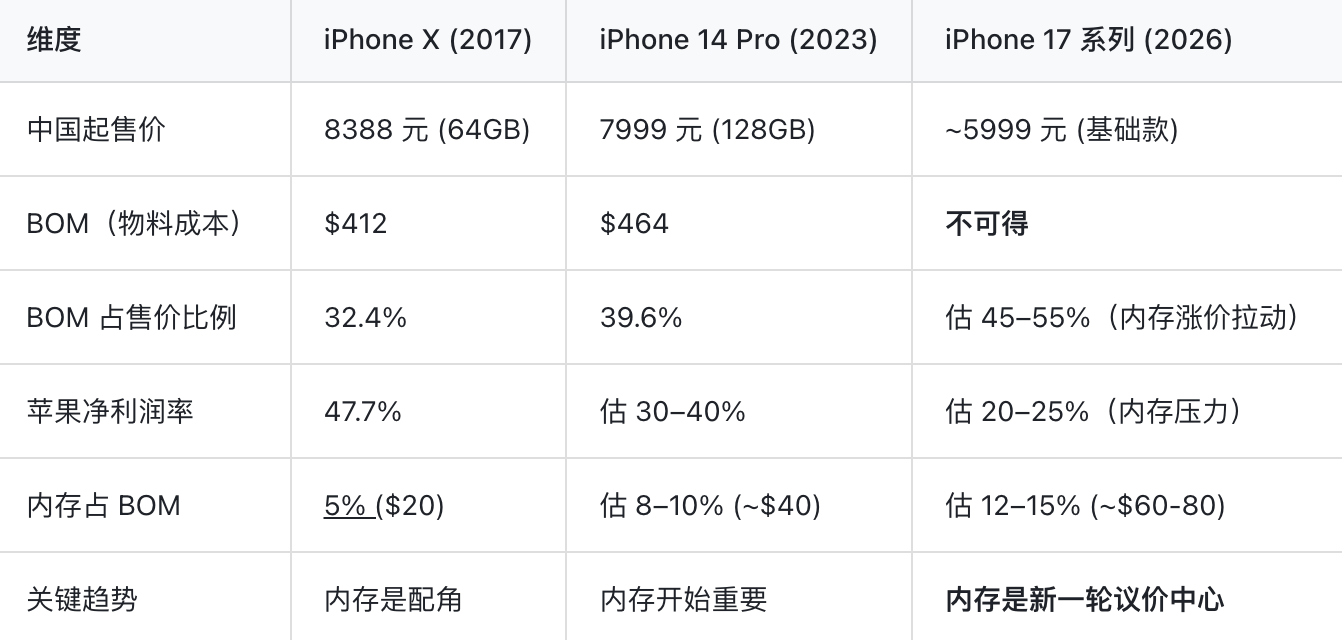
During the iPhone X era (2017), memory cost accounted for only 1.6-2.3% of the selling price (~135-195 yuan out of 8,388 yuan), while Apple's net margin approached 50%. In the 2023 iPhone 14 Pro era, the BOM cost rose to about $464 (40% of selling price), but Apple's net margin stayed near 40%, with memory still a small fraction. By the 2025-2026 iPhone 17 series, memory costs surged to $60-80 per unit, representing 12-15% of the BOM. TrendForce data shows that in Q1 2026, general DRAM contract prices jumped 93-98% quarter-over-quarter, and Citi expects an 88% average price increase for all of 2026. Apple subsequently raised prices across its Mac, iPad, HomePod, Apple TV, and Vision Pro lines. The announcement triggered a 6% stock drop, erasing $263 billion in market cap - Apple's largest single-day loss since April 2025.
Cook and Musk Agree: A 'Once-in-a-Century' Price Surge
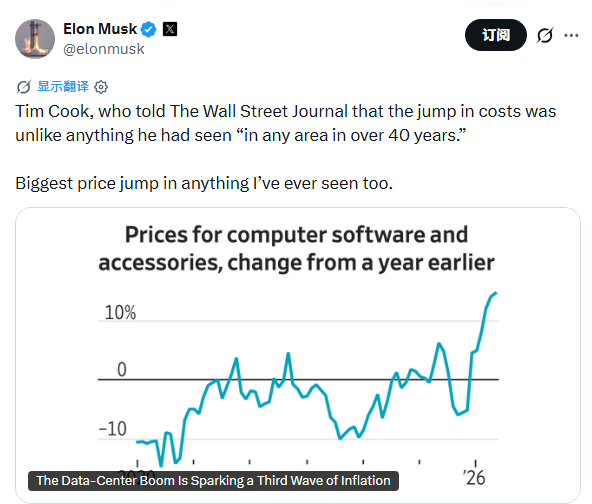
Tim Cook told the Wall Street Journal on June 17 that Apple needed memory pricing and supply to return to reasonable levels for consumer products. But less than a week later, on June 25, he changed his tone dramatically, calling the cost shock a 'once-in-a-century flood.' He said, 'In over 40 years, I have never seen anything like this in any industry.' The same day, Apple announced price hikes across its entire product line. Elon Musk quickly echoed Cook's sentiment: 'Cook told the WSJ this cost surge is something he hasn't seen in 40 years. Me too - this is the most brutal price jump I've ever witnessed.' The solidarity of two of the world's most powerful tech leaders underscores the unprecedented supply chain disruption driven by AI demand. Each AI server requires eight times the DRAM and three times the NAND of a standard server, crowding out consumer-grade memory production. For perspective, a single Nvidia Vera Rubin AI server consumes memory equivalent to about 14,500 MacBook Neo laptops. The 1:14,500 ratio highlights the extreme imbalance between AI demand and consumer supply.
Memory Giants' Resurgence: Micron's 84.6% Gross Margin, Apple Courts CXMT
Micron's Q3 FY2024 earnings reported an astonishing 84.6% gross margin and 346% year-over-year revenue growth to $41.46 billion, demonstrating the massive profit-making capability of oligopolistic memory suppliers. SK hynix recently announced plans to list in the U.S., seeking to raise approximately $29 billion to further capitalize on memory demand. Facing this concentration of power, Apple is actively lobbying the Trump administration to approve procurement of memory chips from China's ChangXin Memory Technologies (CXMT), which is preparing for its IPO next month. Apple aims to break the Samsung-SK hynix-Micron stranglehold by inviting a new competitor. The outcome of CXMT's IPO will determine whether it can secure a seat at the table - but the memory market's cake is still expanding, and the answer will come soon.