

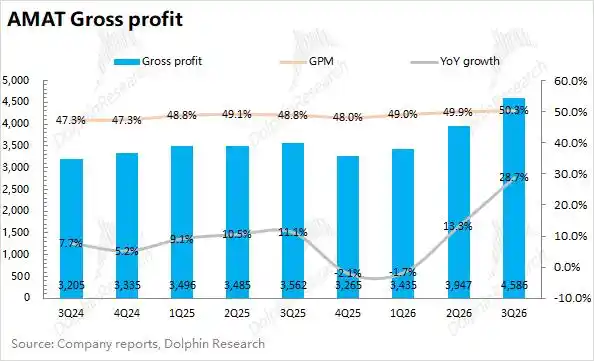
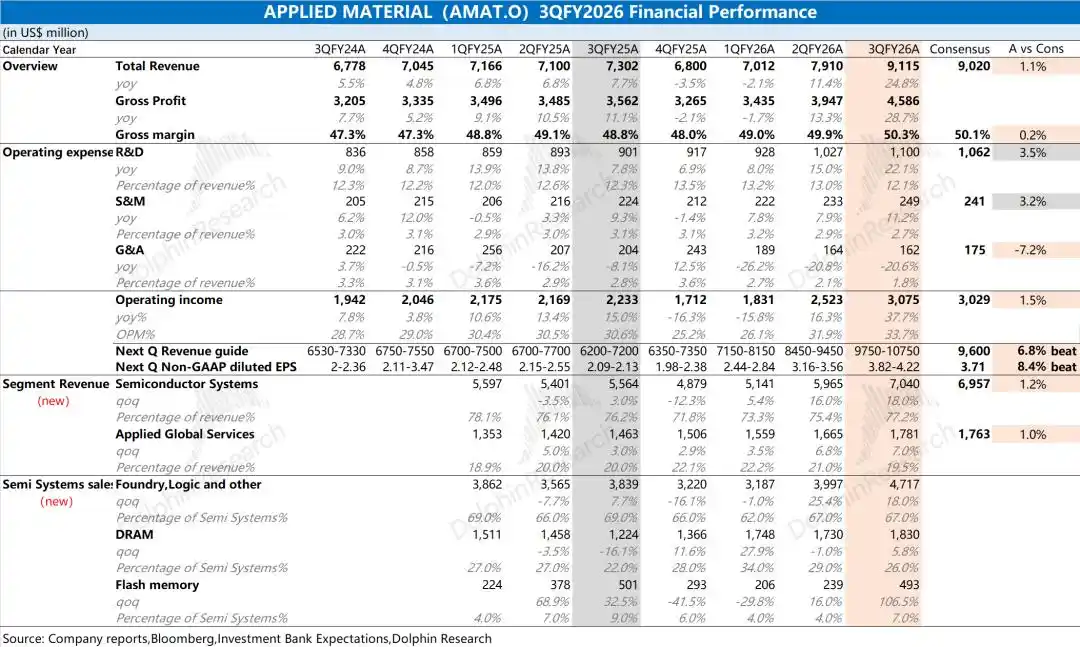
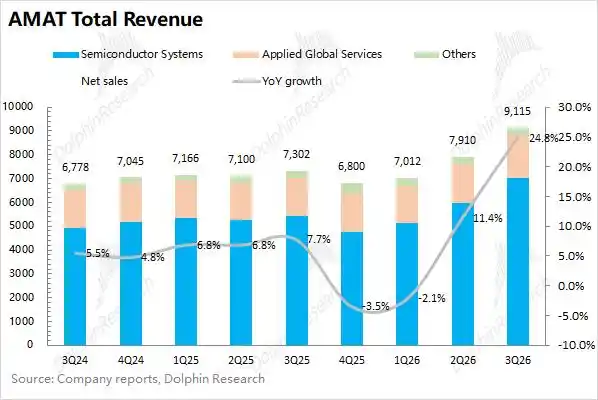
Applied Materials (NASDAQ: AMAT) released fiscal third-quarter 2026 results early on Aug. 14, Beijing time, covering the quarter ended July 2026. Revenue came in at $9.12 billion, up 25% year over year and slightly above the $9.02 billion market expectation cited in the source. Gross margin reached 50.3%, up 0.4 percentage points from the prior quarter and ahead of the 50.1% expectation.
The company tied the growth to the expansion of AI compute infrastructure, which lifted demand for advanced logic, DRAM and advanced packaging equipment. Even so, the market reaction after the release focused less on the quarterly numbers and more on how management described the outlook.
Quarterly results topped expectations
Applied Materials said margin improved despite heavier spending by customers, while noting that costs also increased across semiconductor equipment and services. That kept the pace of gross-margin expansion relatively measured.
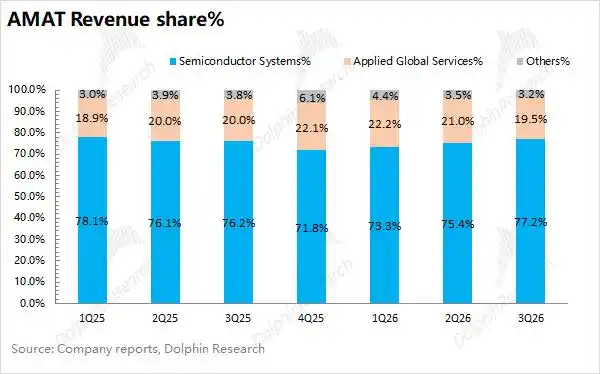
The business is mainly split between semiconductor systems and services, with semiconductor systems still the largest revenue source and accounting for more than 70% of total revenue.
Logic and DRAM both moved higher
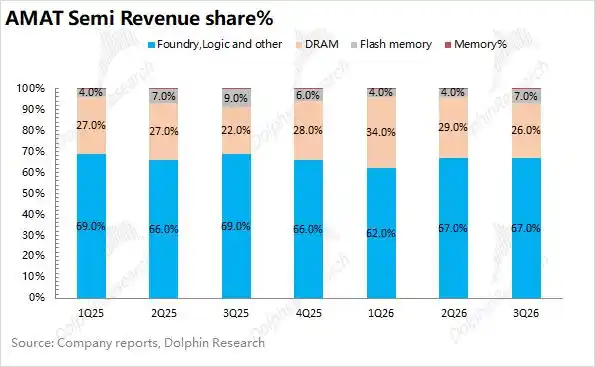
Within semiconductor systems, logic revenue reached $4.72 billion in the quarter, up 18% sequentially, driven by demand tied to advanced process nodes. DRAM revenue was $1.83 billion, up 6% from the prior quarter. The article said that customer fab expansion schedules and delivery cycles were not fully aligned, with cleanroom space constraints affecting the pace.
The source also noted that Applied Materials remains more exposed to logic than memory, with memory contributing only about 20% to 30% of total revenue. On that basis, memory demand is less of a direct swing factor for Applied than it is for Lam Research, where memory revenue is close to half of the total. At the same time, the article pointed out that Applied Materials has broad process coverage in DRAM and HBM, including deposition, CMP, metrology and packaging.
Expenses climbed and headcount rose again
Operating expenses increased to about $1.51 billion, up 14% year over year. R&D spending rose to $1.1 billion, while administrative and selling expenses stayed stable.
On staffing, the company had announced a 4% workforce reduction in late October 2025. As business improved, it later stepped up hiring for semiconductor engineers and service staff. Total headcount rose another 7% quarter over quarter in the latest period.
Q4 guidance beat market expectations
For fiscal fourth-quarter 2026, Applied Materials projected revenue of $9.75 billion to $10.75 billion, above the $9.6 billion market expectation cited in the article. At the midpoint, that implies 12.5% sequential growth. The company also guided for non-GAAP earnings per share of $3.82 to $4.22, ahead of the $3.71 expectation.
The source’s central view was blunt: strong quarterly numbers were not enough to offset what it saw as a conservative stance in the company’s forward framing.
Why the post-earnings reaction turned negative
Applied Materials had previously said its semiconductor equipment business was expected to grow more than 30% in calendar 2026. After this earnings release, management said demand kept strengthening during the quarter and that growth would come in above the previously highlighted “above 30%” pace. It also said share was expected to improve during the year, but it did not provide a firmer numerical update.
According to the article, that gap between market expectations and management’s wording was the main reason the stock sold off after hours. Major chipmakers have recently raised capital spending plans again, and investors were looking for Applied Materials to respond with a clearer upward revision.
The source also argued that because Applied Materials’ fiscal year is offset from the calendar year by two months, even a 40% growth rate for calendar 2026 would still imply a sharp sequential slowdown in semiconductor equipment growth: 18% in the current quarter, 12% next quarter, and 6% in the quarter after that. It added that Q1 FY27, which runs through January 2027, spans 14 weeks, meaning that the cited “+6%” would be close to flat sequential growth on a comparable 13-week basis.
Capex revisions by major chipmakers remain a key backdrop
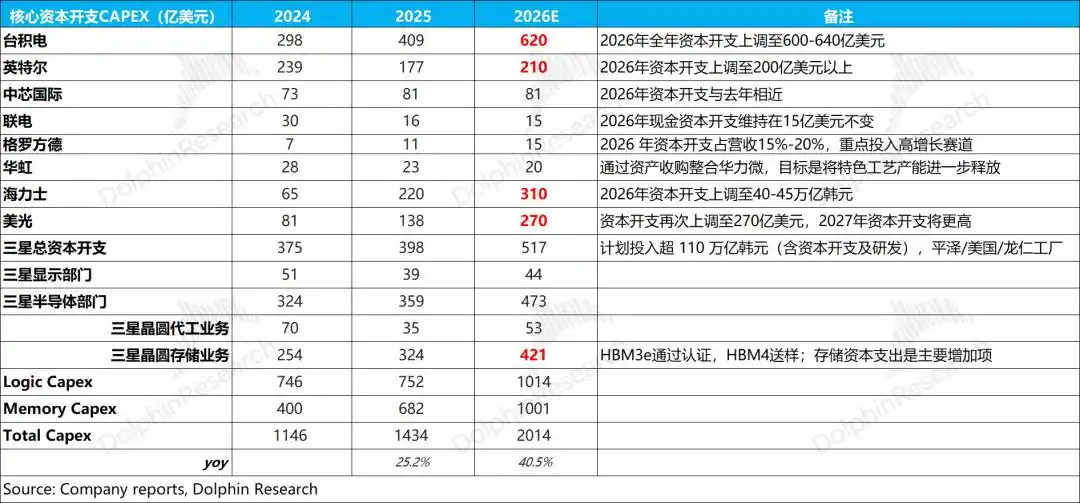
Beyond the quarter itself, the article highlighted several changes that the market is watching. The first is wafer-fab capital spending. Driven by AI demand, several major chipmakers have lifted capex expectations again.
- TSMC raised its 2026 capital spending guidance to $60 billion to $64 billion, implying an annual increase of about $20 billion.
- Micron raised its 2026 capital spending plan again to $27 billion.
- Samsung and SK Hynix also clearly increased capital spending, according to the source.
Based on those company outlooks, the article estimated that capital spending growth at major global wafer fabs could reach about 40% in 2026, with most of the increase coming from TSMC’s advanced-node investment and memory maker expansion. Against that setup, management’s failure to explicitly raise the “more than 30%” growth view for semiconductor equipment was seen as disappointing.
Memory demand and order visibility stay in focus
The second issue is memory demand and order visibility. The article said memory makers appear to have stronger incentives to increase capital spending, based on current fab guidance. Because DRAM and HBM production rely more heavily on deposition, CMP and advanced packaging, Applied Materials is positioned to benefit from this round of memory capex.
During the earnings call, management maintained that its largest customer provides an eight-quarter rolling forecast. The incremental update was that some customer discussions now extend to 2030. The article noted, however, that those longer-range conversations remain at the discussion stage, while the more concrete visibility still sits at eight quarters.
The source grouped Applied Materials, ASML and Lam Research together as upstream semiconductor equipment names exposed to the same cycle and wafer-fab spending trends. It also said Applied Materials is trading on valuation multiples broadly similar to ASML and Lam Research.
The article’s broader industry view
The source argued that the main things to watch in semiconductor equipment investing are the certainty of fab expansion and the potential for strong growth over the next two to three years. As long as AI capex and the semiconductor cycle remain healthy, later increases in capital spending could still push both earnings and valuation higher for upstream equipment suppliers.
It also said semiconductor demand had previously been concentrated in advanced process nodes and memory, but pointed to gross-margin trends at SMIC from the previous day as a sign that mature-node demand is also turning up, especially in the 8-inch segment where price increases have become more common. In the article’s view, supply tightness driven by AI is starting to spill into a wider set of semiconductor categories, and more investment in traditional semiconductor areas would add to equipment demand.
Overall, the source’s conclusion was that the broader semiconductor-cycle trend remains intact, supported by continued AI capex growth and a recovery in traditional semiconductor demand. The near-term issue is management’s decision not to clearly raise its full-year view for the semiconductor equipment business, which may weigh on confidence for now. The article said that if the upcycle holds, customer expansion plans and higher spending should still support Applied Materials’ earnings and valuation over time.
The original article was published by MarsBit and cited WeChat account Haitun Touyan (ID: haituntouyan), authored by Haitunjun.