
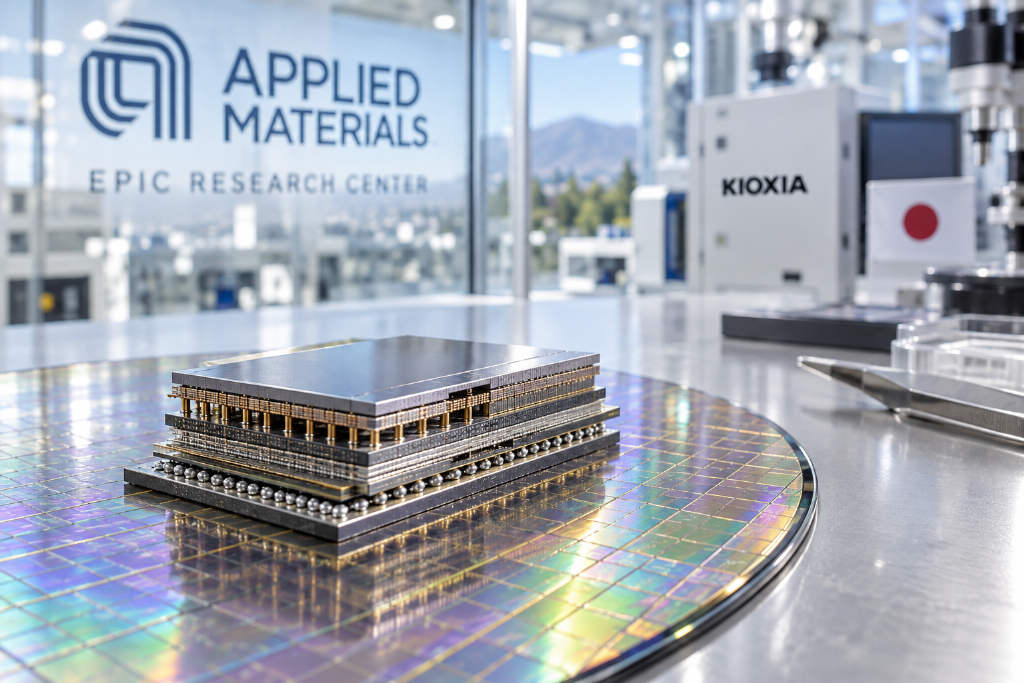
Applied Materials said KIOXIA will join the company’s EPIC Center in Silicon Valley as an innovation partner, where the two sides will work on next-generation AI memory stacking and materials technologies. The announcement comes as Applied Materials shares are up 90.2% this year, while Morgan Stanley has lowered its price target even after lifting its 2027 revenue and earnings estimates.
Joint work spans memory architecture, stacking, packaging and materials
Applied Materials (NASDAQ: AMAT) said KIOXIA, the Japanese flash memory and solid-state drive maker, will take space at its Equipment and Process Innovation and Commercialization Center, or EPIC Center, in Silicon Valley. The companies plan to develop a new generation of memory aimed at improving storage density and performance for AI computing.
According to Applied Materials, the partnership has four main tracks:
- developing new memory cells and structures so more data can be stored in the same footprint while improving operating performance;
- building multi-chip stacking technologies that can raise capacity by stacking more chips in size-constrained designs;
- developing advanced packaging for stacked memory to improve connection and integration across multiple dies;
- using materials engineering to create new structures while considering manufacturability at scale during the R&D stage.
Minori Kajimoto, general manager of advanced memory development at KIOXIA, said the two teams will work side by side at the EPIC Center in hopes of accelerating the move from research to commercialization for memory and packaging technologies.
AI data center growth is raising the bar for storage and materials technology
As AI servers and data centers continue to expand, demand is rising at the same time for storage capacity, transmission bandwidth and power efficiency. One of the industry’s current ways to increase flash memory capacity is to stack storage cells vertically.
But higher layer counts make manufacturing more complex. The report said shrinking line widths alone is no longer enough, and the importance of deposition, etching, new materials and chip integration is increasing. That is why equipment suppliers and memory makers need to start working together earlier in the research cycle.
Prabu Raja, president of Applied Materials’ Semiconductor Products Group, said the central challenge is to push memory density higher while controlling cost and technical complexity, which requires continued progress across materials, equipment and process technologies.
EPIC Center is due to open this year, with capex set to rise to about $5 billion
The EPIC Center is a collaborative R&D base that Applied Materials announced in May 2023. It was described as the largest advanced semiconductor equipment R&D investment in U.S. history and is expected to open this year. Its structure gives chipmakers dedicated space inside an equipment supplier’s campus so they can work with pre-production tools and processes earlier, cutting the time needed to move technology from the lab to volume manufacturing.
When Applied Materials first announced the project in 2023, it said it planned to invest as much as $4 billion over seven years. In its latest update, the company said capital spending will gradually increase to about $5 billion as customer programs get underway.
Before KIOXIA joined, Samsung Electronics and SK Hynix had already announced their participation in the EPIC Center. The partner list also includes chip designer Broadcom, Japanese equipment supplier SCREEN, and the University of California, Berkeley. KIOXIA’s addition fills out the center’s memory lineup further.
AMAT is up 90.2% this year as Morgan Stanley cuts target to $563
Applied Materials shares started 2026 at $268.87 and last closed at $511.38, for a gain of 90.2% this year.
On Sept. 28, Morgan Stanley cut its price target on Applied Materials to $563 from $642, a reduction of about 12%, while keeping its Equal-weight rating. At the same time, the bank raised its 2027 revenue and profit estimates, lifting its revenue forecast to $50.7 billion and its earnings-per-share estimate to $20.92. The reasons cited were stronger flash memory demand and improving gross margin.
The report said the target cut was mainly driven by a lower valuation multiple, with Morgan Stanley reducing the price-to-earnings multiple it used from 26x to 22x to reflect that the stock price has risen faster than earnings growth. After the note was released, Applied Materials shares did not weaken. The stock was up more than 5% intraday on Sept. 29.