BackKIOXIA

KIOXIA

Whale Movemen
2026-08-11 11:07:40

Storage-sector smart money lines up $15.29 million in exits while placing lower buy orders

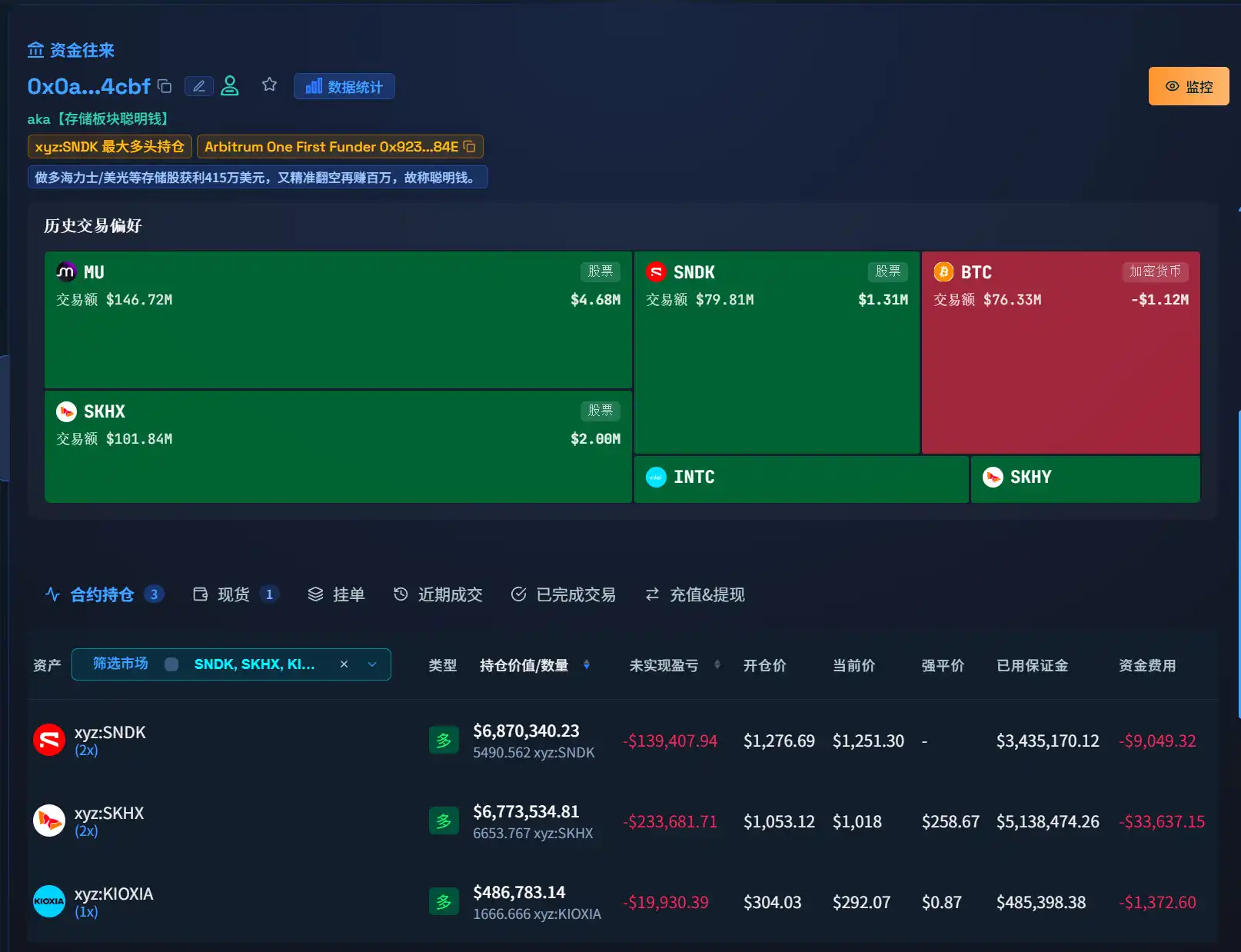
A trader tracked by TradingBeats, formerly Hyperinsight, is preparing to scale out of a large storage-sector position while keeping buy orders ready at lower levels. According to the Aug. 11 update cited by BlockBeats, the address currently holds about $13.972 million in long exposure across storage names but has placed six reduce-only sell orders totaling roughly $15.292 million above current positions. The unwind plan is already largely mapped out for SK Hynix, SanDisk and KIOXIA. The address holds 6,653.8 units of SKHX worth about $6.69 million at an average entry of $1,053.12, with 6,445.1 units listed for reduction between $1,062 and $1,165. It also holds 5,490.6 units of SNDK worth about $6.798 million at an average entry of $1,276.69, with 5,389.2 units offered between $1,280 and $1,440. For KIOXIA, the wallet holds 1,666.7 units worth about $484,000 and has listed the full position at $335. Those three longs are showing a combined unrealized loss of about $552,000. At the same time, the trader has not abandoned the storage theme and has parked roughly $4 million in bids below the market: about $2.5 million for MU at $811, about $1 million for SKHX at $950, and about $500,000 for KIOXIA at $285. Since July, the address has completed 20 trades, with 19 wins and one loss, for a 95% win rate and about $4.6 million in net profit in the storage segment.

580
Storage-sector smart money lines up $15.29 million in exits while placing lower buy orders
AI Agents
2026-08-11 00:17:09

AI agents are pushing storage into the runtime loop, reshaping the role of SSDs, HBM and memory tiers

A MarsBit report argues that AI agents are changing storage from a passive persistence layer into part of the execution path itself. As agents continuously observe, reason, call tools, write back results and preserve state, the value of storage is no longer limited to saving data after a task is complete. The report says SSDs are beginning to take on functions tied to model weights, KV cache spillover, indexing, encryption, compression, lifecycle control and long-term memory, pointing to a broader shift toward programmable, functional SSDs. The piece lays out how this transition could play out on both devices and in the cloud. On the edge, SSDs may become the long-lived state layer for personal agents, holding local models, adapters, vector indexes, personal memory and tool traces. In cloud deployments, storage nodes could move closer to the inference path, handling shared prefixes, KV data, adapters, vector search and governance. The report cites Mooncake and NVIDIA CMX as examples of systems where storage is already participating in token production rather than merely holding cold data. It also argues that the rise of agent systems does not diminish HBM. Instead, HBM, HBF, DRAM/CXL and SSDs are likely to be re-tiered by speed, mutability, capacity, cost and governance needs. Existing AI SSD efforts from Phison, Longsys, Maxio and partners are presented as early industrial samples of this shift, where the focus is moving from faster disks for AI workloads to a reallocation of responsibilities across runtime, memory hierarchy, controllers and flash.

720
AI agents are pushing storage into the runtime loop, reshaping the role of SSDs, HBM and memory tiers
Kioxia
2026-08-04 05:14:45

Kioxia shares rise 2.97% after GP1 SSD launch targeting AI storage

Kioxia rose 2.97% intraday on Aug. 4, according to Bitget market data, while the Nikkei 225 fell 0.53%. The move came as the company formally announced KIOXIA GP1, its first GP-series solid-state drive designed to support direct GPU access to high-speed flash storage. Kioxia said the product delivers 100M IOPS in random read performance. The company described the GP1 series as a product aimed at emerging AI storage architectures that bring high-speed flash media into the VRAM system. According to Kioxia, that setup allows AI systems to access larger datasets at a cost far below adding more HBM, while also improving GPU utilization.

640
Kioxia shares rise 2.97% after GP1 SSD launch targeting AI storage
Asian stocks
2026-07-28 01:58:19

Asian chip stocks slump as South Korea triggers trading curb and Taiwan shares briefly fall below 42,000

Asian equity markets opened sharply lower on July 28, with semiconductor and technology names taking the brunt of the selling. South Korea’s KOSPI fell more than 7%, triggering a circuit breaker again, while Japan’s Nikkei 225 dropped over 4%. KIOXIA, the Japanese memory maker, fell 17%. In Taiwan, the Taiex sank more than 1,800 points within 16 minutes of the open and touched 41,815.78, briefly slipping below the 42,000 mark. TSMC shares fell NT$80 to NT$2,270. According to ABMedia, the pullback is being watched through several lenses: crowded positioning in semiconductor trades, questions around the sustainability of AI hardware demand after Nvidia’s deal valued at more than $750 billion, and shifting supply-chain expectations tied to China’s semiconductor expansion. The report also pointed to CXMT’s recent IPO in Shanghai and said Chinese state-backed firms have started mass production of immersion DUV lithography equipment. Markets are also waiting for earnings from major technology companies including Meta and Amazon. Their capital expenditure plans are being treated as a key signal for the next phase of AI-related spending.

1860
Asian chip stocks slump as South Korea triggers trading curb and Taiwan shares briefly fall below 42,000
Bernstein
2026-07-27 12:00:00

Bernstein says $700 billion in AI tie-ups is really about locking memory and packaging

Bernstein’s July 27 note argues that the most important takeaway from two headline-grabbing AI supply-chain announcements is not another wave of GPU demand, but an earlier and broader scramble for memory and advanced packaging. On July 24, SK Group and Nvidia said they would expand a comprehensive partnership worth more than $500 billion, spanning AI factory infrastructure and next-generation memory. Samsung Electronics then signed an MOU with Broadcom covering more than $200 billion of cooperation through 2030 in memory and foundry work. Bernstein says those figures should be read carefully. The SK Group number is not a standalone memory purchase contract for SK hynix, while the Samsung-Broadcom figure remains an MOU rather than a final order book. Neither announcement disclosed actual purchase volumes, pricing, product mix or delivery schedules. The firm’s core point is that AI servers depend on much more than GPUs or ASICs. HBM, DRAM, NAND, advanced packaging and reliable delivery all sit on the critical path. If those pieces fall behind, chip shipments can also slow. The report keeps Outperform ratings on Samsung Electronics, SK hynix, Micron, Nvidia and Broadcom, with KIOXIA at Underperform, while stressing that execution, yield, customer qualification and capacity will determine whether these frameworks turn into real revenue.

260
Bernstein says $700 billion in AI tie-ups is really about locking memory and packaging
Centralized E
2026-07-25 10:31:03

Q2 2026 CEX data review points to persistently high volume and OI ratios at MEXC and Gate

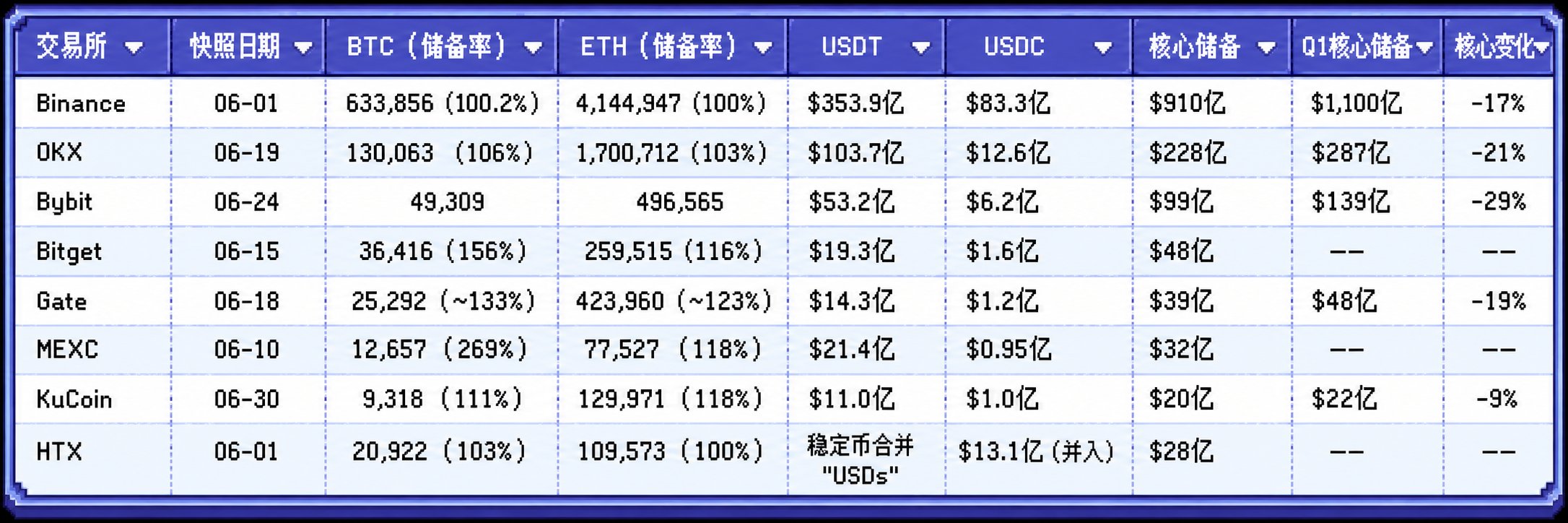
WuBlockchain republished a Q2 2026 review by @agintender that revisits trading volume and open interest across eight centralized exchanges using reserve data as the denominator. The study reruns two ratios, Vol/PoR and OI/PoR, keeps Hyperliquid as the benchmark, and compares Q2 against Q1 to see which venues moved closer to the benchmark and which moved further away. Hyperliquid’s own ratio fell as TVL grew faster than derivatives volume, pushing the Q2 threshold lower to 1.49x from 1.66x in Q1. Against that backdrop, Binance, OKX, HTX and Bybit remained within range on volume, while KuCoin’s ratios dropped sharply from Q1 after earlier trading incentives faded. Bitget moved into a gray area, though the report says much of the deterioration came from a smaller reserve base after excess BTC reserves were withdrawn. MEXC and Gate stood out again. MEXC’s derivatives volume ratio rose to 3.73x and its OI/PoR reached 3.06x, the highest in the sample, while Gate’s total volume ratio climbed to 3.25x and its OI/PoR rose to 2.33x. The report also tests whether rising tokenized stock and RWA trading could explain the numbers, and concludes that even after stripping out those products, both venues still sit well above the benchmark threshold.

840
Q2 2026 CEX data review points to persistently high volume and OI ratios at MEXC and Gate
Hyperliquid
2026-07-24 14:28:10

ARK analyst says Hyperliquid’s HIP-3 RWA volume has overtaken crypto on a weekly basis

ARK Invest analyst Lorenzo said Hyperliquid has reached a new point in its market mix, with real-world asset trading on HIP-3 exceeding crypto-native volume for the first time in a single week. According to the figures cited in the post, RWA accounted for 54% of total platform volume, and 61% of that RWA activity came from single-stock products. The article argues this shift points to a broader change in Hyperliquid’s positioning, from a crypto perpetuals venue to a round-the-clock multi-asset derivatives platform spanning equities, indices, commodities and FX. The write-up also stresses that the RWA products in question are synthetic perpetual contracts rather than tokenized securities. Traders get price exposure, typically margined in USDC, but do not receive actual stock ownership, voting rights or legal claims on the underlying assets. It distinguishes that model from true securities tokenization and notes the two paths carry different infrastructure, legal and operational requirements. At the same time, the piece flags a math issue in the original comparison between Hyperliquid’s HIP-3 RWA volume and the rest of the DEX perpetuals market, and says the claim cannot be directly derived from the numbers presented. It further examines what the trend could mean for HYPE, USDC and Circle, while outlining the current HIP-3 market map, where activity is concentrated in stocks, commodities and indices, with much of the volume attributed to the trade[XYZ] deployment.

3880
ARK analyst says Hyperliquid’s HIP-3 RWA volume has overtaken crypto on a weekly basis