
Robinhood announced in the early hours of yesterday that Robinhood Chain, its in-house Layer 2 network, has officially launched on public mainnet. Built on the Arbitrum technology stack, the chain is being positioned as institutional-grade, permissionless, AI-native, and specifically designed for real-world assets, or RWA. In practical terms, Robinhood is not simply adding another blockchain to the market. It is attempting to unify equities, RWA issuance, lending, trading, and broader on-chain financial products within a single infrastructure layer under its own ecosystem.
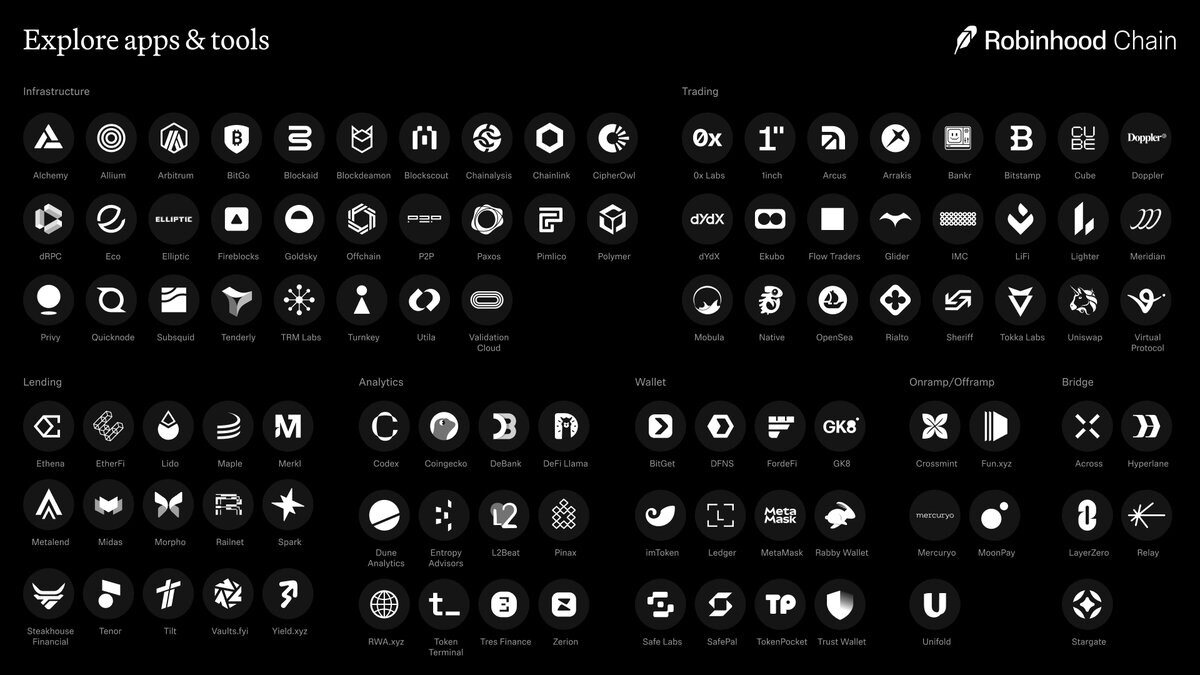
The ecosystem response was immediate. A number of major crypto protocols, including Uniswap, 1inch, Lighter, Morpho, Chainlink, BitGo, Ethena, and EtherFi, announced integrations with Robinhood Chain shortly after the launch. These partnerships span several core segments of crypto infrastructure, including trading, liquidity, lending, oracle services, custody, and cross-chain connectivity. However, among all the integration announcements, the most controversial and widely discussed development was the debut of Arcus, a new DEX built by the dYdX team.
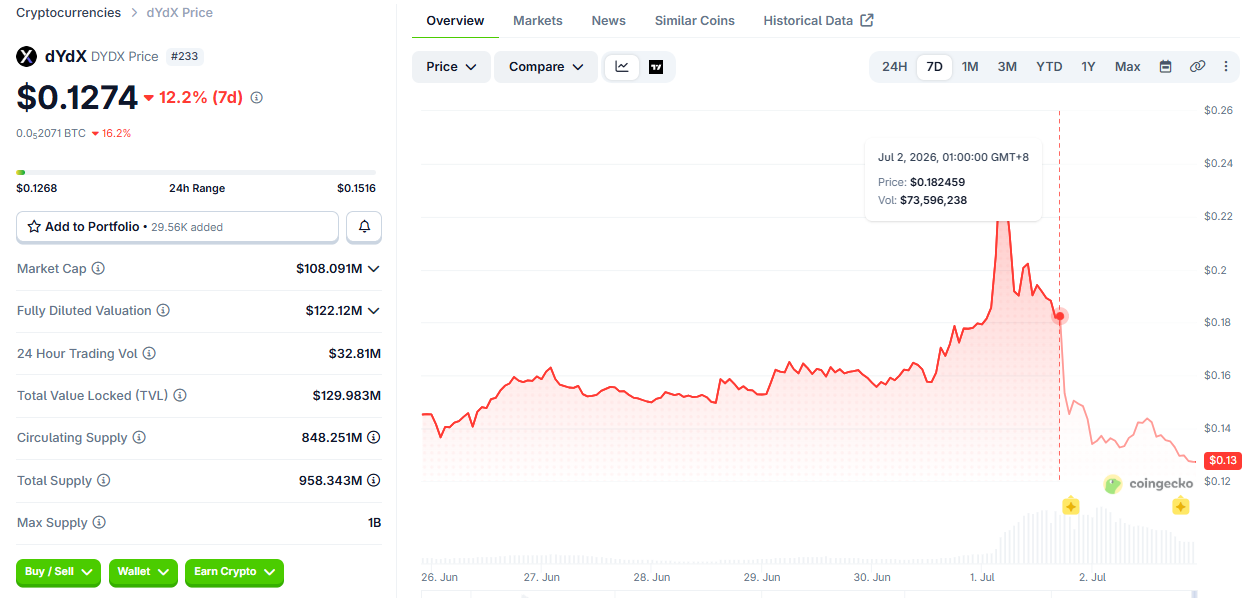
Arcus launches on Robinhood Chain with tokenized stock trading at the center
Arcus is a decentralized exchange developed by the dYdX team and now deployed on Robinhood Chain. The product has opened an early waitlist and is marketing itself around a very specific value proposition: 24/7 zero-fee trading for 95 tokenized stocks and perpetual contracts. In addition to equities, Arcus is designed to support tokenized exposure to commodities, indices, and crypto assets. According to the information disclosed so far, all tokenized stocks on the platform are issued on Robinhood Chain and can be redeemed, while also remaining self-custodied and compatible with DeFi applications.
The early waitlist is already live at https://waitlist.arcus.xyz/ , and users can complete the interaction process by linking an X account and wallet. Looking ahead, Arcus plans to expand into collateral functionality, allowing tokenized stocks and crypto assets to be used as collateral for perpetual contracts. It also intends to support pre-IPO trading for high-profile private companies, with OpenAI explicitly mentioned as an example. This product design aligns closely with one of the strongest crypto narratives of the year: tokenized equities and broader financial asset tokenization.
Why the market sees this as more than a product launch
The central issue is not that Arcus is pursuing tokenized stock trading. The real source of tension is that it is not being launched on dYdX Chain. Instead, Arcus is running on Robinhood Chain and is being advanced as an independent product built on separate infrastructure. For the market, this signals that dYdX Labs is telling a new growth story, but one in which neither dYdX Chain nor the DYDX token appears to occupy the main role.
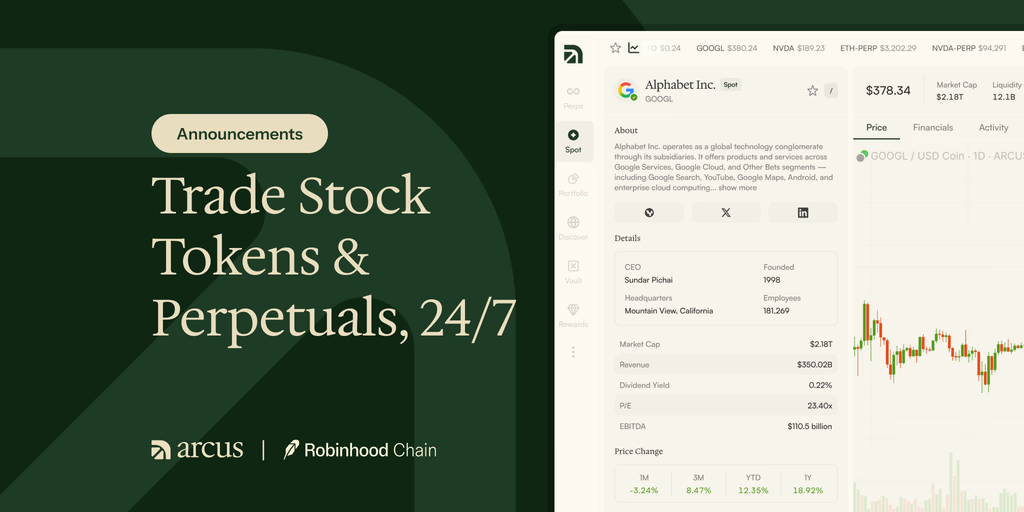
This has led the community to ask a series of difficult questions. Is dYdX Labs shifting strategic focus toward Arcus? Could the original dYdX Chain become marginalized over time? If Arcus ultimately generates meaningful trading volume and revenue, will dYdX Chain capture any of that upside? And if Arcus launches a token of its own, what economic rights, if any, will accrue to existing DYDX holders? These concerns have already had a market impact. DYDX fell more than 12% in the past 24 hours, with its market capitalization reported at $108 million.

Antonio Juliano’s response and the role of dYdX Foundation
In response to the criticism, dYdX founder Antonio Juliano said that dYdX Chain had deliberately gone deep on decentralization. He highlighted the chain’s open-source architecture, community governance structure, more than 200 markets, and a validator set of over 50 operators running the orderbook. At the same time, he acknowledged that this path came with trade-offs in performance and user experience. As competition in on-chain derivatives intensifies, the market has increasingly rewarded platforms that offer greater speed, simpler UX, and more concentrated liquidity. Arcus, in his framing, is a direct response to that reality.
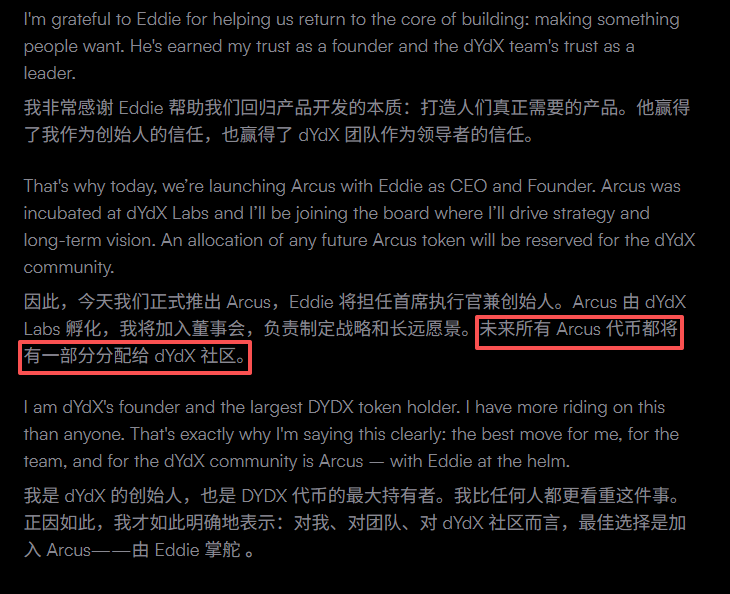
Antonio also clarified Arcus’ organizational structure. The new platform will be led by Eddie Zhang as CEO and Founder, while Antonio himself will join the board and focus on strategy and long-term vision. That distinction matters. It confirms that Arcus is not merely a new module added to dYdX Chain, but rather a separate trading platform being advanced by dYdX Labs on its own terms. For existing users, Antonio said dYdX v4 will continue to receive support, and user funds and positions will remain accessible on dYdX Chain.
He further stated that if Arcus issues a token in the future, a portion of that token would be allocated to the dYdX community, with priority given to users who have historically contributed through trading, staking, validating, or community participation. Shortly afterward, the dYdX Foundation reinforced that Arcus is an independent product built on separate infrastructure and that dYdX Chain is not being altered by the launch. The Foundation emphasized that DYDX remains the governance and staking token of dYdX Chain, and that there are currently no plans for any token swap, migration, or changes to supply mechanics.

The unresolved question is value capture, not operational continuity
From a communications standpoint, the dYdX team has tried to reassure the market that dYdX Chain will continue to operate and be supported. But that is not the question investors are really asking. The deeper concern is value capture. If Arcus succeeds on Robinhood Chain by attracting users, generating volume, and potentially building a profitable business around tokenized equities and derivatives, how much of that growth will flow back into the existing dYdX ecosystem? Governance continuity alone may not be enough to satisfy token holders if the economic upside is accruing elsewhere.
Another major factor is the token expectation surrounding Arcus. Antonio’s comment that “a portion of Arcus tokens will be allocated to the dYdX community” was likely intended as reassurance. Instead, it amplified speculation around a future Arcus token and possible airdrop. Given that dYdX previously ran one of the largest airdrops in the industry, the market is naturally paying attention. If Arcus later introduces trading incentives, points programs, or other early-user reward mechanisms, it could attract traders and liquidity providers before its core economics are formally defined. That, in turn, could place further pressure on dYdX Chain, which is already facing competition for activity and attention.

For dYdX Labs, Arcus clearly represents a new strategic narrative built around faster product execution and a timely tokenized equities theme. For DYDX holders, however, it introduces a more uncomfortable test: whether a team can create a successful new platform outside its original chain while still preserving alignment with the legacy token community. Until the market receives clearer answers on revenue linkage, token economics, and internal resource allocation between Arcus and dYdX Chain, the debate is unlikely to fade.