
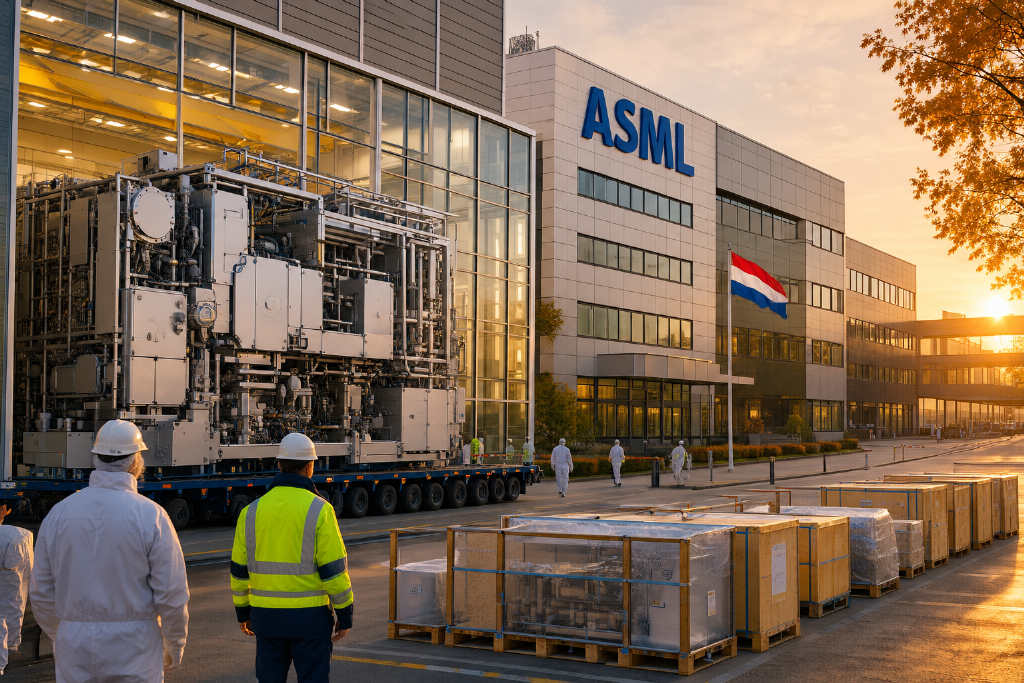
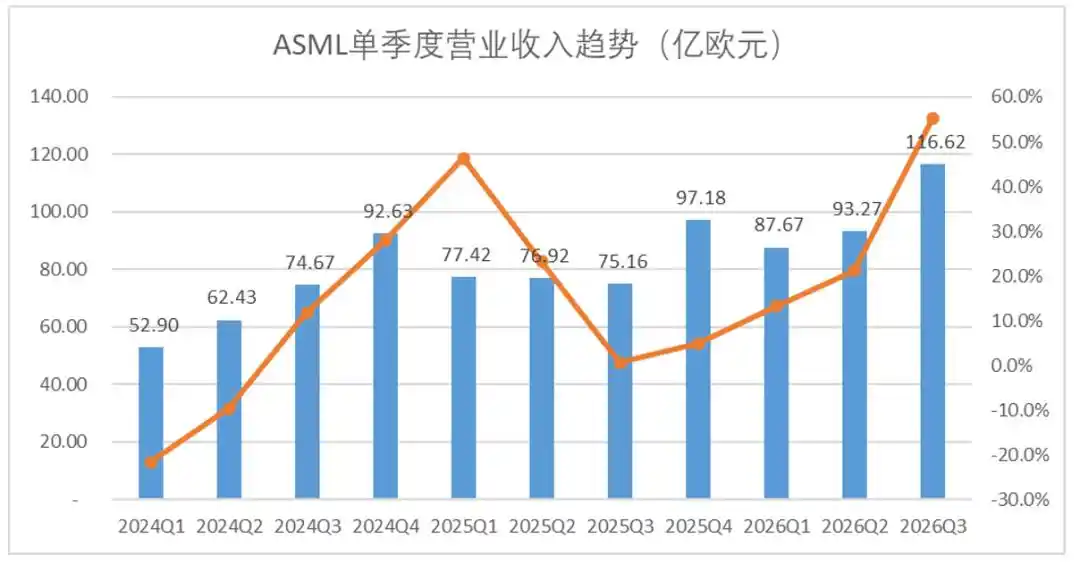
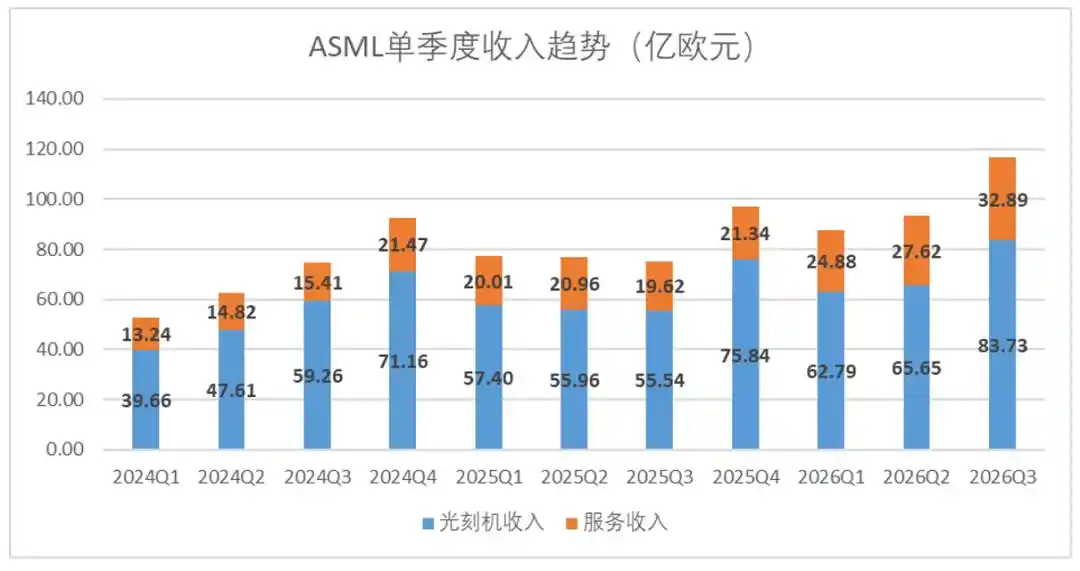
ASML released its third-quarter earnings on Oct. 14, posting revenue of 11.662 billion euros, up 55.2% year over year and marking the first time the Dutch lithography equipment maker has generated more than 10 billion euros in a single quarter. The figure was slightly below industry expectations.
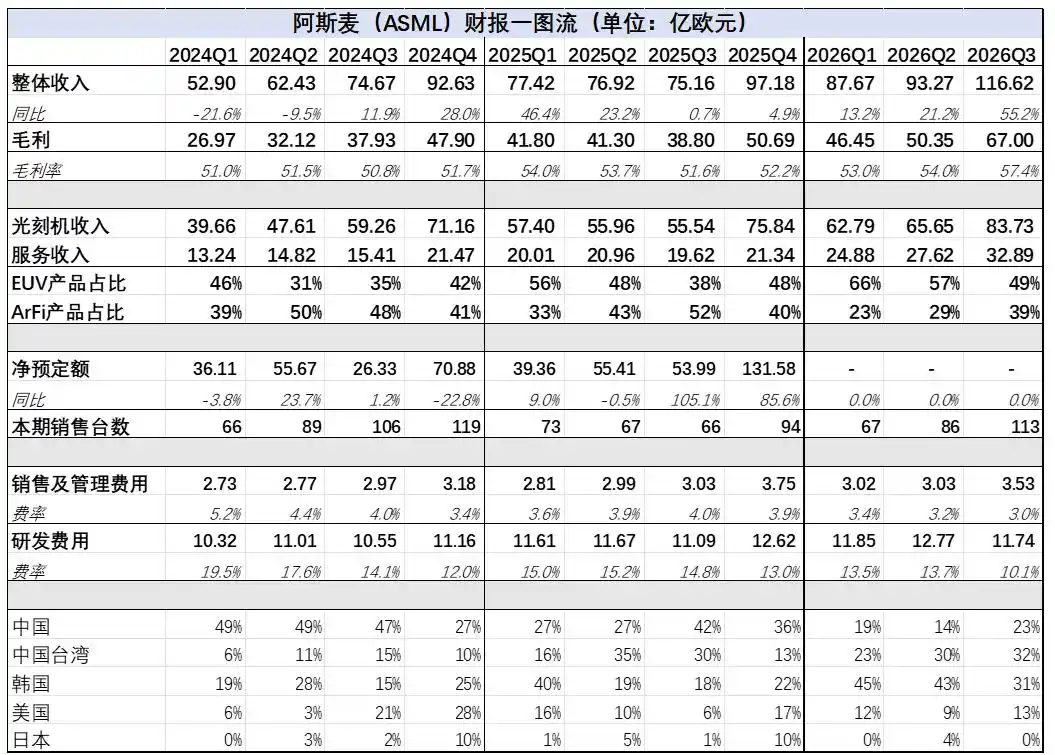
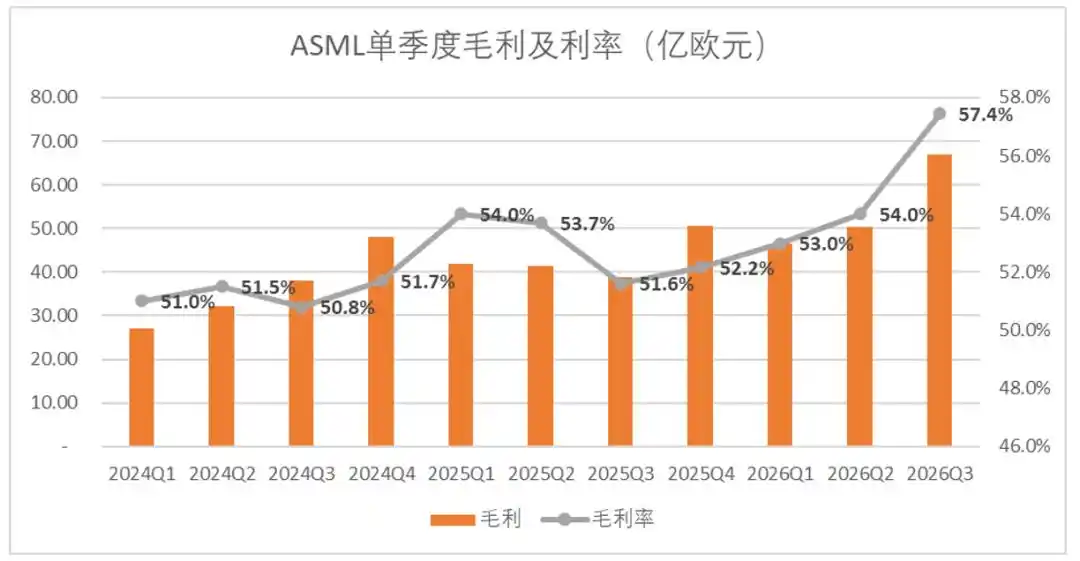
The stronger surprise came from margins. ASML reported a gross margin of 57.4% and a net margin of 42.5%, both record highs. Set against earlier reports that the company had raised prices by 10% on certain products for Samsung and SK Hynix, the quarter highlighted how much control ASML currently has over its earnings power in a supply-constrained market.
Revenue topped 10 billion euros as shipments and service sales climbed
ASML’s quarterly revenue has long been tied mainly to two variables: how many systems it can ship in a given period, and how much it can charge per machine.
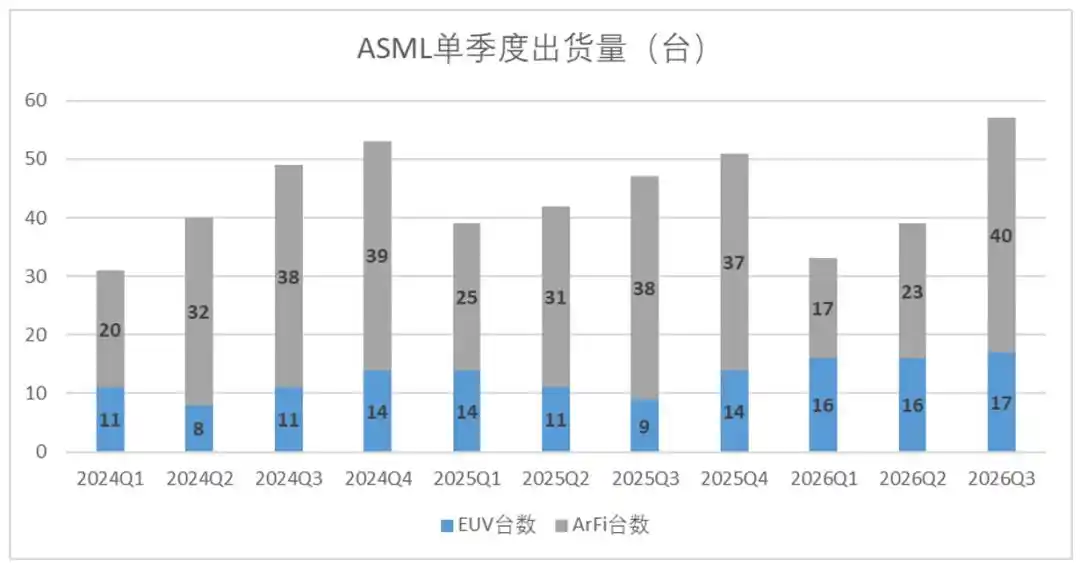
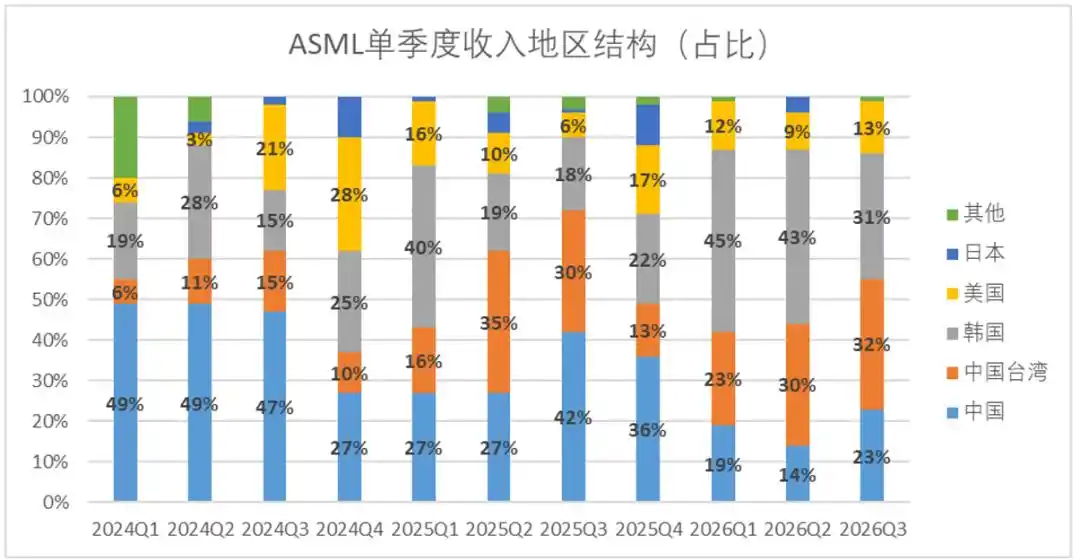
In the third quarter, both shipment pace and after-sales monetization helped. ASML delivered 17 EUV lithography systems, one more than the previous quarter, while ArFi shipments reached 40 units. Both core product lines set quarterly shipment records. The article said orders from mainland China showed a relatively visible recovery.
The other growth lever was services. With new capacity still limited, ASML leaned harder on its installed base. Service revenue rose to a quarterly record of 3.29 billion euros. On the earnings call, management said the increase "mainly came from strong customer demand for EUV and DUV productivity upgrade products," pointing to rising demand for maintenance and iterative upgrades on tools already in the field.
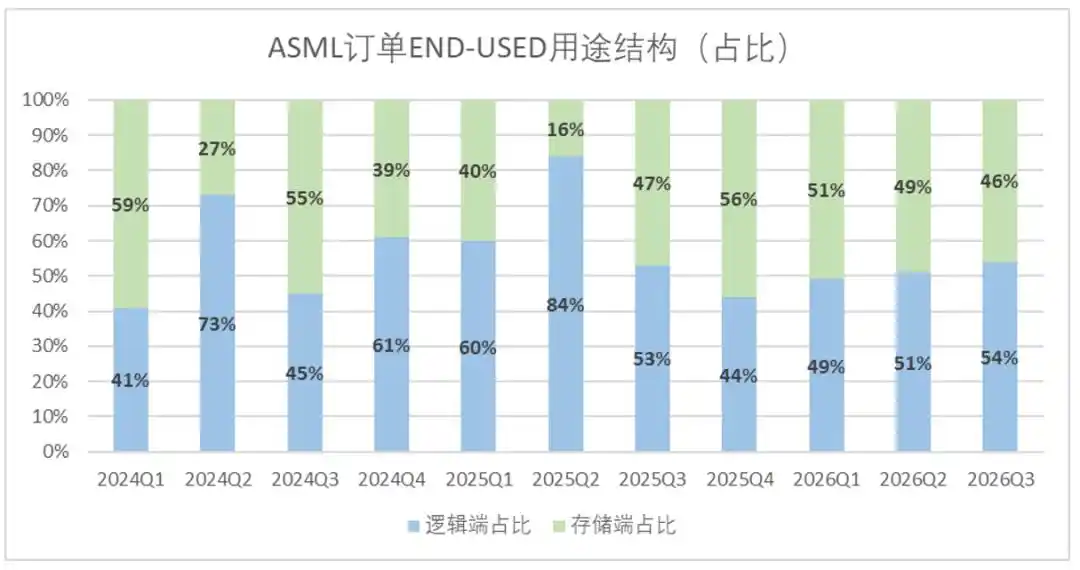
Order mix remained stable, according to the article. Since the storage upcycle accelerated in the third quarter of 2025, logic and memory chip orders have broadly split 50-50, and that pattern continued in the third quarter of this year.
Contract liabilities also increased sharply. Customer prepayments and billed but deferred long-term revenue rose by 5.7 billion euros in the quarter to 9.3 billion euros, suggesting that much of ASML’s output is already spoken for and that near- to mid-term revenue volatility should stay limited.
Profitability, not revenue, was the biggest upside
Compared with sales, profit was the real standout in the quarter. ASML generated 6.7 billion euros in gross profit, lifting gross margin to 57.4%, another record. The article attributed much of that improvement to the rising contribution of high-margin service revenue.
Cost discipline remained steady. It said ASML did not need to materially step up cost-side investment and that fixed expenses were being diluted as scale increased. The overall expense ratio fell 570 basis points from a year earlier and 380 basis points from the previous quarter.
That translated into net profit of 4.96 billion euros, a new quarterly high, with net margin at 42.5%. Included in that figure was a 510 million euro revaluation gain on ASML’s stake in Mistral AI. Even excluding that investment gain, the article said operating profit still doubled and net margin remained above 38%.
Its argument was straightforward: even if ASML pushes through price hikes of 5% to 10%, the effect on downstream demand is likely to be limited, given how sharply memory and logic chip pricing has already moved this year. On that basis, it said ASML’s margins could still rise meaningfully over the next two years before new capacity is fully released.
ASML is trying to capture more of the profit pool downstream
Average selling prices stayed elevated in the third quarter. Based on a rough calculation from the earnings release, the article estimated that EUV tools were still priced at around 336 million euros apiece, while ArFi systems were holding near 114 million euros, both up notably from a year earlier.
Management raised the lower end of its fourth-quarter revenue guidance, but the article argued that this still does not fully satisfy ASML’s ambitions.
Its customers are in the middle of an unusually rich profit cycle. The article said memory makers including SK Hynix, Samsung and Micron were seeing gross margins of about 76%, well above ASML’s own profitability.
SEMI expects global semiconductor manufacturing equipment sales to reach $165.9 billion in 2026, up 23.2% year over year, with DRAM equipment spending up 39%.
Against that backdrop, ASML management used this year’s earnings call to discuss future price increases in greater detail. The company said pricing for key products had already been discussed with customers, with contributions expected to begin in 2027 and the full impact showing up in 2028. Earlier reports had said ASML would raise prices by 10% from January next year on replacement parts for lithography machines supplied to the South Korean market, and that Samsung and SK Hynix had accepted the adjustment after discussions.
Not every customer is on board. The article said Taiwan Semiconductor Manufacturing Co. had opposed the pricing plan. Still, based on management’s confidence on the earnings call and the gradual rollout of High-NA EUV shipments, it suggested further price hikes may be difficult to avoid.
Orders are locked in through 2028, and so is part of the valuation story
On the surface, the quarter looked strong across the board: revenue was broadly in line, profit exceeded expectations, guidance was raised, and management laid out both price and capacity plans for the coming year. Yet the market reaction was muted. ASML shares fell 4% after the report and were down about 17% from their late-June high.
The article centered that reaction on one management remark: "We now expect that, under current plans, output in 2027 and 2028 will not fully meet customer demand."
That statement may sound like a sign of strength, but it also reveals the company’s central constraint. Demand is not the problem. Capacity is. Orders are effectively booked out to 2028, yet production growth is not accelerating enough for ASML to fully convert that demand into near-term reported earnings.
Upstream bottlenecks remain part of the equation
Most of the questions on the earnings call focused on production plans. The article highlighted one from TD analyst Krish Sankar, who asked whether there was a natural ceiling on EUV output in a strong-demand environment, including whether production was constrained by the expansion pace of Dutch supplier VDL or by capacity at Zeiss.
Management denied that Zeiss was the active bottleneck, while also saying it was discussing capacity expansion with Zeiss. The article took that as evidence that ASML is not fully in control of its own ramp. Whether the constraint sits with VDL, Zeiss or raw-material suppliers further upstream, the company still depends on others to expand faster.
It also said management’s projected capacity growth of 30% over the next two years looked slightly below market expectations, and that actual capital expenditure had not meaningfully accelerated in the earnings release.
Investors want earnings to arrive faster
For most manufacturers, being sold out through 2028 would be an obvious positive. For ASML, sitting at the center of a once-in-a-generation AI buildout, the situation is more awkward. The simplest reason is that strong demand over the next few years cannot be fully translated into accounting profit on the timetable investors want.
The article contrasted ASML’s market performance with that of its customers. ASML’s market value has risen 55% this year, while downstream names such as SK Hynix and Samsung have both gone through valuation reratings of roughly 2x. Even after recent pullbacks, the year-to-date gains cited were still 95% and 77%, respectively.
Management tried to address that gap on the call by stressing the longer-term earnings runway and pointing to services as a practical answer while tool output remains capped. It said: "The ability to increase capacity through upgrades within the same footprint is highly attractive to our customers because the effect is an immediate increase in output capacity. We will continue to advance this important value driver, expand the upgrade product portfolio over the coming years, and provide customers with new productivity-enhancement options."
The article’s response was blunt: unless production capacity rises meaningfully, the income statement will not improve as much as investors hope. It referenced Carlota Perez’s framework in Technological Revolutions and Financial Capital, arguing that once a turning point arrives, markets stop paying for promise alone and focus on hard earnings.
Valuation is not cheap, and time itself becomes a cost
ASML earned 10.6 billion euros in the first nine months of the year, according to the article. If fourth-quarter results come in at the midpoint of guidance, and if current margins and cost discipline hold, fourth-quarter net profit should be about 5.8 billion euros. That would imply 2026 full-year earnings per share of around 43 euros, or about 41.6 euros excluding the Mistral gain.
At a share price of 1,560 euros, or $1,718, that translates into a price-to-earnings ratio of roughly 37x. For a hardware company, the article said, that is not cheap.
That leads to the final question it posed: how much room is left for ASML’s valuation to expand from here? AI demand still looks broad, and ASML remains hard to replace in the semiconductor supply chain. Under the current thesis, even if near-term profit ceilings remain capped, the company should eventually realize that value over time. But if that timeline stretches out, changes in technology paths may begin to matter more.
For investors putting real capital to work, waiting several years for value realization carries a cost of its own. That is where the comparison with downstream companies becomes sharper: if all are benefiting from the same cycle, the market may still prefer businesses with greater earnings elasticity.
This article was originally published by the WeChat account Caibaoji and written by Yaohua.