


By Zen, PANews
Automakers are becoming hard to avoid in embodied AI.
They are building humanoids themselves, backing robotics companies, opening factory floors to early deployments, and, in some cases, supplying the capital behind the sector. Tesla has Optimus. XPeng has IRON. Hyundai Motor owns Boston Dynamics. Mercedes-Benz has invested directly in Apptronik, while Zhiyuan counts automakers including BYD and SAIC among its backers.
That puts car companies in almost every part of the stack: making robots, training them, buying them, and paying for the businesses behind them.
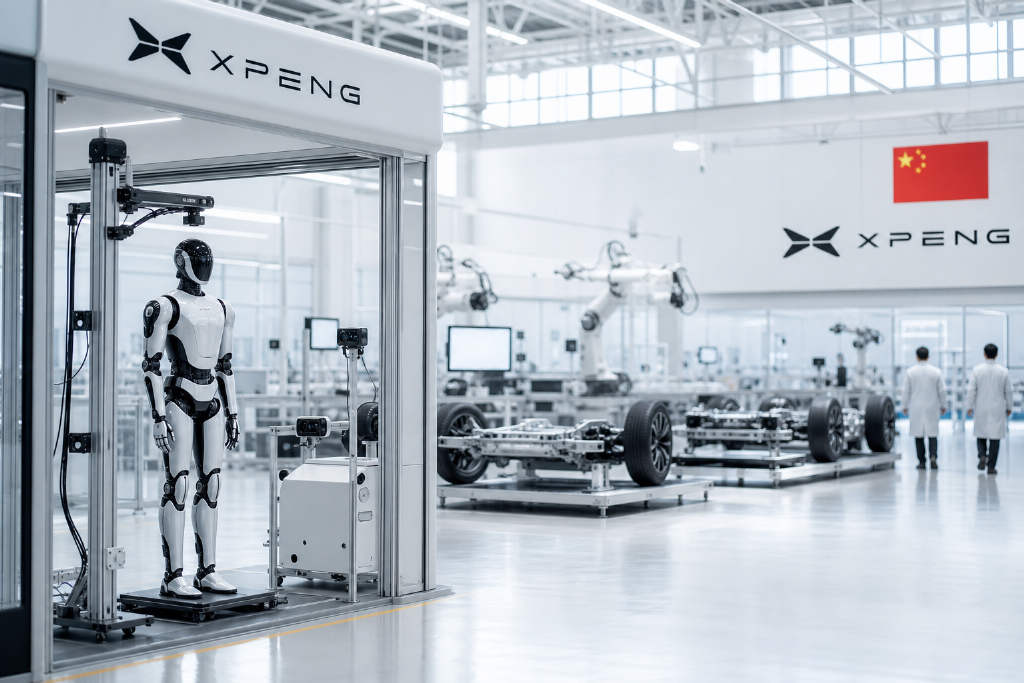
Two developments this week pushed that relationship into sharper view. On Aug. 24, XPeng’s robotics business completed a first funding round of more than $900 million at a post-money valuation above $6.3 billion, setting a record for a single private financing round in China’s embodied AI sector. On Aug. 26, Hyundai Motor used its CEO Investor Day to outline a robotics roadmap that, according to PANews, looked more complete than what many robotics startups have publicly presented.
The shift reflects a broader change in the industry. Robots are moving out of the lab and into a phase where they need to be manufactured at scale, trained over long cycles, placed into real jobs, and eventually sold, financed, and maintained like industrial goods. Once competition reaches that point, the systems the auto industry built over decades start to matter.
As robots move toward mass production, the contest starts to look more like the auto industry’s game
Cars and humanoid robots are both highly complex electromechanical products. Software matters more each year in both categories, but the result still has to be delivered by a physical machine.
In cars, software and control systems ultimately govern braking, steering, and body motion. In robots, model outputs end up as joint movement, grasping, and physical manipulation. A precision error does not stay inside a benchmark forever. It can become a broken part, a halted production line, or a safety incident.
That is why the standard changes when robots approach mass production. A few successful runs, grabs, or lifts can show that a machine is capable of a task. Industrial production asks a different question: can the same motion be repeated thousands of times while keeping precision, reliability, and consistency within acceptable limits?
BMW’s factory testing with Figure offers one example. Figure 02 has operated for about 10 months at BMW’s Spartanburg plant in the U.S., handling sheet-metal parts used for welding. Over that period, the robot logged roughly 1,250 working hours, moved more than 90,000 parts, and participated in the production of more than 30,000 BMW X3 vehicles. BMW highlighted that the task required millimeter-level positioning accuracy.
Executing one millimeter-precision action shows technical capability. Staying stable across tens of thousands of parts begins to resemble the real exam for an industrial product.
The assets automakers can transfer to robotics go well beyond supplier lists. The auto industry has spent decades building a full set of methods for taking complex products from design drawings to large-scale production: design for manufacturability, supplier management, parts standardization, quality control, durability testing, and production systems built around line takt, maintenance efficiency, and traceability.
Hyundai’s production planning for Boston Dynamics robots is one case in point. During CES this year, Hyundai Motor Group laid out how its affiliates are split across the robotics value chain. Hyundai Motor and Kia provide manufacturing infrastructure, process control, and large-scale production data. Hyundai Mobis is responsible for high-performance actuators and uses its experience in automotive parts design and mass production to push standardization and manufacturability improvements in key components. Hyundai Glovis handles logistics and supply chains.
The newest Atlas design makes that automotive way of thinking even more concrete. To prepare for scaled manufacturing, Boston Dynamics sharply standardized actuator assemblies that had previously mapped to more than 50 different motor types, reducing them to three core categories. It also added field-replaceable limbs and automatic battery swapping.
There is little science-fiction polish in those changes. They matter because they determine whether a robot can become a commercial product. Once output reaches tens of thousands of units, every extra custom part introduces new procurement, inventory, inspection, maintenance, and supply-chain risk. Every reduction in repair time raises utilization and lowers operating costs for customers. The jump from dozens of units to tens of thousands magnifies the value of standardization, yield, and serviceability.
If the first round of embodied AI competition was about who could build a robot at all, the next round may be about who can manufacture one reliably at scale. That is where the auto industry has long been strongest.
Autonomous driving left behind more than algorithms. It built Physical AI infrastructure.
Once the robot’s body can be manufactured, the next challenge is more important and more expensive: how to keep its brain improving.
On that front, years of spending in smart vehicles have left some automakers with a sizable inheritance. The development of autonomous driving pushed companies such as Tesla, XPeng, and Hyundai to build real-world AI infrastructure early. Vehicles collect data from real environments. Cloud systems filter valuable cases and failures. Training sets move into compute clusters. Models are trained and validated, then redeployed to vehicles, which generate new data and restart the cycle.
Real world, data, model, deployment, then back to the real world. That loop is also the core mechanism behind Physical AI iteration, and it is one of the biggest technical advantages automakers bring into embodied intelligence.
Hyundai’s latest roadmap put that investment on display. Atria AI will begin collecting real-road data in South Korea this year. Hyundai plans to deploy an L2+ system in 2028 on its first mass-produced software-defined vehicle developed with NVIDIA. From 2029, it plans to activate a 100MW AI data center designed to house more than 50,000 GPUs. Hyundai Group had also previously said it would invest more than $500 million in AI infrastructure and talent and had established Physical AI-related partnerships with Google DeepMind and NVIDIA.
Most of those assets were originally built for the auto business, but they are not fenced off for car training alone. High-performance compute clusters, data engineering platforms, simulation tools, model deployment systems, edge computing capacity, and OTA frameworks are general infrastructure for training and operating Physical AI. Adding robotics is, in effect, like adding a new product line to an AI factory that already exists.
XPeng’s path is more direct. The company has placed VLA 2.0, Robotaxi, and IRON inside a unified Physical AI framework. In the latest robotics financing, model development itself was listed among the intended uses of proceeds. XPeng has also described its advantages as including on-device AI chips, Physical AI foundation models, training compute, and a high-quality closed data loop.
That helps explain why the recent entry of smart EV companies into robotics should not be read simply as a search for a second growth curve. For companies that have already spent years on autonomous driving and built large AI teams and compute infrastructure, robots offer a way to extend Physical AI from machines with four wheels to machines with hands and feet.
That does not mean the transition is frictionless. It does mean that, relative to a startup starting from zero, the costly foundations in data and training do not need to be rebuilt from scratch. Automakers look more like companies that prepaid part of the admission cost, even if they still need to raise hundreds of millions of dollars to keep building data systems, compute, training tools, and model teams.
Automotive factories are turning into training grounds for robots
Once a robot has a body and the infrastructure to train its brain, another question follows: where does the data come from? Here, factories in the hands of automakers become another key advantage.
Manufacturers of many kinds have factories, and PANews notes that Foxconn, Amazon, and large logistics companies are also likely to be major participants in embodied AI. What makes automotive plants different is how neatly they connect to the manufacturing systems and Physical AI capabilities already in place.
For humanoid robots that still lack general-purpose competence, automotive plants are a fitting environment. They are much more complex than labs, but far more controlled than homes or city streets. Workers move around. Parts vary. Processes change. Robots need to perceive the environment and respond. At the same time, workstations, materials, workflows, and evaluation metrics remain relatively stable.
Just as important, auto manufacturing offers a large volume of high-frequency repetitive tasks. Grasping, moving, sorting, assembling, and inspection can be repeated hundreds or thousands of times a day. Whether a motion succeeds or fails, how long it takes, whether a human has to intervene, and whether production rhythm is affected all produce clear outcomes.
That is why a carmaker’s factory is more than an application scenario. It is a machine that continuously produces experience for robots. PANews ties that logic to Figure 02’s work inside BMW’s Spartanburg plant and to Zhiyuan’s cooperation with SAIC, where robots are also being put to work in real production settings.
Zhiyuan and SAIC’s jointly developed "Nengzai No. 1" has already been deployed at the SAIC-GM Ultium Super Factory.
Hyundai has gone a step further by building a dedicated training ground. In June, its Robot Metaplant Application Center, or RMAC, began operating in the U.S., with plans to expand its scale tenfold before year-end. RMAC simulates real production environments so manufacturing robots can complete training, data collection, testing, and validation before entering formal production lines. Hyundai’s closed loop sends real operating data from robots in its Software-Defined Factory back to RMAC for retraining and optimization.
That differs sharply from how many robotics companies have historically developed products. The older pattern was to train capability in the lab and then look for customers. What Hyundai and similar automakers are trying instead is to connect robot R&D, simulation training, real factories, and scaled deployment into one cycle. Before robots are mature enough to sell broadly, the group can serve as the first customer itself.
Toyota, which the article describes as the top name in vehicle sales, has written this advantage directly into its robotics strategy this year. The company said its global factories produce about 10 million vehicles annually and that its skilled workforce and Toyota Production System will be an important foundation for continuous robot learning and improvement. The use cases it has shown so far include parts transport, picking, and medical equipment handling.
This highlights a special position for automakers in embodied AI. If robots are not mature enough, ordinary customers may simply wait. A large automotive group can place robots inside its own controllable factories first, exchange internal demand for deployment scale, and then use data from those deployments to improve the product.
Embodied AI faces an early-stage loop: without customers there is not enough real data, without data progress is slow, and if robots are not mature enough customers hesitate to buy. Automotive factories can open a gap in that cycle.
Robots are starting to look like an asset business
Even if robots can be mass-produced, their models keep improving, and factory deployment is technically proven, one more practical hurdle remains before a large market can form: how to sell them.
That was one of the more notable parts of Hyundai’s investor-day presentation this week. Hyundai Motor CEO José Muñoz did not stop at Atlas’s technical route. He moved all the way to dealers and Hyundai Capital, saying the existing dealer network may eventually take on robot distribution and sales, while the group’s finance arm is studying matching funding plans, with leasing and installment payments among the possible tools.
In other words, Hyundai has started to think about robots as industrial assets that need to be procured, financed, and operated over long periods. If a high-performance robot still costs tens of thousands of dollars in the future, then 500 units would already imply capital expenditure in the tens of millions. After that come deployment, maintenance, software, parts replacement, and downtime losses.
For enterprise buyers, purchase decisions will not be shaped only by what a robot can do. Financing costs, depreciation cycles, maintenance efficiency, software pricing, and residual value calculations matter too. Those factors determine whether robots remain stuck in small pilot programs or enter ordinary capital expenditure budgets in the same way forklifts, servers, and other industrial equipment do.
The auto industry has long dealt with exactly those questions. Global sales networks, enterprise client systems, auto loans and finance leases, service outlets, spare-parts management, residual value, and second-hand circulation are all part of the lifecycle a car faces after leaving the factory.
Hyundai is now trying to transplant that system to robots. Under plans the group had previously disclosed, robots can continue receiving OTA software updates, hardware maintenance and repairs, and remote monitoring after delivery, with a fuller solution later offered through Robotics-as-a-Service.
This layer is easy for the embodied AI sector to overlook. Startups usually spend far more time talking about models, degrees of freedom, and total addressable markets than about service outlets or equipment financing. Once robot sales reach tens of thousands of units a year, those pieces stop being secondary.
XPeng also appears to be moving toward that stage. IRON is planned to enter XPeng stores and campuses first, then be delivered at scale in 2027 to external customers in retail and service in China and overseas. For an automaker that already has manufacturing bases, store systems, overseas channels, and enterprise partnership resources, that commercialization path is plainly shorter than it is for a robotics startup with only an R&D team.
At that point, "automakers entering robotics" means much more than opening another business unit. What they are really bringing into embodied AI is the manufacturing, channels, service systems, finance, and asset-management structure that grew up around the car business.
As robots shift from a single product to thousands of industrial assets that need financing, maintenance, and continuous operation, those capabilities, many of which have nothing to do with the AI label itself, could matter more and more.
Embodied AI may not belong to automakers, but it is becoming harder to separate from the auto industry
None of this means car companies are guaranteed to dominate robotics in the end.
BMW does not need to become Figure, and Mercedes-Benz can keep working with robotics startups. Independent robot makers and foundation-model companies may still emerge as major players, while automakers take on roles more like large customers, manufacturing partners, data providers, and commercialization channels.
What is changing is the industry’s competitive standard. Early in embodied AI, the scarce thing was a robot that could move convincingly at all, so attention naturally flowed to motion control, dexterous hands, and eye-catching demos. As more companies clear that threshold, scarcity and critical bottlenecks move further downstream. Those are also the areas where the auto industry’s moat runs deepest.
Hyundai’s 30,000-unit capacity plan, XPeng’s more than $900 million robotics financing, and the growing investment by BMW, Toyota, and other automakers in production-line robots all point to the same conclusion in PANews’ telling: embodied AI is shifting from a problem for AI labs to a complex industrial engineering project.
Automakers may not be the final winners. But as robotics competition advances into its next stage, the auto industry has already begun to bring the game onto its own field.