
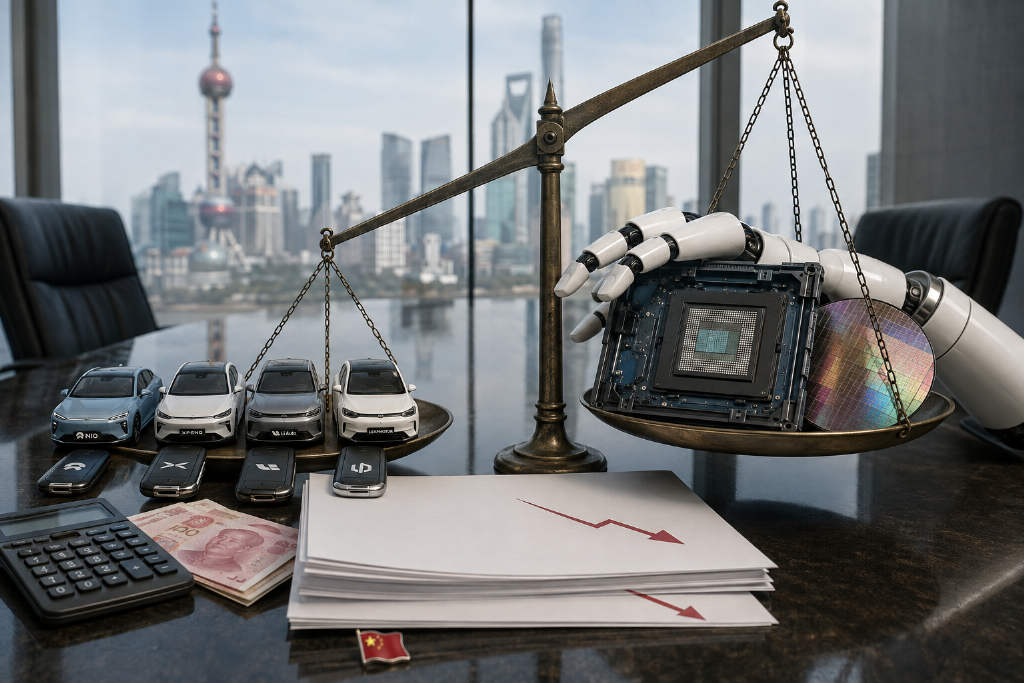
Carmakers are selling more, but the market is worthing them less
"Selling cars is no longer a good business." That was how one investor, who asked not to be named, described the experience of holding auto stocks in 2026 in comments to the reporter from National Business Daily. The investor said losses on those positions had kept mounting, reflecting both frustration with share prices and confusion over how the market now values the auto sector.
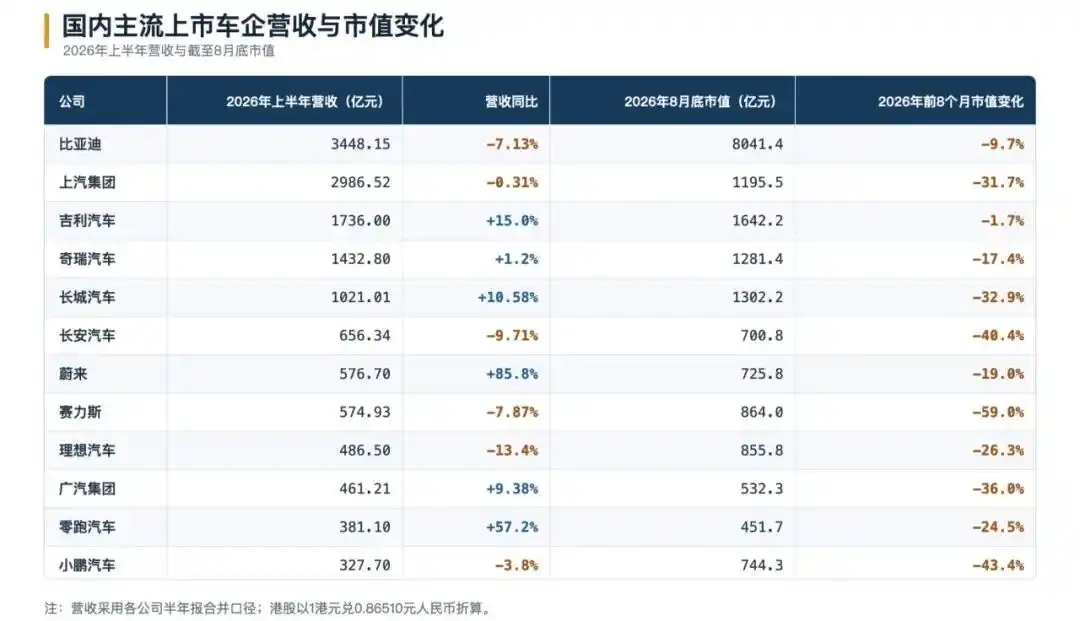
As China’s major listed automakers released their first-half 2026 earnings, a contradiction came into sharper focus. A number of companies still posted growth in sales and revenue, with deliveries reaching into the hundreds of thousands and revenue running into the hundreds of billions of yuan. Yet the stock market was assigning them valuations below those of robotics companies with revenue only in the low billions of yuan, and in some cases below large-model AI companies that are still posting heavy losses.
The mismatch between industrial scale and market capitalization has pushed many carmakers to branch out beyond vehicle manufacturing into areas such as intelligent driving, AI large models and humanoid robotics. Even so, the market is still largely valuing them with the lower-margin yardstick used for manufacturing companies.
Unitree’s valuation came close to the total of NIO, XPeng, Li Auto and Leapmotor
Since the start of 2026, market values for China’s mainstream listed automakers have broadly declined. Data cited in the report showed that as of the end of August, all 12 listed vehicle manufacturers tracked were worth less than they were at the end of 2025. Seres, XPeng and Changan Automobile were down 59.0%, 43.4% and 40.4%, respectively.
What stands out is that the direction of those valuations has not matched operating scale. Among the 12 automakers, six still posted year-on-year revenue growth in the first half. NIO and Leapmotor, for example, reported revenue growth of 85.8% and 57.2%, while their market capitalizations fell 19.0% and 24.5%.
On revenue alone, carmakers are not short of scale. In the first half of 2026, BYD, SAIC Motor, Geely Automobile, Chery Automobile and Great Wall Motor each posted revenue above RMB 100 billion. Looking specifically at NIO, XPeng, Li Auto and Leapmotor, NIO delivered 191,100 vehicles and generated RMB 57.67 billion in revenue; XPeng delivered 166,000 and reported RMB 32.77 billion; Li Auto delivered 193,500 and posted RMB 48.65 billion; Leapmotor delivered 356,500 and recorded RMB 38.11 billion. Together, the four companies delivered about 907,000 vehicles and generated about RMB 177.2 billion in first-half revenue.
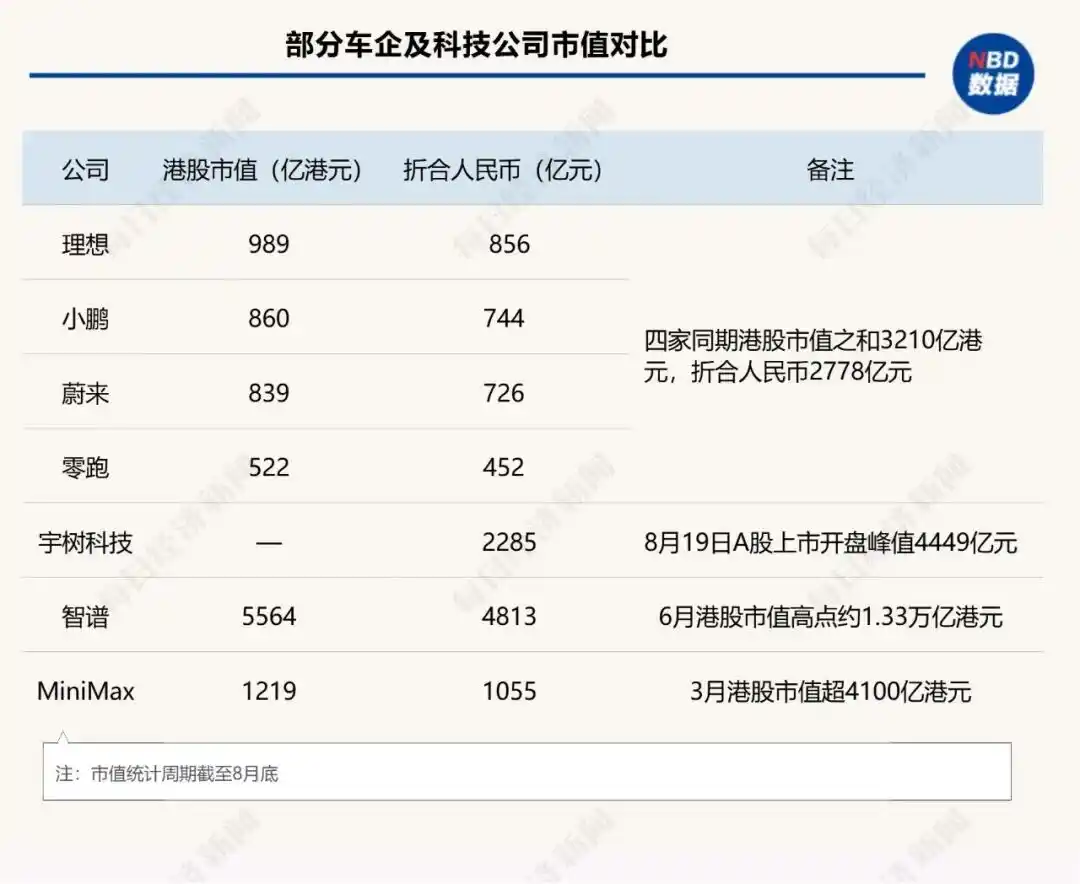
That scale still did not translate into a comparable market value. At the end of August, the four companies had Hong Kong market capitalizations of about HK$83.9 billion, HK$86.0 billion, HK$98.9 billion and HK$52.2 billion, respectively. Combined, that was about HK$321 billion, or roughly RMB 277.8 billion.
By comparison, Unitree Robotics had an A-share market capitalization of about RMB 228.5 billion at the end of August. That was nearly half below its roughly RMB 444.9 billion value at the open on its listing day, but 1.2 Unitree was still roughly equal to the combined value of NIO, XPeng, Li Auto and Leapmotor. Public data cited by the report showed that Unitree generated RMB 1.152 billion in revenue in the first half of 2026, with a gross margin of about 56%. In 2025, it sold 23,000 quadruped robots and 5,215 humanoid robots. Its annual robot volume amounted to only about 3% of the four carmakers’ combined first-half vehicle deliveries in 2026, yet its valuation was about three times that of NIO, XPeng or Li Auto, and five times Leapmotor’s.
Large-model AI companies are also valued more richly
The same pattern appears when AI companies are compared with automakers.
MiniMax posted first-half revenue of $116.6 million, or about RMB 800 million, only around 1/220 of the four carmakers’ combined revenue. Its gross margin was 17.9%, and its adjusted net loss for the same period was $293 million. As of the end of August, it had a market capitalization of about HK$121.9 billion. That was down about 70% from a peak above HK$410 billion in March, but it still stood above several of the four automakers.
Zhipu reported total revenue of RMB 724 million in 2025, while its MaaS API platform had annual recurring revenue of about RMB 1.7 billion as of March this year. At the end of August, its market capitalization was about HK$556.4 billion, down about 58% from a June high of roughly HK$1.33 trillion. The report noted that ARR is not recognized accounting revenue, but it reflects the market’s expectations for future recurring revenue.
Automakers hold a clear advantage in current revenue and product volume. Valuation comparisons almost flip that picture upside down. User counts and token calls at large-model firms are not directly comparable with vehicle deliveries, but the report says the pricing gap is now unmistakable: technology companies are securing higher valuations with much smaller current revenue and shipment scale.
Why investors are discounting automakers
Cao He, president of All-China Automobile Dealer Investment Management (Beijing) Co., told the reporter that there are two main reasons for the drop in carmaker valuations: "one is the broader market, and the other is expectations for the future auto market." The first affects overall risk appetite. The second determines how much investors are willing to pay for auto companies.
Zheng Yun, global senior partner at Roland Berger and head of its automotive business in Asia, summarized the shift this way: "The essence of rising revenue and sales but falling market value is a change in valuation logic: capital markets are moving away from growth premiums and toward pricing based on earnings quality and cash flow." In his view, China’s penetration rate for new energy vehicles is already high, and the industry has moved from incremental growth to competition over existing share. As a result, the marginal return on expansion has fallen.
Zheng said the issue for automakers is not the absence of revenue, but whether incremental sales can bring matching profit and cash flow. Ongoing price competition keeps squeezing per-vehicle profit. At the same time, higher volumes come with rising capital spending, depreciation and channel subsidies. Capacity expansion, new plants and spending on intelligent-driving research also tie up large amounts of capital in fixed assets, inventory and receivables. That can leave some companies with lower net margins even as they expand, and in some cases without positive free cash flow from new business lines.
He argued that if accounting profit does not convert into operating cash flow, revenue scale on its own offers limited support for valuation. Data from the National Bureau of Statistics showed that from January to June 2026, China’s auto manufacturing industry generated RMB 5,189.32 billion in operating revenue, up 1.8% year on year, while total profit fell 19.5% to RMB 195.35 billion. The figures reinforce the pressure behind a "more revenue, less profit" pattern.
Li Auto is one example cited in the report. Using the company’s own disclosure, Li Auto had RMB 87.5 billion in cash reserves as of the end of June 2026. At the end of August, its market capitalization was about RMB 85.6 billion, meaning cash reserves were about 1.02 times its market value. Even so, second-quarter free cash flow was negative RMB 1.3 billion. The article notes that cash reserves and market value are not directly comparable items, but the large cash balance clearly did not generate a valuation premium.
On that point, Zheng said, "Cash is only a safety cushion, not a source of value." A large cash position may show stronger downside protection, but if the core business is weakly profitable, return on invested capital is low, and that cash cannot be deployed into higher-return businesses, the market may still apply a discount and may even see the company as a value trap.
He said investors should not look only at reported cash. They also need to consider actual vehicle gross margin, how well operating cash flow matches net profit, free cash flow, return on invested capital, working capital turnover and cash-use efficiency. Investors are also watching whether per-vehicle profitability and brand pricing power can hold up, whether capital expenditure continues to consume profit, and whether globalization, software and service revenue can be converted into real business results.
Another factor is uncertainty over the future competitive landscape. Zheng said the auto industry is still in an elimination round, and the market cannot yet tell which companies will survive and maintain long-term profitability. Under those conditions, investors are less willing to pay high multiples for what might happen later and more inclined to value companies on visible returns associated with manufacturing.
Robotics companies are being priced with a different framework
Robotics firms are getting a different kind of treatment from the market. Unitree’s revenue base remains small, but its roughly 56% gross margin means that, for each yuan of revenue, it currently retains more gross profit than most carmakers.
UBTech Robotics, a Hong Kong-listed humanoid robot company, reported first-half 2026 revenue of RMB 1.269 billion and a net loss of RMB 339 million. It sold 921 full-size embodied-intelligence humanoid robots in the period. Even so, it still had a market capitalization of about HK$42.7 billion at the end of August.
Zheng said the entire vehicle segment is now priced lower because cars are viewed as a mature hardware manufacturing business, while humanoid robots are defined as the next generation of general-purpose AI hardware. That difference leads the market to assign a richer growth valuation to robotics than to traditional automaking.
Cao added that robotics remains a capital-driven industry at this stage, with broader application areas than automobiles, a longer industrial cycle and room to keep extending into new use cases. Compared with car companies already being valued on visible profit and cash flow, robotics and large-model AI firms are still in an early phase, so capital is more willing to price in future growth space and business models.
Automakers are piling into robotics in search of a new valuation driver
Against this backdrop, automakers’ collective move into robotics is also giving investors a new angle for valuation. Zheng said humanoid robotics and smart vehicles are highly homologous, with an estimated 60% to 70% overlap in relevant technologies and capabilities.
He said autonomous-driving algorithms can be transferred to robots’ environmental perception and motion planning. Carmakers’ mature electric-drive supply chains, million-unit mass-production systems and quality-control frameworks can also help bring robot costs down. Their own factories can then serve as early testing grounds for inspection, assembly and material-handling scenarios.
The article said this view is echoed by McKinsey research, which sees close adjacency between key humanoid robot components and the new energy vehicle supply chain, including motors, harmonic reducers, power electronics, batteries and sensors. In Zheng’s view, carmakers entering robotics is an extension of their existing "physical AI" capabilities into another carrier.
That overlap has also turned auto executives and engineers into an important source of embodied-intelligence startups. According to the report, former executives and technical leads from Li Auto have founded five embodied-intelligence companies: Zhijian Power, Kunlunxing, Xieyue Intelligence, Heyu Robotics (Ngoro) and Wujie Power. Most remain in R&D, product validation or small-batch delivery, with very limited disclosed revenue. Even so, based on public and market financing data, the combined valuation of their latest funding rounds is estimated to be close to half of Seres’ RMB 86.4 billion market capitalization at the end of August.
Some investors see this as proof that capital is willing to price in the combination of "automotive talent + embodied intelligence track" ahead of time, while still requiring listed automakers themselves to prove profit and cash flow first.
Cao said, however, that whether robotics can directly lift an automaker’s own valuation is "a different matter." Robotics is a hot segment in the capital market right now, he said, and compared with the more mature and more clearly bounded business model of the auto industry, it still carries more room for imagination.
Zheng described robotics operations as a kind of "valuation option" for carmakers. Even if they do not contribute profit in the short term, they may change the market narrative around a company, extending it from a vehicle manufacturer toward a "physical AI" or robotics company and opening new valuation room.

XPeng’s separate fundraising for its robotics unit is one example. On Aug. 24, XPeng said its robotics business had raised more than $900 million at a post-money valuation above $6.3 billion, roughly 60% of XPeng’s overall market value at the time. XPeng said in its announcement that standalone financing would allow the robotics unit’s value to be reflected independently, attract investors different from those focused on smart EVs, and secure growth capital without relying on the listed company’s balance sheet.
The article noted that some brokerages have already begun to include robotics value separately in sum-of-the-parts valuations for XPeng, raising the possibility that carmakers may be valued on a combined basis of "cars + robots + Robotaxi" rather than on vehicle manufacturing alone.
Repricing does not mean every robot story deserves a premium
Industry participants cited in the report said that as carmakers expand into robotics, their valuations may need to be revisited. But a reassessment is not the same as mechanically assigning a higher multiple, and it does not mean that releasing a robot product suddenly turns a manufacturing company into a technology platform.
Xiaomi’s recent stock performance was presented as a case in point. The company had previously won platform-style valuation premiums through its "smartphone × AIoT" positioning and its "human-car-home full ecosystem" narrative. Its smart EV, AI and other new businesses also posted their first operating profit of RMB 900 million in 2025. Yet as of the end of August, Xiaomi’s share price was still down by more than half from an intraday high of about HK$60 over the past year. In the first half of 2026, Xiaomi’s total revenue fell 8.4% year on year and adjusted net profit dropped 42.8%. Over the same period, its smart EV, AI and other new businesses generated RMB 44.76 billion in revenue, with a gross margin of about 19.6%. The change fits Zheng’s point that markets are shifting away from growth premiums and toward profit quality and cash flow.
Competition risk in robotics is another factor that cannot be ignored in any revaluation. Public data cited in the article already show signs of falling hardware prices: the average selling price of Unitree humanoid robots dropped from RMB 593,400 in 2023 to RMB 166,400 in 2025. China’s National Development and Reform Commission had also previously warned that there are already more than 150 humanoid robot companies in the country, creating a need to guard against excessive product duplication and squeezed R&D space.
Zheng said low- and mid-end robotics will repeat the kind of price competition seen in autos, and high-end general-purpose humanoids will likely go through part of that process as well, though with a more complicated rhythm and structural differences. Based on his observations, sectors including industrial robots, AGVs and simple wheeled-legged robots have already seen an influx of companies and expanding planned capacity, while real commercial demand remains limited, utilization is low and product prices are falling. Some smaller manufacturers have already been pushed out after sustained losses. In humanoids, he sees similar signs: industrial parks being launched in clusters, many prototypes but few real orders, and planned capacity running ahead of the current market. That could set up a round of consolidation later.
Cao was somewhat more optimistic on whether robotics will fully retrace the auto industry’s path of capacity expansion, price wars and weakening profit. He said the development logic for robotics is not the same as for cars, and its industrial path may not mirror the auto sector exactly.
The core question remains whether carmakers can escape low-margin hardware competition
Zheng said that if automakers want robotics to become a second growth curve, they cannot stop at hardware assembly. They need five core capabilities:
- in-house development of key components and vertical integration;
- a full-stack embodied AI software capability;
- scenario definition and commercial deployment;
- scaled manufacturing and supply-chain management;
- a service-based business model that goes beyond one-off hardware sales.
Among those, he sees full-stack embodied AI software as the most important moat. Scaled manufacturing is the traditional strength of car companies, while real-world scenarios and an ability to generate recurring charges will determine whether they can move beyond low-margin hardware competition.
At the valuation level, the article lays out three areas to watch. The first is the vehicle manufacturing business itself, where the focus is on earnings stability and free cash flow. The second is intelligent-vehicle business lines, where the question is whether driver assistance, cockpit systems, technology licensing and software services can form independent revenue streams. The third is robotics, where investors need to see paying external customers, a closed data loop and recurring service income, along with proof around actual operating hours, failure rates and customer payback periods.
Zheng said that if a carmaker is only reassembling auto parts into a robot, the market will still end up valuing it as a low-margin manufacturer. At the same time, the AI teams, supply chains, quality control systems and scaled manufacturing capabilities already built by car companies are exactly what robotics firms need to move from the lab into real operating environments. In his view, the market should neither assign a blanket premium to every robot narrative nor ignore the companies that can convert capabilities built in the automotive era into new products and new revenue.
That leaves two key questions for any real repricing of carmakers. Can the core auto business generate stable free cash flow and show that expansion no longer comes at the expense of profit? And can AI and robotics businesses move beyond key components and full-stack software to find validated use cases, external revenue and recurring service models? The first question determines whether the company can operate on a stable footing. The second determines whether it can win growth room beyond the limits of traditional manufacturing.
The article’s conclusion is that the real dividing line is not whether an automaker has a robot product, but whether those investments can be turned into sustained profit and cash flow. If the core car business stabilizes earnings and the robotics unit develops real orders, data accumulation and service revenue, then the company may eventually break out of the valuation framework applied to pure vehicle manufacturing. If not, and the effort stays at the level of concept showcases and one-time hardware sales, the extra business may bring only short-term imagination rather than a lasting reset in value.
The original article was published by the WeChat account "Meijing Toutiao," written by Sun Lei and edited by Zhang Jinhe, Yu Tingting and Du Hengfeng.