
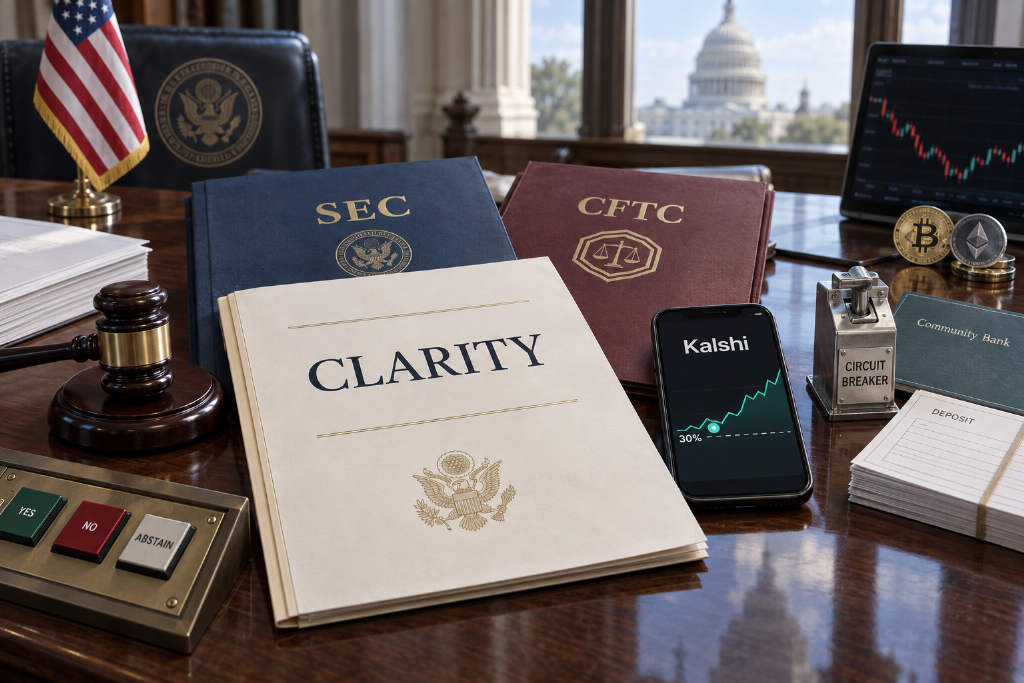
Bernstein said in a report dated Sept. 14, 2026 that the probability of the CLARITY Act passing on prediction market Kalshi has recovered to above 30%. A week earlier, most client conversations had assumed the bill would fail. According to the firm, the latest Senate Republican draft made meaningful concessions on Trump-related ethics language and added a “new circuit breaker” provision designed to address concerns about deposit outflows from community banks. That leaves market positioning built around failure exposed to a potential reversal.
What the CLARITY Act is meant to do
The CLARITY Act, short for the Digital Asset Market Clarity Act, is intended to establish a federal regulatory framework for the U.S. cryptocurrency market. As described in the report, the bill would draw the line between the authority of the U.S. Securities and Exchange Commission, or SEC, and the U.S. Commodity Futures Trading Commission, or CFTC. It would also define registration and compliance obligations for digital commodity exchanges and set rules around stablecoin yield.
In Bernstein’s framing, the bill is about giving the crypto industry a formal rulebook. Whether it passes or not will shape how much regulatory certainty the market gets and how that certainty is delivered.
Bernstein analyst Gautam Chhugani laid out three core views in the report. First, the latest ethics concession appears close to the limit of what Democrats can extract. Second, no CLARITY would amount to the worst outcome, including for bank lobbying groups. Third, with the midterm elections approaching, some Senate Democrats may be sensitive to being portrayed as anti-crypto.
Bernstein says ethics concessions may be near the ceiling
The report said most client discussions last week were based on the assumption that CLARITY would fail, leading investors to think SEC and CFTC rulemaking would follow. Bernstein said the bill has long sat in the “too close to call” category, with the political backdrop around Trump ethics provisions acting as the main variable. In its view, the White House’s latest proposal may represent the most Democrats can secure on that issue.
Beyond crypto asset divestment and blind trust conditions, the White House has agreed to give state attorneys general an enforcement role on the ethics language, according to the report. Bernstein said that could be enough to bring at least a small number of Democrats on board in Tuesday’s procedural vote and preserve room for last-minute negotiation before a final vote. The bill needs 60 votes to advance. Republicans hold 53 Senate seats, so at least seven Democratic senators would need to support it.
Failure would not remove the underlying pressure points
Bernstein said the CLARITY bill has gone through marathon bipartisan negotiations that touched on stablecoin yield, ethics wording, community bank concerns and DeFi market structure. Multiple interest groups and lobbying organizations have been involved. Bank lobby groups have focused most closely on how stablecoin yield could affect community banks, and at minimum want guardrails around their central concerns.
The firm argued that if CLARITY fails, the status quo may be worse. Third-party platforms could continue offering full yield on idle stablecoin balances. In a potential banking crisis, deposits moving into stablecoins that increasingly resemble deposit substitutes would face no guardrails. Even if the bill passes, the market would not change overnight. The legislation provides for a 360-day implementation period after enactment.
Midterm politics could matter in the vote
Bernstein also pointed to election pressure. As the midterms get closer, some Senate Democrats may face political risk if they are tagged as anti-crypto. The report said crypto lobbying groups have supported candidates from both parties over the last several election cycles, and that their funding base is large enough to create pressure in competitive districts. For Democratic senators seeking reelection, alienating a well-funded single-issue voting bloc may not be attractive.
That pressure, Bernstein said, could push a small number of Democrats toward a yes vote in the procedural round, keeping the bill alive. As the election window narrows, crypto policy is becoming a practical issue in some constituencies rather than a purely abstract one.
A crowded catalyst week for markets
Bernstein said this week is packed with catalysts: a procedural vote on Tuesday and a Federal Reserve rate decision on Wednesday. A hawkish Fed combined with a CLARITY failure would lead to a sharp pullback, the report said, while current market positioning is skewed bearish. In Bernstein’s view, any positive surprise has not been priced in.
The firm said both crypto-native markets and crypto-linked equities could see large moves depending on the outcome. It added that if CLARITY fails, SEC and CFTC would move toward writing rules on their own. If crypto stocks were to sell off hard first on that outcome, later rulemaking could still provide enough clarity to support a recovery in share prices.
Company ratings and price targets in the report
Bernstein rated Circle (CRCL) outperform with a $140 price target. It rated Coinbase (COIN) outperform with a $330 target, Figure (FIGR) outperform with a $70 target, Robinhood (HOOD) outperform with a $160 target, Strategy (MSTR) outperform with a $350 target, and Sharplink (SBET) outperform with a $24 target. Bullish (BLSH) was rated market-perform with a $50 target.
As of the Sept. 11, 2026 close, Circle was at $90.60, Coinbase at $175.26, Figure at $34.87, Robinhood at $112.57, Strategy at $130.97, Sharplink at $8.88, and Bullish at $35.12.
The regulatory path still hinges on the vote
If CLARITY passes, the crypto industry’s regulatory framework would take effect 360 days later. If it fails, the next question becomes where SEC and CFTC rulemaking goes from there and who, if anyone, can price that path in ahead of time.
This article is based on a整理 and interpretation of a third-party broker research report from Bernstein dated Sept. 14, 2026, together with public market information. The ratings, price targets, earnings forecasts and related judgments cited are the views of that broker’s analysts and represent the position of their institution only. They do not constitute investment advice. Market risk remains, and decisions should be made independently. This article should not be used as the basis for buying or selling any security.