
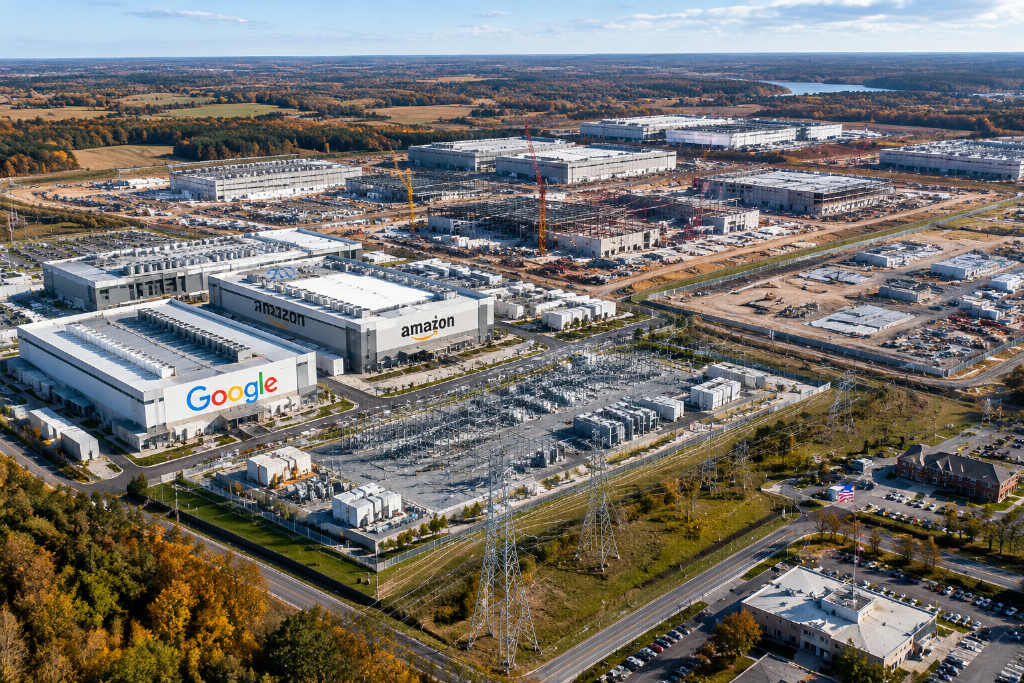
Bernstein said in an Oct. 11, 2026 U.S. industrial and technology report that the data center project pipeline reached 456 GW in September, up from 404 GW in August. That was a monthly increase of 52.2 GW, or 13%, with the total up 173% year over year and 82% year to date. Rolling 12-month pipeline additions came to 289.1 GW.

The firm said pipeline growth was being driven mainly by developers and hyperscalers. At the same time, it said demand tied to AI data center construction was still expanding, while local opposition and permitting constraints were also building.
Developers and hyperscalers led the monthly increase
Hyperscaler pipeline capacity stood at 68.7 GW, up 10.1 GW on the month. Google added 3.9 GW, Amazon added 3.8 GW, and Meta added 2.4 GW.
Developers accounted for 38% of the pipeline and added 24.6 GW in the month. Colocation providers made up 12% and added 7.6 GW. Bernstein said developers and hyperscalers were the main sources of pipeline growth in September.
Behind-the-meter, or BTM, projects reached 192.5 GW, up 29 GW in the month, a gain of 18%. BTM represented 42% of the total pipeline, up from 39% at the start of the year. Bernstein said developers had the highest reliance on BTM, with 60% of their pipeline in that category, while emerging cloud providers were at 58%.
By geography, Texas had 116 GW of pipeline capacity, nearly three times the level of the second-ranked state. Utah posted the largest monthly increase at 10.8 GW. Texas added 7.9 GW in the month, below the 14.5 GW added in August.
Capacity under construction rose to 79.9 GW
Capacity under construction increased from 72.9 GW in August to 79.9 GW in September, up 7 GW, or 10%, on the month. It was up 153% from a year earlier, and rolling 12-month additions totaled 48.4 GW.
Hyperscalers had 31.4 GW under construction, up 3.4 GW in the month. Google added 2.1 GW and Microsoft added 1 GW, while Amazon fell by 0.3 GW and Meta fell by 0.1 GW. Colocation providers added 1.4 GW under construction, emerging cloud providers added 1.1 GW, and developers added 0.9 GW.
Texas had 20 GW under construction and added 3.4 GW in the month, above the 1.9 GW added in August. Virginia had 9 GW under construction, and Ohio had 5 GW.
At the current pace of construction, Bernstein estimated it would take 13.3 years to absorb the 456 GW pipeline, slightly longer than the 13.1 years estimated a month earlier.
Within capacity under construction, hyperscalers accounted for 39%, colocation providers 29%, and emerging cloud providers 9%. Amazon, Google and Meta together represented 80% of hyperscaler capacity under construction.
Shelved capacity hit a record as more states weighed restrictions
Shelved capacity rose from 49.6 GW in August to 51.7 GW in September, up 2.1 GW on the month and 186% from a year earlier. Shelved projects accounted for 11% of the total pipeline, unchanged from the prior month, and set a record high.
Bernstein said 27 states were restricting or considering restrictions on new data center construction, up from 25 in the previous month. About 70% of pipeline and under-construction capacity is located in states with gubernatorial elections in 2026. If public sentiment continues to worsen, the report said, capacity at risk of suspension could come close to doubling.
Within shelved capacity, developers accounted for 32%, colocation providers 16%, hyperscalers 10%, and undisclosed projects 38%. BTM projects made up 25% of shelved capacity, up from 16% in May.
Bernstein estimated the electrical equipment TAM
Using the current pipeline and a $5 million per megawatt opportunity, Bernstein estimated the total addressable market for electrical equipment tied to data centers. It put Quanta Services (PWR) at $684.3 billion, Vertiv (VRT) at $164.2 billion, Schneider Electric at $121.8 billion, Eaton (ETN) at $106.7 billion, and ABB at $91.2 billion.
On positioning, Bernstein maintained outperform ratings on Eaton, Hubbell, Quanta Services, Legence, Jacobs, Forgent, Trimble and United Rentals. Its price targets were $534 for Eaton, $584 for Hubbell, $775 for Quanta Services, $103 for Legence, $163 for Jacobs, $48 for Forgent, $73 for Trimble, and $1,317 for United Rentals.
Consensus expectations cited in the report show hyperscaler capital expenditure at $771 billion in 2026, up 87% year over year. For 2027, the figure is expected to rise 40% to $1.1 trillion. Bernstein said demand for electrical equipment is being driven by data center construction, with orders and backlog remaining solid.
The firm said it favors the electrical equipment segment, naming Eaton, Quanta Services and Vertiv among the main beneficiaries. It also said strong pipeline growth is being offset by rising shelved capacity and state-level restrictions as the main risks, while order visibility supports growth over multiple years.
Source note
This article is based on a summary and interpretation by Chaoxiang Research of a third-party brokerage report from Bernstein dated Oct. 11, 2026, combined with public market information. The ratings, price targets, earnings forecasts and related views cited are those of Bernstein analysts and represent the position of their institution, not that of Chaoxiang Research or TechFlowPost, and do not constitute investment advice.
The original article also said that markets involve risk, decisions should be made independently, and the material should not be used as the basis for buying or selling any security.




