Microsoft2026-09-22 08:31:12Goldman Sachs Keeps Buy Rating on Microsoft, Says AI Margins Can Move Closer to Cloud LevelsGoldman Sachs reiterated a Buy rating on Microsoft in a Sept. 20, 2026 NDR note and kept the stock on its Conviction Buy List, with a 12-month price target of $640. Based on the cited current price of $493.78, the implied upside is 29.6%. The bank said Microsoft’s enterprise AI platform transition is starting to validate strategic decisions made over the past three years, including early long-duration capital spending, balanced allocation between first-party applications and third-party customers, and a measured split between frontier labs and enterprise workloads. The note argues Microsoft’s control over supply chain execution and capacity ramp has improved versus a year ago. Long-duration capex has fallen to about 33% of total capex from roughly 50%, while CPU has replaced GPU as the largest component of short-duration capex. Goldman also highlighted a $51 billion quarter-over-quarter increase in fourth-quarter remaining performance obligations, all of which came from enterprise customers outside frontier labs. On profitability, Goldman said there is no structural reason AI gross margins cannot approach cloud gross margins over time. The bank also pointed to Microsoft’s silicon, model and software strategy, including MAIA, Jalapeno, MAI models, Foundry’s 11,000 hosted models, and the company’s view that changes in frontier model progress do not alter current demand signals driving capex.510
TrendForce2026-08-26 06:59:19TrendForce says memory could take 68% of major cloud providers’ capex by 2027A new TrendForce report says DRAM and NAND Flash are on track to account for 68% of total capital expenditure by major cloud service providers in 2027, overtaking GPUs and other server components as the biggest cost center in the AI buildout. The report projects capex by hyperscalers including Amazon, Microsoft, and Google will rise 98% in 2026 and another 50% in 2027, with memory contract prices driving much of the increase. Server DRAM prices rose 64% in the second half of 2025 and are expected to climb another 270% in 2026, while enterprise NAND Flash increased 35% over the same period and may jump a further 235% in 2026. TrendForce also said HBM prices could still rise 70% to 140% in 2027 even where long-term agreements cap part of the pricing. The report argues that memory vendors are gaining more pricing power across the AI supply chain, while cloud providers may have to choose between spending more, passing costs to customers, reducing memory configurations, or shifting to in-house AI ASICs.1570
Alibaba2026-08-23 11:44:58Alibaba plans $10.2 billion AI raise as server price hikes start testing capexAlibaba said on Aug. 23 that it plans to place newly issued ordinary shares to investors outside the United States for total consideration of HK$80 billion, or about $10.2 billion, with all net proceeds earmarked for full-stack AI capabilities, including expanded and upgraded AI infrastructure. The company said the deal would be the largest primary follow-on offering ever by a Hong Kong-listed company, though completion remains subject to market conditions and other factors. The financing headline landed alongside a broader set of signals on AI spending. Bloomberg reported that some major NVIDIA customers have been told that servers using the company’s AI chips will, in many cases, cost more than 15% extra starting in early 2027, with Vera Rubin and Grace Blackwell systems affected and pricing dependent on chip generation and memory configuration. The report said higher memory chip costs are driving the increase. Elsewhere, Brazil said it will commit about $444 million to expand domestic AI compute capacity, while Japan’s semiconductor equipment makers posted roughly $3.5 billion in July sales, up 35.4% year over year. Taken together, the developments point to continued expansion across corporate financing, sovereign compute projects, and upstream semiconductor investment, even as rising component costs begin to pressure the economics of AI infrastructure.1290
Citi2026-08-13 09:44:52Citi keeps Buy/High Risk rating on Nebius, says capacity timing remains the key constraintCiti said in its latest report that Nebius is not facing a demand problem, but a capacity ramp timing issue, and it maintained a Buy/High Risk rating with a $278 price target. The bank pointed to strong second-quarter revenue, driven by asset SLA revenue, Token Factory, Tavily, higher utilization, and on-demand demand. Management said demand remains very strong, with multiple buyers behind every GPU, while backlog growth has come from larger average order sizes and more mid-term contracts in the core AI cloud business. Citi also highlighted that roughly 50% to 60% of Nebius’ infrastructure capital expenditure is supported by customer prepayments. On a cash basis, project payback can come in at under one year, around 10 months, which the bank said helps ease concerns about funding pressure in the neocloud model. Still, Citi said the real test will come in the second half, when signed capacity starts moving toward deployment and revenue recognition. Nebius expects most contracted capacity to come online in the second half of 2026, with Microsoft-related deployments following a similar timeline. Citi added that the company’s 800MW to 1GW connected power target remains achievable, though converting that into active power still requires network testing, integration, and commissioning. The bank also flagged customer concentration, heavy capex, GPU supply, and financing conditions as key risks.1290
CoreWeave2026-08-13 00:16:10CoreWeave shares jump about 15% after earnings as capacity ramps and margins start to recoverCoreWeave reported fiscal 2026 second-quarter results after the U.S. market closed on Aug. 12, with its stock rising about 15% in after-hours trading. The quarter was not described as a major beat on headline revenue, which came in at nearly $2.58 billion, up 112% year over year and roughly in line with expectations. What stood out instead was the change in operating trends: active power reached 1,500MW, a net addition of 500MW from the prior quarter and well above market expectations of 250MW to 300MW, while capital expenditure climbed to $9.4 billion as deployment accelerated. The report also pointed to an early recovery in profitability. The article said CoreWeave’s “real” gross margin, defined there as revenue minus cost of revenue and Tech & Infra expense, rose to 7.3%, up 3 percentage points from the prior quarter’s low. Adjusted operating margin improved to 5% from 1%. Meanwhile, net debt approached $27.3 billion, but debt ratios and average borrowing costs moved lower on a relative basis. Management also said it had locked in more than $14 billion in cumulative equity and debt funding sources. Guidance remained central to the bullish reaction. Based on the midpoint, next-quarter revenue is expected to reach $3.53 billion, implying 158% growth, while adjusted profit is guided to $230 million. The company also raised its full-year fiscal 2026 outlook, with the article calculating implied fourth-quarter revenue at $4.3 billion to $4.9 billion and adjusted operating profit at $610 million to $740 million.1640
SpaceX2026-08-05 02:16:31SpaceX shares reverse after earnings as AI revenue tops space business but spending surge hits stockSpaceX shares swung sharply after its latest earnings report. The stock finished regular trading up 9.43% at $125.33, then fell more than 8% in after-hours trading, briefly dropping to about $114.6. The report showed that quarterly AI revenue reached $2.561 billion, topping the company’s space business revenue of $962 million by more than 2.6 times. Total revenue came in at $7.814 billion, above the market expectation of $6.93 billion, while AI revenue also beat analysts’ estimate of $2.18 billion. The problem for investors was not the top line. Capital expenditure surged to $18.37 billion, far above the roughly $13.22 billion analysts had expected, with $15.83 billion of that tied to AI investment. According to the report, SpaceX has been expanding its compute leasing business after redirecting data center capacity that had originally been intended for Grok. The company also said it had agreed to acquire coding tool Cursor. SpaceX currently divides its business into space, AI and connectivity, with Starlink generating $4.2 billion in revenue and remaining the only consistently profitable segment.1790
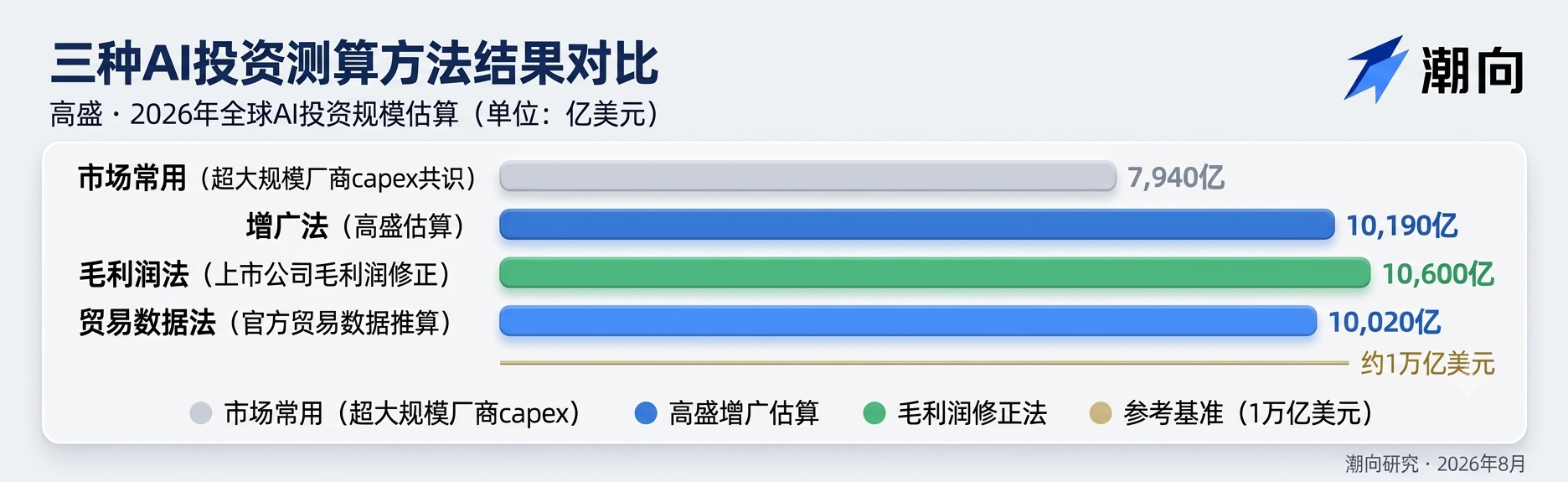
Goldman Sachs2026-08-04 02:32:35Goldman Sachs Puts 2026 Global AI Investment at $1.019 Trillion, Above the Market’s $800 Billion BenchmarkGoldman Sachs said in an Aug. 2 global economics report that the market’s commonly cited $800 billion figure for 2026 hyperscaler capital expenditure understates the scale of worldwide AI investment and overstates how much of that spending is actually taking place in the United States. After adjusting for private companies, non-U.S. firms, pre-existing spending and the geographic split of projects, the bank estimated 2026 global AI investment at roughly $1.019 trillion, including about $581 billion in the U.S. The report said the widely used benchmark misses around $200 billion of global AI investment while overstating U.S. domestic AI investment by roughly the same amount. Goldman also used two separate cross-checks — one based on forecast revisions to gross profits at AI-related listed companies, and another based on national accounts and trade data — and said the results converged around the same conclusion: global AI investment is nearing $1 trillion and U.S. AI investment is close to $600 billion. Looking ahead, Goldman expects AI investment to rise as a share of GDP. It projected the ratio for the U.S. at 1.8% in 2026, 2.5% in 2027 and 2.8% in 2028. For the world economy, it forecast 0.9%, 1.3% and 1.4% over the same period.1940
Citi2026-08-03 02:03:42Citi says cloud giants are monetizing AI faster than capex is risingCiti said in a July 31 research note that second-quarter data from Microsoft, Amazon, Google and Oracle is challenging a market narrative that heavy AI infrastructure spending would crush profit margins. The four cloud vendors posted a combined $103.8 billion in quarterly revenue, up 50% year over year, accelerating from 41% in the prior quarter. According to the note, revenue growth is now outpacing the rise in capital expenditures, suggesting that AI investment has moved beyond a pure cash-burn phase. Azure revenue growth accelerated to 43%, AWS to 37%, Google Cloud to 82%, and Oracle Cloud Infrastructure to 92%. Citi also highlighted improving monetization metrics, including AWS AI annualized revenue rising from $15 billion to $25 billion in one quarter and Google reporting token usage growth of 37.5% quarter over quarter to 22 billion per minute. The bank kept Buy ratings on Microsoft, Amazon, Google and Oracle, with price targets of $600, $350, $447 and $330, respectively. Citi argued that operating leverage is helping offset pressure from depreciation and expansion, while growing backlog at AWS, Google Cloud and Microsoft points to sustained AI demand and stronger revenue visibility in coming quarters.2970