

CoreWeave reported fiscal 2026 second-quarter earnings after the U.S. market closed on Aug. 12, and its shares rose about 15% following the release. The quarter did not appear to be a major surprise on headline numbers, but investors focused on faster infrastructure deployment, improving margins and guidance that continued to point to rising growth and profitability.
Revenue kept expanding, but the quarter was broadly in line
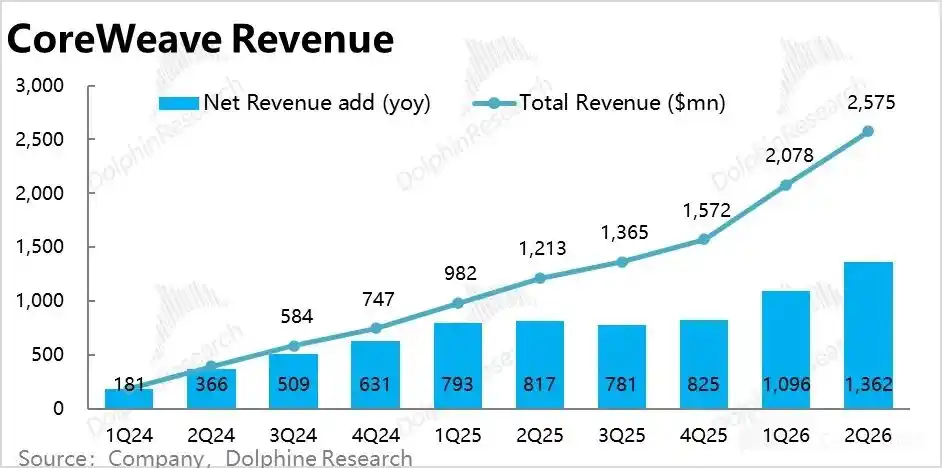
CoreWeave posted nearly $2.58 billion in total revenue for the quarter, up 112% year over year, with an incremental increase of nearly $1.4 billion. The article said growth continued to accelerate, though the result came in slightly below the upper end of the company’s prior guidance and was broadly in line with market expectations.
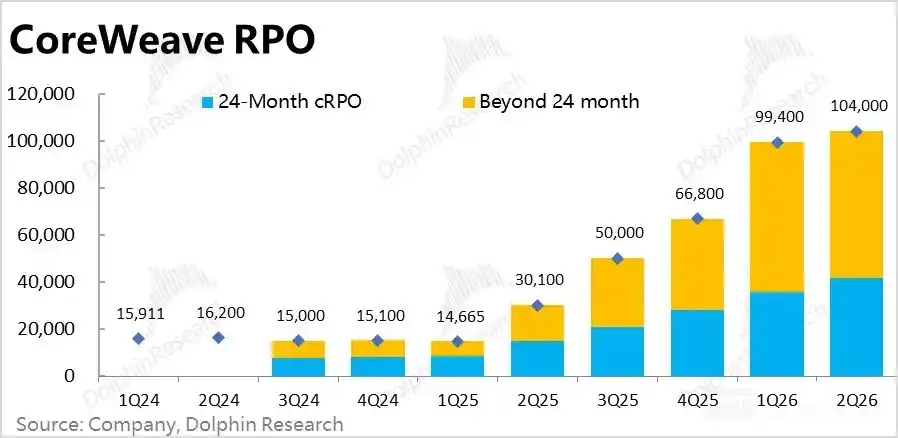
Remaining performance obligations, or RPO, stood at $104 billion at the end of the quarter, up only $4.6 billion from the prior quarter. With no recent public reports of major new contract wins, market expectations for RPO growth had already been restrained. The article noted that some investment banks had been looking for about $100 billion, leaving the reported figure slightly below those forecasts.
CoreWeave also disclosed that roughly $25 billion in new contracts had been signed so far in the third quarter, suggesting a rebound in booking momentum.
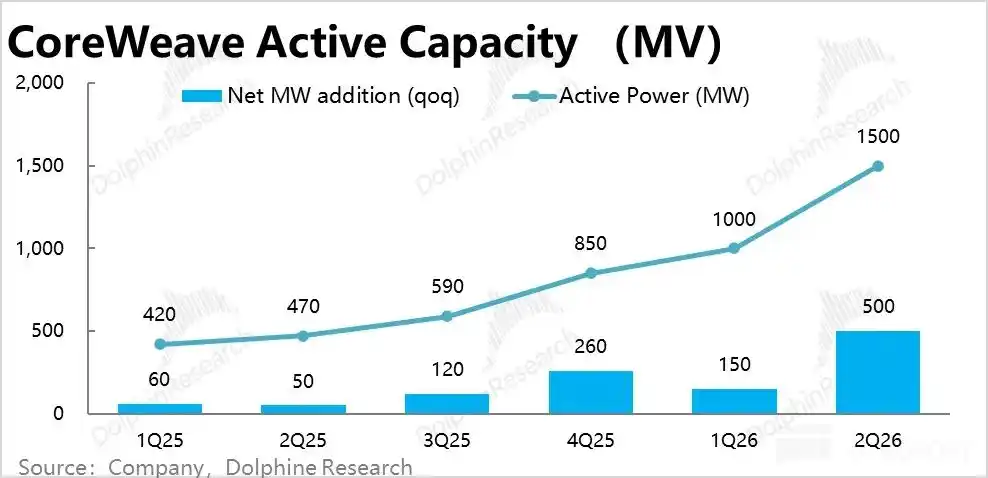
Active power reached 1,500MW as deployment sped up
One of the most closely watched operating metrics was active power. CoreWeave ended the quarter at 1,500MW, a net sequential increase of 500MW, marking a record high and coming in well above market expectations of 250MW to 300MW.
The article said one of the market’s main concerns in the prior quarter had been the pace of power coming online, which fed doubts about execution. This quarter’s increase was presented as a direct response to that concern. As a leading indicator, the faster rollout was also seen as pointing to a much quicker revenue ramp in the quarters ahead.
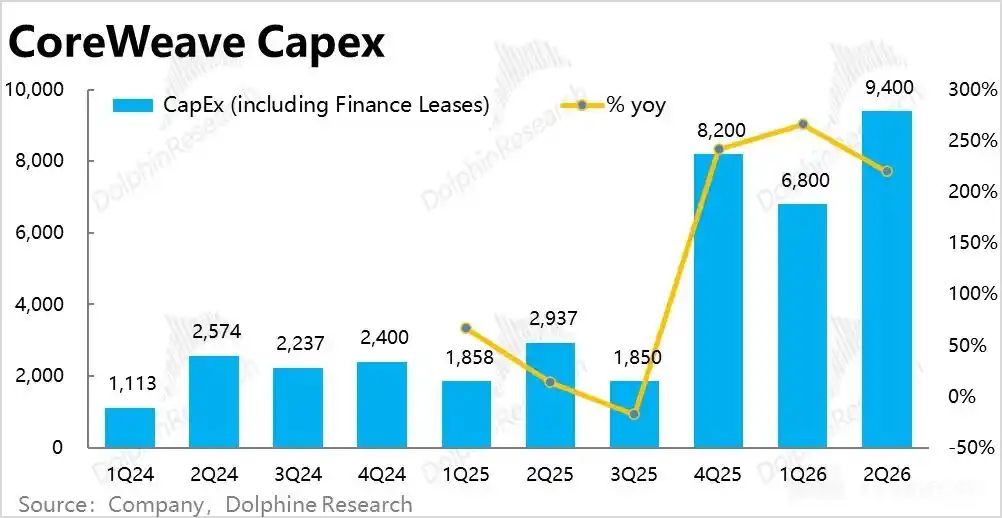
Capital expenditure matched that faster buildout. Capex totaled $9.4 billion in the quarter, up $2.6 billion sequentially, another record and well above market expectations of $7.96 billion.
According to company guidance cited in the article, next-quarter capex is expected to rise again to between $11.5 billion and $13.5 billion. The article said part of that increase may reflect higher hardware prices, but it also implies that even more power could come online next quarter. Based on the full-year outlook, fourth-quarter capex may fall back below $10 billion.
Margins showed signs of turning up
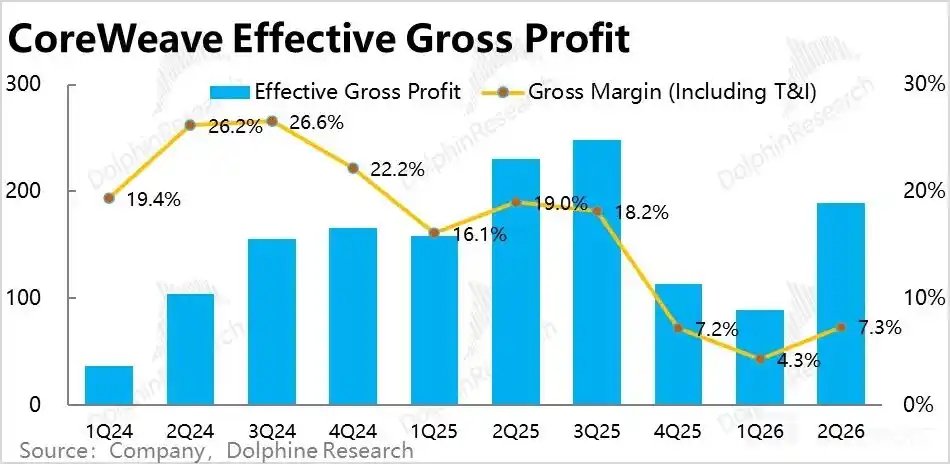
As revenue scaled, CoreWeave’s profitability metrics began to improve. The article used a “real” gross margin measure, defined as revenue after cost of revenue and Tech & Infra expense. On that basis, gross margin reached 7.3% in the quarter, up 3 percentage points from the prior quarter’s trough.
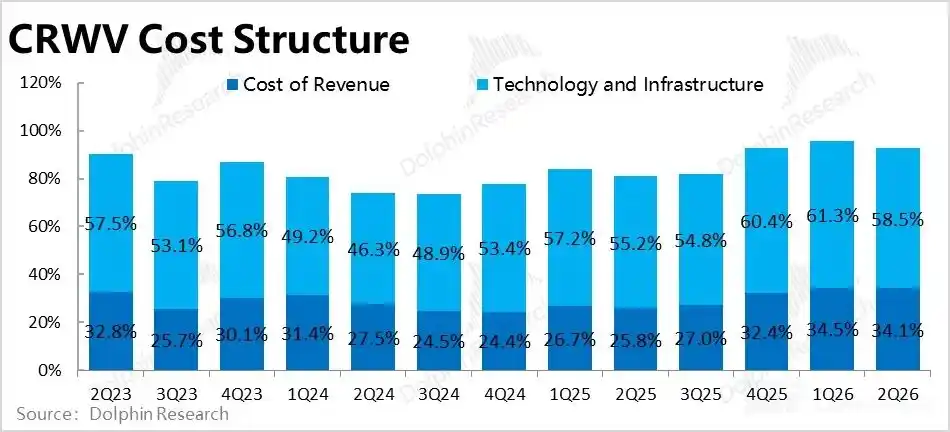
Depreciation and amortization, the company’s largest single cost item, came in at $1.39 billion, up 149% year over year. That represented 54.1% of revenue, down 1.1 percentage points from the previous quarter. The article said this suggested the depreciation burden was beginning to be diluted by stronger revenue scale.
At the same time, selling, marketing and administrative expenses grew at a slower pace, allowing those cost ratios to continue falling as revenue expanded. The quarter added about 0.3 percentage points of margin improvement on that basis, according to the article. Stock-based compensation as a share of revenue also fell by about 1 percentage point sequentially.
With those factors combined, adjusted operating margin reached 5% in the quarter, up from 1% in the prior quarter. The article said that was consistent with management’s earlier indication that the first quarter would mark the low point for margins.
Net debt rose to nearly $27.3 billion, while relative debt pressure eased
Because CoreWeave is investing at a pace far above the cash flow it currently generates, funding access remains central to the business model. At the end of the quarter, net debt was close to $27.3 billion, up by about $6.6 billion from the previous quarter. That was still an increase, though smaller than the prior quarter’s rise.
Debt as a share of total assets stood at 37%, down from 39% in the prior quarter. Interest expense climbed to $640 million from $540 million, but interest expense as a share of revenue fell from 26% to 25%, and the average interest rate on debt declined from 9.2% to 8.5%.
The article’s conclusion was that debt pressure and the drag from financing costs were easing on a relative basis. During the earnings call, the company also said it had secured more than $14 billion in cumulative equity and debt funding sources to support investment over the coming quarters.
Guidance still pointed to faster growth ahead
Beyond the quarter itself, the company’s outlook remained a major part of the market response. Based on the midpoint of guidance, next-quarter revenue is expected to reach $3.53 billion, which would imply 158% growth and represent a further acceleration from the current quarter in both absolute dollars and growth rate.
Adjusted profit for next quarter was guided to $230 million, implying a 6.5% margin. That profit figure was slightly below the market expectation of $260 million cited in the article, but the implied margin would still improve from the current quarter.
CoreWeave also raised its full-year fiscal 2026 guidance again. The article calculated implied fourth-quarter revenue at $4.3 billion to $4.9 billion, with midpoint year-over-year growth of 194%, showing another step up from the third quarter.
Adjusted operating profit for the fourth quarter was estimated at $610 million to $740 million, implying a 14.6% margin. The article said that trajectory suggested a rapid climb in profitability, bringing a 25% to 30% margin target much closer into view.
Other factors highlighted in the article
The piece also pointed to a recent rebound in risk appetite across parts of the technology sector. It cited share-price reactions in companies including Shopify, Airbnb, Sea, Unity and Palantir after better-than-expected earnings, saying gains of 10% and even 15% to 20% had not been unusual. In that context, CoreWeave’s roughly 15% after-hours move was described as not especially extreme for a high-beta name.
The article added that cloud companies had previously come under pressure because they were carrying much of the capex burden while also absorbing higher prices for hardware such as memory, which fueled concerns over return on investment. That left cloud providers broadly on the short side of pair trades, with newer cloud names hit even harder. It said sentiment has shifted again after cloud growth at Microsoft and Amazon accelerated more than expected and AI cloud margins appeared better than feared.
Two company-specific developments were also highlighted. First, CoreWeave said that after July it broadly raised pricing across its product lines by 25%, with part of the increase meant to offset rising hardware costs. Second, beyond directly renting out hardware through a bare-metal model, the company has begun offering a TaaS-like service called Managed Inference, under which models are deployed on servers and made available to users through APIs. The article said margins for this kind of service are materially higher than for bare-metal rentals.
The article’s longer-term view
The original piece said the main positive takeaways from the quarter were the much faster-than-expected buildout of computing capacity and the emerging benefit of scale, which is starting to dilute depreciation, operating expenses and interest costs. On that reading, gross margin and operating margin have begun to rebound from their lows, while the company’s investment payback profile is improving.
It also argued that the latest guidance supports the same direction, with revenue growth still accelerating and margins still moving higher.
At the same time, the article cautioned that the long-term competitive outlook for newer cloud providers remains uncertain. Once the current phase of constrained supply passes, the basis of competition may shift from who can deliver capacity fastest to who can offer better service at a lower price. In that setting, the end-state for new cloud vendors is still unclear.
The article was originally published by the WeChat account Haitun Touyan, authored by Haitunjun, and republished by MarsBit.