
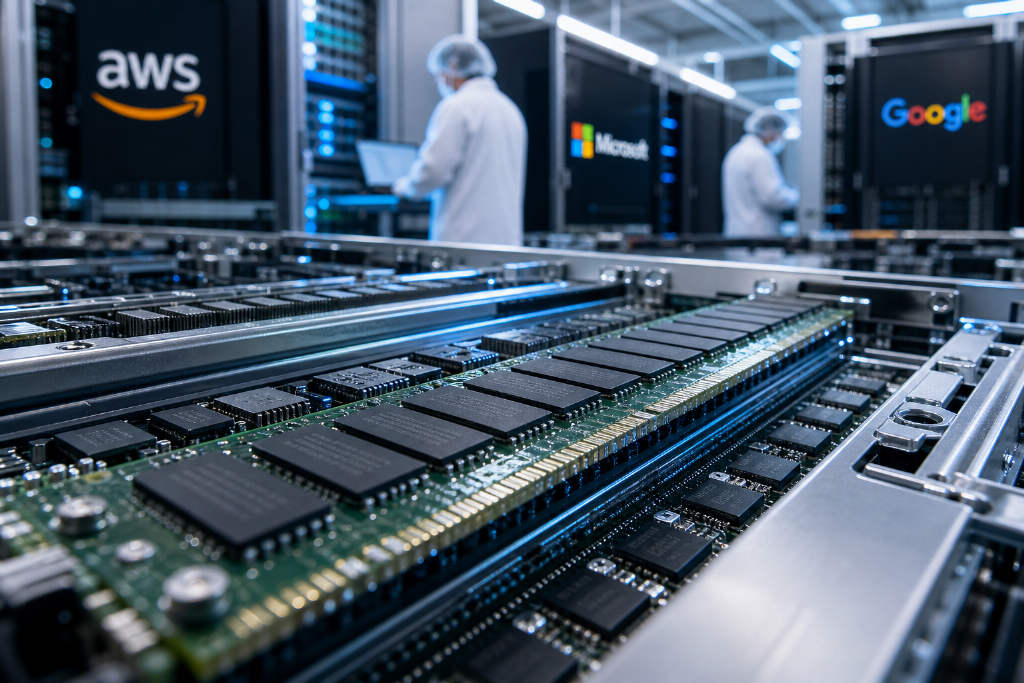
DRAM and NAND Flash will account for 68% of total capital expenditure by major cloud service providers in 2027, according to the latest research from TrendForce. The forecast puts memory well ahead of GPUs and other server components and shifts attention to where spending power is concentrating across the AI infrastructure stack.

Memory costs are becoming the main driver of cloud capex growth
TrendForce said total capital expenditure by hyperscalers, including Amazon, Microsoft, and Google, is expected to rise 98% in 2026 and another 50% in 2027. In that expansion cycle, memory pricing is one of the main forces pushing spending higher.
The report listed a sharp run-up in contract pricing across several categories:
- Server DRAM contract prices rose a cumulative 64% in the second half of 2025 and are projected to increase by about 270% in 2026.
- Enterprise NAND Flash prices rose about 35% over the same period and are expected to post another cumulative gain of 235% in 2026.
- HBM contract prices could still rise by 70% to 140% in 2027, even though some suppliers and CSPs began signing long-term agreements with price caps from the second quarter of 2026.
TrendForce expects memory contract prices to stay broadly elevated throughout 2027.
Supply is shifting toward servers as bit allocation tightens
Behind the pricing pressure is a reallocation on the supply side. TrendForce estimates that HBM and RDIMM together will account for half of total DRAM bit supply in 2026. Memory makers are channeling limited advanced-node capacity toward the server market, leaving less room for consumer memory.
In 2027, as process migration advances and new fab capacity comes online in the second half of the year, bit supply for Server DRAM and HBM is expected to increase 27%. Even so, the report said demand is likely to remain strong enough that supply tightness may ease only temporarily or only in part.
AI chip vendors may gain pricing cover, but the balance of power is shifting
TrendForce said the surge in memory costs gives server and AI chip suppliers such as Nvidia stronger justification to raise prices.
That does not mean Nvidia is insulated. Citrini analyst Zephyr said, 「Nvidia’s central position in the AI supply chain from 2022 to 2025 is loosening.」
Zephyr said Nvidia is facing competition on performance per dollar, or perf/$, and performance per watt, or perf/W. He added that nearly all incremental capital expenditure is flowing to memory suppliers rather than GPU vendors, describing the current pricing structure with the phrase 「BANK OF MEMORY controls everything」.
Cloud providers are left with four choices
TrendForce said CSPs effectively face four options:
- keep increasing capex to maintain planned AI chip purchases,
- maintain or expand capex and pass costs on to enterprise customers,
- cut memory per system by lowering specifications or reducing capacity,
- or shift toward in-house AI ASIC programs.
Another analyst, katz, pointed to a market risk in the form of a negative feedback loop across the AI supply chain. If memory prices stay high, CSP returns on investment could come under pressure, forcing capex cuts. If that pressure moves upstream, it could hit GPU orders and server procurement before feeding back into memory makers’ own shipments.
katz also said the trigger from tighter liquidity and higher costs could arrive before any hardware or power supply crisis. In his view, expensive memory alone could push CSPs to impose tighter capex discipline earlier than expected.
Public cloud pricing may shape deployment choices
The report also pointed to a longer-term variable that remains open: if public cloud AI service pricing keeps moving higher as providers pass through costs, enterprise customers may accelerate a shift toward on-prem AI infrastructure to avoid rising cloud bills. That, in turn, could affect CSP business models and market share.
TrendForce’s 2027 estimate suggests pricing power in the AI infrastructure era is being redistributed again, with memory costs becoming one of the clearest constraints on how long the current investment cycle can keep expanding.