Price Target Hiked, but Rating Unchanged: Why?
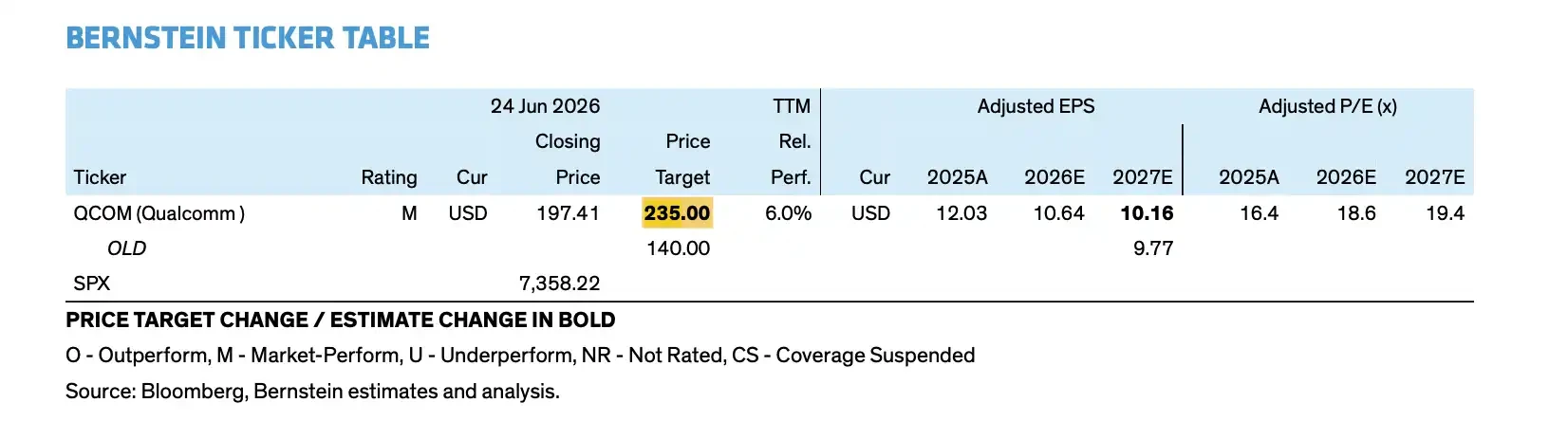
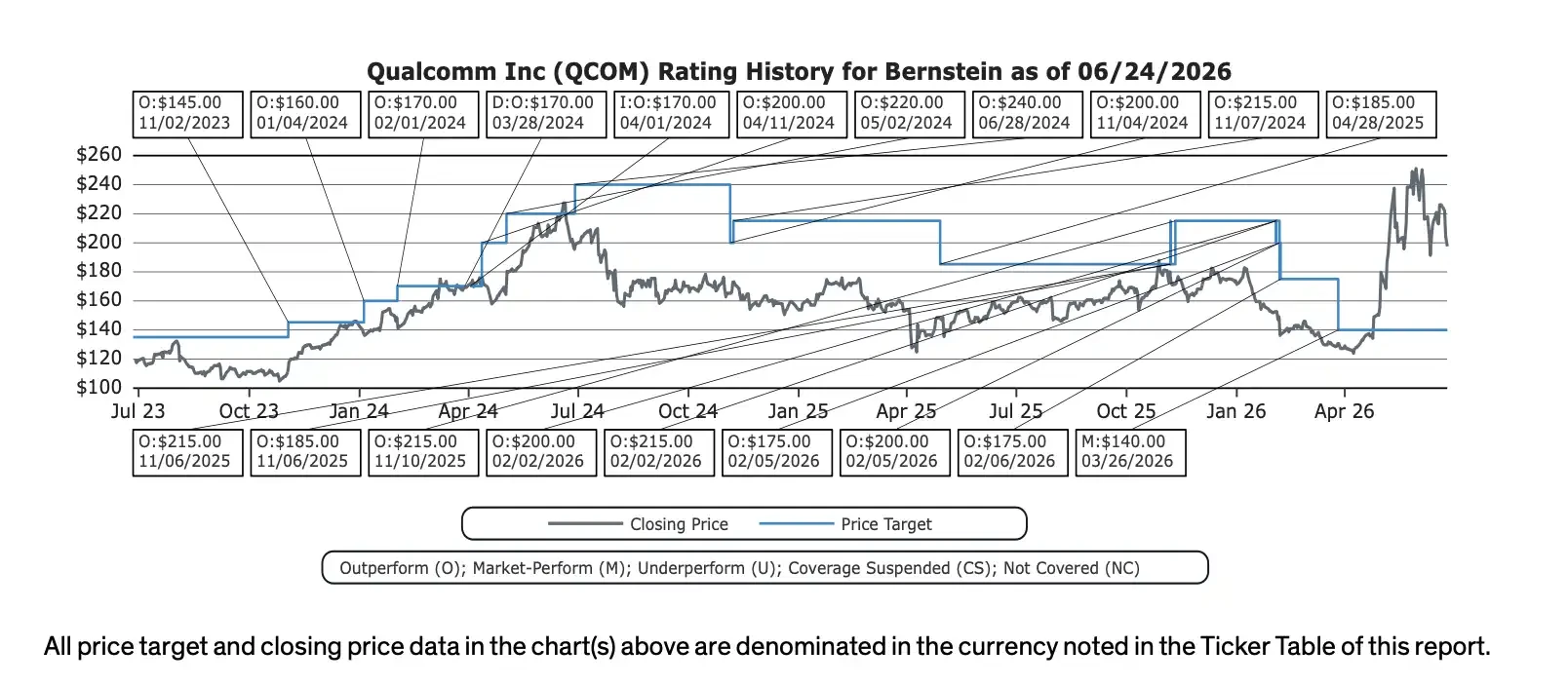
Following Qualcomm's ambitious long-term targets unveiled at its New York Investor Day, Bernstein raised the price target from $140 to $235 while maintaining a Market Perform rating. The target hike signals that Bernstein acknowledges Qualcomm's transformation story — from a mobile chip supplier to a broader computing player spanning AI data centers, automotive, IoT, and personal AI devices. Qualcomm officially targets ~$40 billion in non-handset revenue by FY2029, with data center revenue exceeding $15 billion and Non-GAAP EPS above $18. Yet the unchanged rating suggests the sell side sees insufficient certainty: data center and automotive monetization are back-loaded, while headwinds from declining smartphone sales, Apple revenue exit, rising OPEX, and gross margin pressure will hit financials sooner. The $235 target does not equal a "buy" signal; current shares already reflect some optimism, and risk-reward is not clearly tilted to the buy side.
Data Centers: Qualcomm's Most Important New Story
Qualcomm's official target calls for data center revenue to exceed $15 billion by FY2029, a dramatic leap from the current ~$30 million base. To achieve this, Qualcomm must secure meaningful allocations from cloud AI infrastructure budgets. Its data center roadmap includes custom ASICs, AI inference accelerators, the Dragonfly C1000 CPU, connectivity products, and software layers. The company disclosed two unnamed hyperscaler clients expected to each contribute over $1 billion in custom silicon revenue by FY2027. The partnership with Meta is a key validation point — the Dragonfly C1000 CPU is slated for production in the second half of 2028, though Qualcomm is only one of multiple suppliers, and details on volume, capacity, and exclusivity remain undisclosed. Bernstein's model assumes data center gross margins of ~40%, below Qualcomm's current corporate average, meaning even at scale the segment may not immediately lift overall profitability.

Automotive and IoT: The Second Growth Curve
Qualcomm targets automotive revenue of $10 billion and IoT revenue exceeding $14 billion by FY2029. The automotive design-win pipeline has grown from $45 billion 18 months ago to $65 billion, with continued investment in digital cockpits, assisted driving, and in-vehicle connectivity. However, these remain longer-term stories with limited near-term contribution.

Smartphone Declines and Cost Headwinds Constrain Near-Term Earnings
Qualcomm's handset business remains its largest revenue source but faces multiple pressures: Android handset revenue is expected to be flat or slightly down in FY2027; combined with Apple revenue exit, total handset revenue could decline by $5-6 billion year-over-year. The company's long-term Android assumptions are also more conservative, with a compound annual growth rate of only ~5% from FY2026 to FY2029. Meanwhile, cost pressures are emerging earlier: FY2027 OPEX is expected to grow at a double-digit rate due to investments in data center CPUs, AI accelerators, and software ecosystems, while revenue recognition lags. This creates downside risk for EPS estimates around FY2027. Bernstein projects overall gross margins declining from 55.2% in FY2026 to 51.6% in FY2029.
Bigger Story, but Near-Term Pain: Market Needs Proof
Bernstein's report is not a bearish call but a reminder to not treat long-term targets as already delivered. In a bear case where data center revenue falls well short of $15 billion, Qualcomm could still achieve FY2029 EPS of ~$15, showing the core business is not fragile. However, the gap between $15 and $18+ EPS is significant for valuation. If the market has already priced in optimistic data center revenue and higher multiples, Qualcomm must demonstrate three things: hyperscaler clients ramp on schedule; data center gross margins do not persistently drag overall margins; and handset declines do not excessively depress EPS before new growth materializes. Thus, the $235 target reflects a new price incorporating a more diversified long-term story, but the Market Perform rating cautions that until smartphone headwinds ease and data center revenue validates, the market has reason to wait before declaring Qualcomm a definitive AI winner.