
Bernstein said in a Sept. 1 research note that SpaceX’s valuation will hinge on whether it can establish large-scale, reusable orbital launch capacity around 2028. The firm kept its Outperform rating and a $248 price target, which the report said represents 73% upside from the current share price.
The note reviewed six major August developments: a new Starship base in Louisiana, updated launch and recovery targets, an in-house industrial gas turbine blade foundry, the completion of the Cursor acquisition, a new Terafab site, and continued growth in Starlink’s aviation business.
According to the report, Louisiana launch infrastructure and recovery technology are the two pillars behind that thesis.
Louisiana Starship base
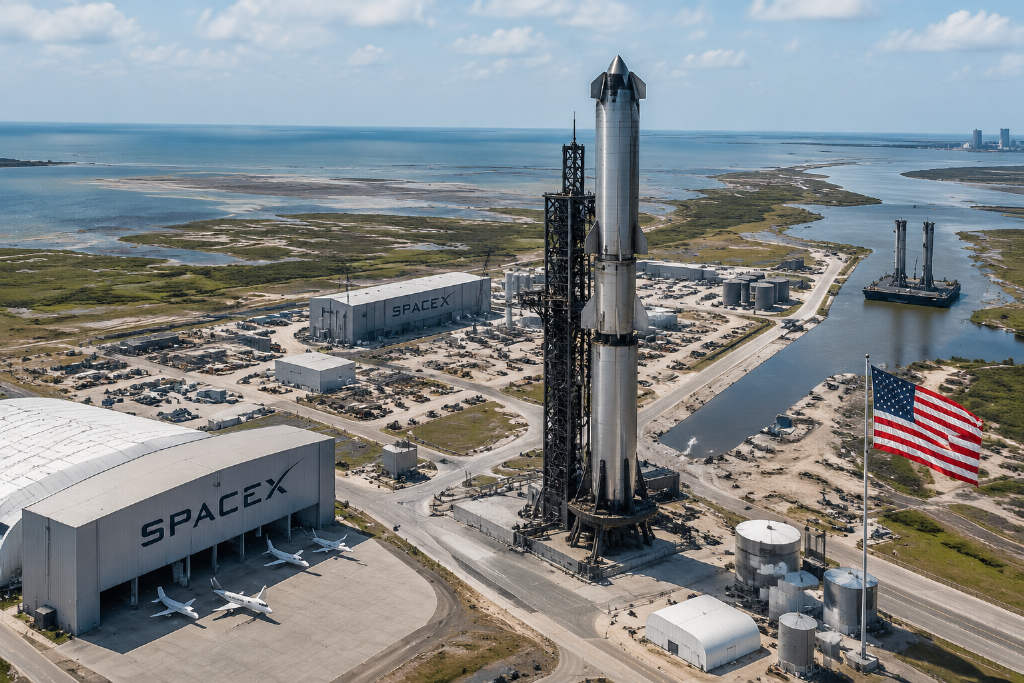
SpaceX said in August that it will build a new Starship base at Pecan Island in southern Louisiana. The site spans 125,000 acres and includes a deepwater port, an airport, propellant production, and power generation facilities. The target is to support thousands of Starship launches a year.
The company committed to invest at least $100 billion over the long term and create at least 3,000 new jobs. The base is expected to eventually have at least 10 launch pads and support more than 30 Starship flights a day, making it the largest hub for Starship operations.
The first flight target is 2029. Before that, the site still needs major clearing, land reclamation, and reinforcement work. Bernstein said the scale of construction would exceed that of SpaceX’s existing Starship base in Texas and called the Louisiana site critical for the launch cadence needed for orbital data centers.
Recovery timeline and flight plans
Bernstein said Starship’s 14th flight is expected within weeks. Unlike earlier expectations, this mission will not attempt to catch the second stage. Instead, it is expected to fly to orbit and deploy V3 Starlink satellites.
The Federal Aviation Administration has not yet approved the orbital flight license, though the U.S. Department of Transportation recently eased environmental review requirements and the approval process is moving ahead, the article said.
Bernstein expects the 15th flight to attempt a second-stage catch, with reusability targeted for early 2027. The report also said SpaceX had given a positive assessment of thermal protection system performance during the 13th flight, though it remains unclear whether recovering actual hardware will reveal additional issues.
In Bernstein’s view, reusability is the economic basis for high-frequency launch. Without it, the math behind thousands of launches a year does not work.
Blade foundry near Bastrop
On Aug. 29, Elon Musk said SpaceX will build a foundry near Bastrop, Texas, to produce industrial gas turbine blades and vanes for large-scale power generation projects.
The article said the global market for IGT blades is dominated almost entirely by Howmet and Precision Castparts. SpaceX’s concern is that supply constraints could become a bottleneck as it builds 20 GW of ground compute infrastructure.
Bernstein was cautious on feasibility. High-end turbine blade manufacturing is extremely difficult, the report said, which is one reason the field has so few competitors. Building meaningful production capacity within 18 months would be very hard. Even if the plant comes online, Bernstein expects it to serve internal demand rather than challenge Howmet directly.
The report said the project would prioritize speed over cost and that economics are not the primary consideration.
Cursor acquisition and AI monetization
SpaceX has completed its acquisition of Cursor, according to the article. Bernstein said Cursor’s coding capabilities are an important complement to Grok, while work on Grok 4.6 is also underway.
OpenAI said it will cut off Cursor’s access to its models. Anthropic said Cursor will continue to have access to Claude.
Bernstein said stronger competitiveness at the AI intelligence layer would give SpaceX a better way to monetize its ground and orbital AI infrastructure. The core assumption behind orbital data centers is selling raw compute, while upgrades tied to Grok and Cursor could open a higher-margin path.
The article added that the outcome of the AI copyright dispute remains uncertain, though the direction is becoming clearer.
Terafab site in Grimes County
On Aug. 6, SpaceX, Tesla, and the governor of Texas formally announced that Terafab will be built in Grimes County. In the initial phase, SpaceX and Tesla committed about $16.8 billion in capital expenditure and at least 3,000 jobs.
Bernstein focused on what Elon Musk has repeatedly called the ultimate goal: annual chip output of 1 TW. The article said that figure is far beyond current global semiconductor capacity. Even if Terafab reaches only a fraction of that level, it would still be enough to reshape AI chip supply.
Under that framework, the initial $16.8 billion is only a starting point.
Starlink aviation expansion
Starlink’s aviation business is still expanding quickly, the article said. Royal Air Maroc was added in August, and Qatar Airways expanded deployment. That brought the total to 46 airline customers.
At the Farnborough Airshow, aircraft retrofits for Starlink had become a major topic, according to the report. Delta Air Lines and JetBlue were identified as the only two airlines that declined Starlink and instead signed with Amazon’s Project Kuiper.
Kuiper currently has only 396 satellites in orbit and is still short of operational scale, while Starlink has more than 11,000 satellites in orbit, the article said. Musk publicly said Delta would lose passengers as a result. Bernstein said the airline’s choice may be a mistake and that Starlink’s lead in aviation is still widening.
What underpins the $248 target
Bernstein’s broader point was that SpaceX’s future is not mainly about the success or failure of a single launch. It is about how fast the company can expand infrastructure. The Louisiana base, Terafab, the blade foundry, and recovery technology are presented as the core capabilities behind an orbital data center business.
The report ties the $248 target to expectations that those capabilities will be delivered step by step between 2028 and 2031. In Bernstein’s framing, SpaceX is no longer valued only as a rocket company. It is building industrial infrastructure beyond Earth.
The original article also said the ratings, price target, earnings forecasts, and related judgments cited in the piece are Bernstein analysts’ views only and do not constitute investment advice.