
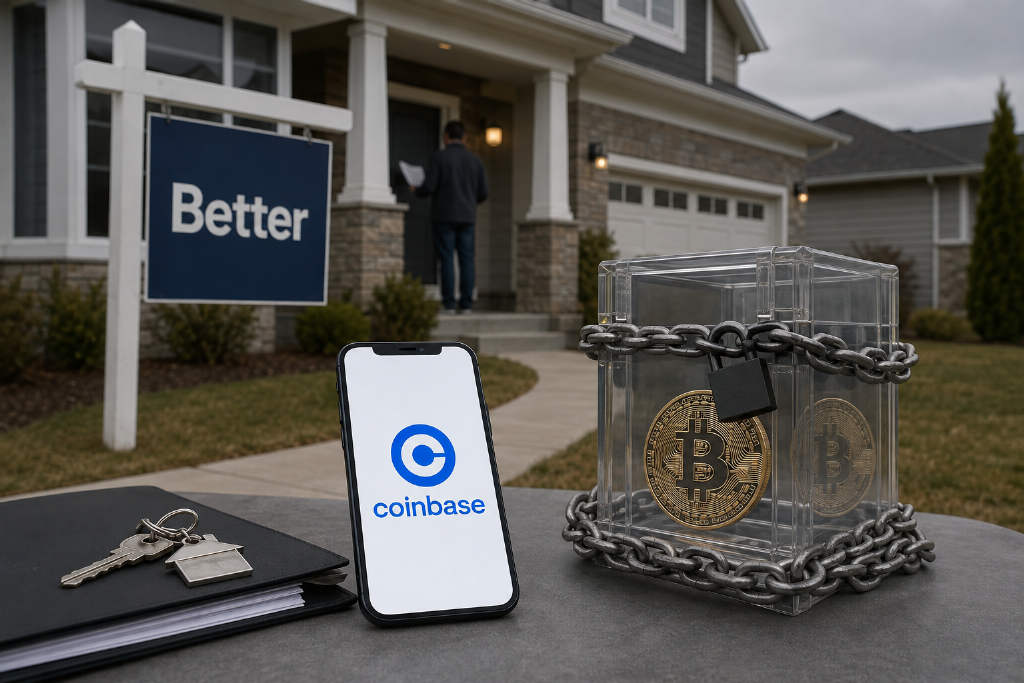
Better and Coinbase have opened applications for a bitcoin-backed mortgage product, but newly disclosed terms show borrowers could face two major constraints: pledged BTC may be rehypothecated, and it may remain locked up for as long as 15 to 30 years.
$360 million in pre-applications after the broader rollout
According to data Better shared with CoinDesk, the product has generated $360 million in pre-application loan volume since opening more broadly last week. That is above the $260 million estimate from the waitlist period.
When the product was first announced in March, it accepted BTC and USDC. At last week’s official launch, only BTC was made available. Coinbase said the two companies chose to launch with bitcoin first, while other forms of collateral are still under review.
The product uses two separate loans
Borrowers are signing two loans at once.
- The first is a standard Fannie Mae-compliant mortgage secured by the home.
- The second is a bitcoin-backed loan used for the down payment, secured by BTC and a second lien on the property.
The collateral ratio is 250%, meaning a borrower must pledge $2.5 in BTC for every $1 borrowed for the down payment. In Better’s example, a buyer purchasing a $500,000 home would pledge $250,000 in bitcoin to obtain a $100,000 down-payment loan.
Both loans are originated by Better and combined into a single monthly payment. At closing, the borrower’s bitcoin is transferred from a Coinbase account into Better’s custody account on Coinbase Prime.
Disclosures say Better may rehypothecate the BTC
Better disclosed that it may rehypothecate customer bitcoin collateral, provided it maintains an equivalent amount of BTC available to return when the loan is repaid.
Rehypothecation allows a lender to reuse collateral in other transactions instead of leaving it untouched in a custody account. In practical terms, the borrower is relying on a promise to receive equivalent BTC back, not necessarily the exact same coins that were originally posted.
That structure means borrowers are exposed not only to bitcoin price movements, but also to Better’s credit risk.
The report notes that this approach cuts against the push for 1:1 reserves and verifiable assets that gained traction across crypto after the collapse of FTX.
Better said its lending agreements and custody arrangements comply with applicable laws and regulations, including bankruptcy rules. The company did not say whether each borrower’s BTC can be individually identified, who holds legal ownership after rehypothecation, or whether borrowers would be treated as property claimants or unsecured creditors if Better or one of its financing partners were to fail.
Borrowers may not get their bitcoin back for 15 to 30 years
Another key term is that repaying the bitcoin-backed loan alone does not release the BTC. Better said the collateral can only be released once the main mortgage has been fully repaid or refinanced.
That means the bitcoin could remain locked up for 15 to 30 years, in line with the term of the primary mortgage. Unless the borrower refinances or sells the home, the BTC cannot be retrieved.
Better’s official product page also says that when a home is sold, the down-payment loan must be repaid before the bitcoin is released.
No margin calls, but BTC can be sold after default
Unlike many crypto-backed lending products, a drop in BTC’s price does not trigger a margin call, does not require additional collateral, and does not lead to automatic liquidation.
Even if bitcoin falls below the value of the down-payment loan, liquidation happens only after the borrower defaults.
The disclosed default process works as follows:
- If the borrower misses the combined monthly payment, the default process begins.
- After 60 days, Better can start auctioning the pledged BTC, with notice to the borrower, and only enough bitcoin can be sold to cover the debt.
- After 180 days, foreclosure proceedings on the home can begin under Fannie Mae rules.
Better said it must dispose of the BTC first. If a shortfall remains after the bitcoin sale, standard lending remedies may still apply. Proceeds from a foreclosure sale would first go to the mortgage, then to the bitcoin-backed loan, with any remainder going to the borrower.
Holding bitcoin does not help a borrower qualify
Better also made clear that owning bitcoin does not itself help an applicant qualify for the mortgage. Borrowers still need to meet Fannie Mae requirements for income, credit score, and debt-to-income ratio, or DTI.
In a written response, Better said: "This product does not convert crypto assets into qualifying income, nor does it relax DTI or credit thresholds. The bitcoin loan only solves the cash-down-payment issue."
Coinbase acts as custodian, not the lender
Coinbase’s role is limited to custody and technical infrastructure. It does not take part in underwriting decisions or in judgments around collateral liquidation.
Coinbase One members who are approved for the product can receive a closing-cost subsidy from the lender equal to 1% of the mortgage amount, capped at $10,000.
Applicant data also shows that 35.9% hold more than $500,000 in crypto assets, and 38% plan to buy a home within the next three months.
A traditional finance collateral model inside a crypto product
The report says rehypothecation is standard practice in traditional finance, but in crypto, the practice has been treated far more cautiously since the FTX collapse and the industry’s push toward 1:1 reserves and verifiable holdings.
Under Better’s design, the pledged crypto is not freely retrievable during the life of the loan. More importantly, paying off the bitcoin-backed portion is not enough. Borrowers may have to wait until the main mortgage ends, potentially 30 years later.
The report also points to several open questions: how Better will actually use rehypothecated BTC, how risks would be managed if bitcoin sees sharp price swings in the future, and whether other mortgage lenders adopt the same model.