

U.S. technology companies’ financial commitments to build AI infrastructure are running far ahead of what appears on their balance sheets. Citing a Wall Street Journal report published on Aug. 18, Odaily said nine major companies — Alphabet, Meta, Microsoft, Amazon, Oracle, Nvidia, Broadcom, SpaceX and AMD — disclosed about $3 trillion in off-balance-sheet commitments in recent securities filings, most of them tied directly to AI infrastructure.
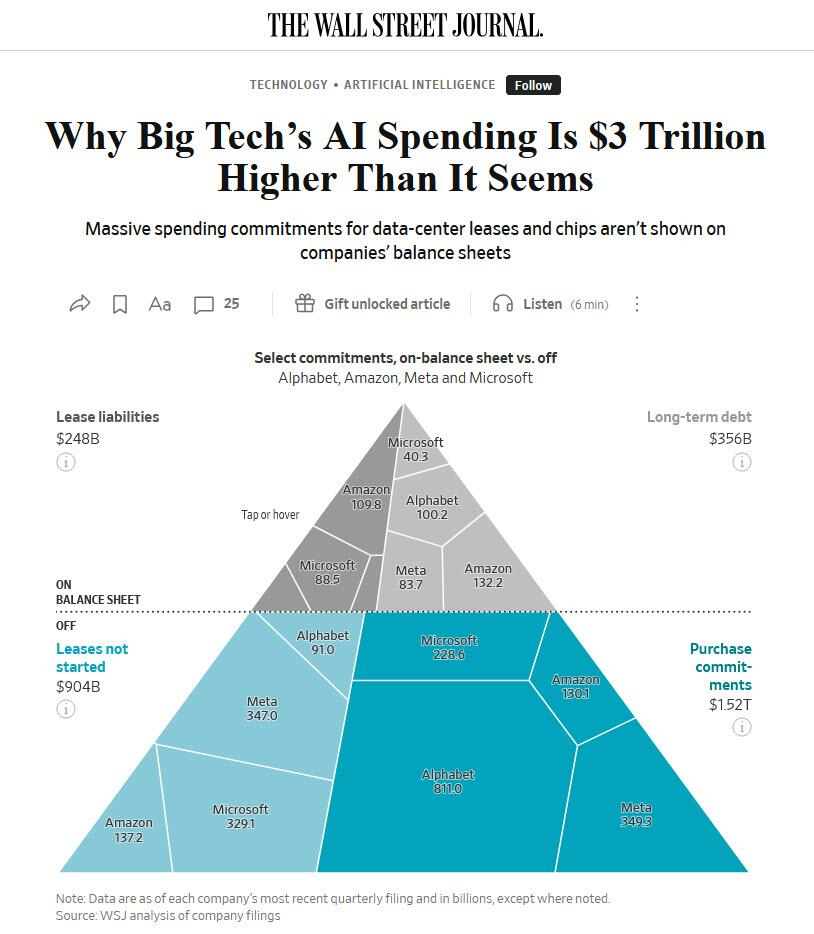
That figure was about five times the group’s combined capital expenditures of $600 billion over the past year and about three times their outstanding lease and long-term borrowing balances. It was also about 50% above the roughly $1.8 trillion level cited two months earlier.
Two accounting buckets carry most of the exposure
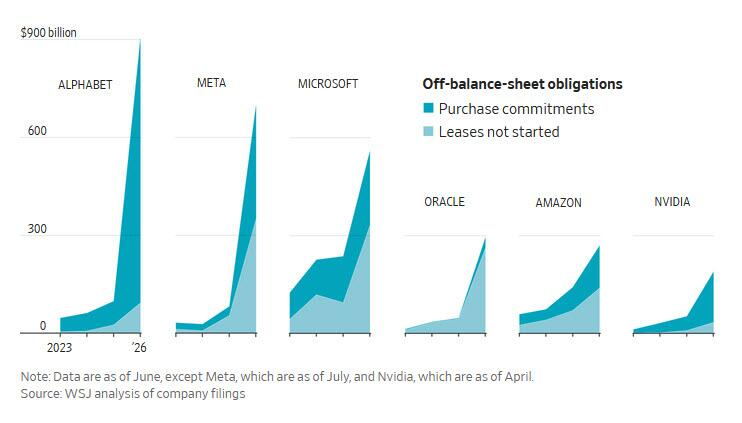
The article said the hidden obligations were concentrated in two categories: about $1.2 trillion of uncommenced leases and about $1.9 trillion of purchase obligations. Under current accounting rules, neither has to be recorded on the balance sheet before delivery takes place or lease payments begin.
Odaily also referenced an earlier Wallstreetcn article citing Bloomberg on Aug. 15, which said a newer off-balance-sheet financing structure built around residual value guarantees, or RVGs, had already reached about $70 billion. Nvidia, Broadcom and other chip suppliers have used their own credit standing to back customer financing, creating contingent liabilities that, according to the article, have not been fully priced by the bond market.
Alphabet and Amazon have recently posted negative free cash flow, with capital expenditures exceeding cash generated from operations. The article said that leaves hyperscalers dependent on capital markets funding for the foreseeable future. If the $3 trillion in off-balance-sheet commitments starts converting into on-balance-sheet obligations, the impact could hit balance sheets long seen as fortress-like.
How uncommenced leases stay off the balance sheet
The Wall Street Journal analysis pointed first to uncommenced leases. One example was Meta’s Hyperion data center project in Louisiana, which the article described as covering an area equal to about 1,700 football fields. Meta initially signed a lease starting in 2029 for four years, with extension options that could stretch the term to 20 years. It also agreed to make bondholders whole if the lease were terminated early.
Because Meta judged the probability of actually paying under that guarantee to be low, it did not record a liability on its balance sheet. Under accounting standards, such lease obligations can remain off balance sheet until rent payments formally begin. Meta disclosed about $347 billion in these uncommenced lease commitments.
The Wall Street Journal said total uncommenced leases for the companies it reviewed had climbed to about $1.2 trillion, roughly four times the amount disclosed a year earlier.
Purchase obligations add another $1.9 trillion
The second major category is purchase obligations. Data centers require large volumes of hardware, including Nvidia chips and memory chips used to train and run models. To secure supply, technology companies have widely signed long-term procurement contracts in advance. Under accounting rules, those commitments also stay off the balance sheet until products or services are delivered.
The combined total for purchase obligations was about $1.9 trillion. Together with uncommenced leases, they make up the bulk of the roughly $3 trillion in off-balance-sheet exposure. The article noted that in most cases, once these contracts and leases are signed, they cannot be canceled unilaterally even if revenue fails to arrive as expected.
RVG structures add a second layer of hidden risk
Beyond leases and procurement commitments, the article said AI financing is also seeing fast growth in residual value guarantee structures worth about $70 billion.
In that setup, a special purpose vehicle borrows to buy chips, with repayment backed by cash flow from an AI company’s usage contract. If the AI company stops paying, the chips are re-leased or sold to cover the debt. If there is still a shortfall, the guarantor — usually the chip maker — makes up the difference.
That leaves suppliers such as Nvidia and Broadcom acting as the final backstop, even though those guarantee obligations usually do not show up on their balance sheets. The article quoted Meta’s filing language as support for that treatment: 「RVG guarantors are unlikely to make payments, so no liability has been recorded to date.」
Broadcom applied the same logic to a project code-named Big Sky. According to the article, Broadcom guaranteed a $35 billion debt deal in which Apollo Global Management, Blackstone and other investors bought custom AI chips and then leased them to Anthropic. The support helped senior debt obtain an investment-grade rating, lowering the financing cost.
Bank of America strategists estimated that Broadcom’s AI XPV platform could accumulate $370 billion in senior debt by mid-2029. Nvidia CEO Jensen Huang said the company could provide residual value support of as much as 25% on selected opportunities. He said deals would be evaluated 「case by case」, with the aim of 「unlocking a large pool of independent capital while maintaining disciplined risk exposure.」
Nvidia said last week that it had entered into a $500 billion financing partnership with six U.S. investment institutions including BlackRock and Goldman Sachs. The article said part of the rationale was to bring in outside capital and ease the closed loop in which AI companies finance one another’s product purchases.
Ratings firms and bond investors are paying closer attention
Odaily said ratings agencies have openly raised concerns about the pace of RVG expansion. Moody’s wrote that 「the key risk is the concentration of these transactions over a short period of time」 and warned that a large increase in Broadcom’s contingent obligations 「could constrain Broadcom’s financial flexibility and pressure its credit profile even if leverage on existing debt remains low.」
S&P Global Ratings described Broadcom’s residual value support as a contingent debt-like obligation and said it would include that amount in its adjusted debt calculations.
Bond investors are focused on a simpler question: when do off-balance-sheet contingent liabilities turn into real losses on the balance sheet? DoubleLine portfolio manager Mariya Entina put it this way: 「This is like exploiting gaps in the system to win favorable treatment from rating agencies and secure the highest ratings possible... We are entering an era of financial engineering. When you do financial engineering, you are obscuring financial reality.」
CreditSights analysts compared Nvidia’s residual support to selling a put option. Their view was that the structure is procyclical: it carries little cost in a boom, but becomes critical in a severe downturn when customers default and hardware market values fall.
Brian Gelfand, co-head of global credit at TCW, said: 「This is not ordinary investment-grade credit underwriting. It is much more complex than that. Given the off-balance-sheet nature, tail risk is higher.」
The market is split on whether the risk is manageable
Not everyone is bearish. John Lloyd, global head of multi-sector and corporate credit at Janus Henderson Investors, said extreme conditions would be required to trigger residual value support.
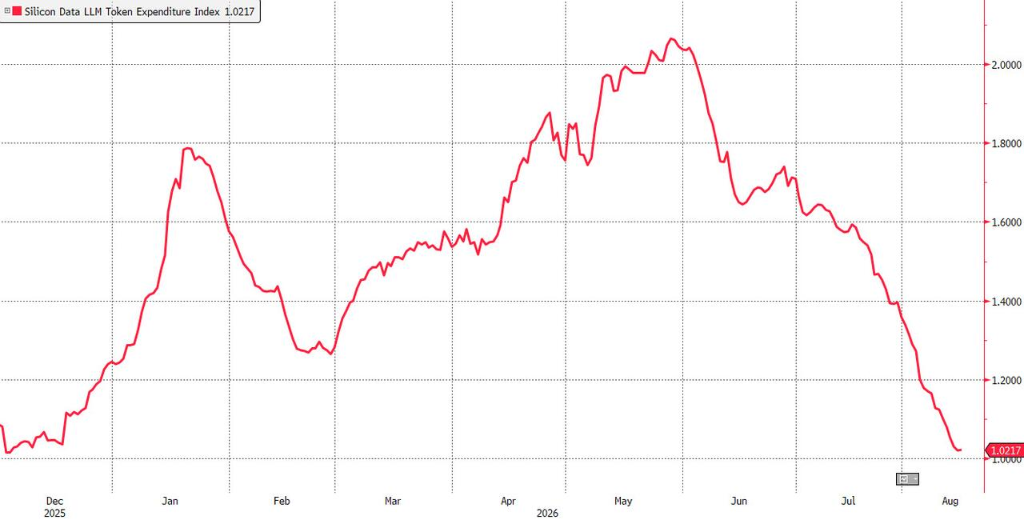
He said: 「You would need to see token usage growth fall off a cliff, and that is simply not what we are seeing.」 He also argued that these companies 「are not trying to hide contingent liabilities; they are trying to finance them.」
The broader market remains divided on whether these off-balance-sheet obligations amount to a systemic risk. The bullish case is that demand for AI tools is still surging, lifting equities and creating shortages in key hardware, which in turn supports the view that demand will remain strong for years and that large technology companies will generate enough cash flow to pay the bills.
The bearish case centers on two points. First, most procurement commitments and signed leases cannot be reversed, so the bills still have to be paid whether revenue materializes or not. Second, the article said Chinese open-source models are offering near-frontier performance at much lower prices. If companies and consumers shift in large numbers to those cheaper alternatives, hyperscalers could face broad pressure on margins while their infrastructure bills remain fixed.
According to the article, related token prices have fallen more than 50% over the past few weeks. At a structural level, the risk comes from a mix of timing mismatch and limited transparency: capital spending commitments are arriving before revenue and free cash flow, large depreciation charges are still deferred, and profit pressure could emerge in a concentrated way once projects under construction begin moving onto the books. The article also said companies do not classify and disclose off-balance-sheet liabilities in a uniform way, making true cross-company leverage comparisons inherently uncertain.
The article cited analysts as saying these liabilities do not yet amount to an imminent repayment crisis. But the mismatch between timing and disclosure remains at the center of the issue, along with a wall of deferred depreciation and a bill whose final size is still unclear.