

Late July 2026 brought one of the busiest earnings stretches of the year for U.S. technology stocks. Alphabet opened the run, followed by Intel, Microsoft, Meta, and Apple. Across all five reports, the main theme was nearly identical: spending on AI infrastructure is still accelerating, but investor patience with that spending is wearing thin.

On revenue and profit, most of the companies beat expectations. On the market side, the reaction split sharply. Some shares rose on stronger guidance, while others sold off as investors focused on capital expenditure, cash flow pressure, or a weaker forward view.
Alphabet: strong revenue growth, but capex and cash flow took center stage
Alphabet reported second-quarter 2026 results after the close on July 22 Eastern Time. Total revenue reached $119.796 billion, up 24% year over year, marking a 12th straight quarter of double-digit growth. Operating income came in at $40.77 billion, ahead of the market estimate of $40.55 billion. Net income attributable to shareholders was $112.1 billion, including roughly $99 billion in unrealized gains on equity securities.
Google Cloud was the standout. Revenue rose to $24.8 billion, up 82% from a year earlier and faster than the prior quarter's 63% growth rate. That also beat market expectations of $22.3 billion. Enterprise AI solutions became the core growth engine for the cloud segment, with Gemini Enterprise paid monthly active users up 40% quarter over quarter. Cloud backlog doubled from the prior quarter to $460 billion.
The concern was capital spending. Alphabet's second-quarter capex surged to $44.92 billion, doubling from a year earlier. About 60% went to servers, while 40% went to data centers and networking equipment. The company also raised its full-year 2026 capex guidance from $180 billion-$190 billion to $195 billion-$205 billion and said spending would rise again in 2027.
That level of investment weighed directly on cash reserves and left Alphabet with its first quarterly negative free cash flow since going public, at about negative $5.855 billion to $5.9 billion.
After the release, Alphabet shares fell more than 4% in after-hours trading. On July 23, the stock dropped more than 7% intraday as the three major U.S. indexes sold off. The report linked that move to rising oil prices tied to an escalation in the Middle East, while investor concern over expanding AI capex and the company's cash flow outlook added to the pressure.

Intel: fastest revenue growth in 15 years, then a sharp reversal in the stock
Intel reported after the close on July 23 Eastern Time. The results delivered one of the biggest contrasts of the season. Second-quarter revenue rose 25% year over year to $16.128 billion, the strongest growth rate in more than 15 years and well above the market expectation of $14.42 billion, beating by close to 12%.
Data center and AI drove the upside. Revenue in that segment reached $6.3 billion, up 59% from a year earlier and above analysts' expectation of $5.6 billion. On a non-GAAP basis, the company returned to profit with net income of $2.2 billion and earnings per share of $0.42. On a GAAP basis, it still reported a net loss because of fair-value changes tied to U.S. government custodial shares, but operating cash flow remained strong at $7 billion. Intel also raised its third-quarter revenue outlook, with a midpoint of about $16.3 billion, implying growth of more than 15% and topping market expectations.
The spending outlook complicated the picture. Intel said it would raise full-year 2026 capex guidance from $18 billion to more than $20 billion and said 2027 capex would be significantly higher than the 2026 level. Management said customer demand signals were extremely strong and that demand for data-center CPUs was already running ahead of the company's expanding supply capacity. Executives used the word "takeoff" to describe current demand conditions.
In a report after the earnings release, Goldman Sachs said the higher capex plan implied more short-term pressure on free cash flow. The bank estimated Intel's 2026 net debt-to-EBITDA ratio would rise from 0.8x to 1.2x and that wafer front-end equipment spending would increase by about 40%, showing the company is moving from the plant construction phase to the equipment fill phase. Goldman kept its Neutral rating and $150 price target and did not upgrade the stock despite the earnings beat.
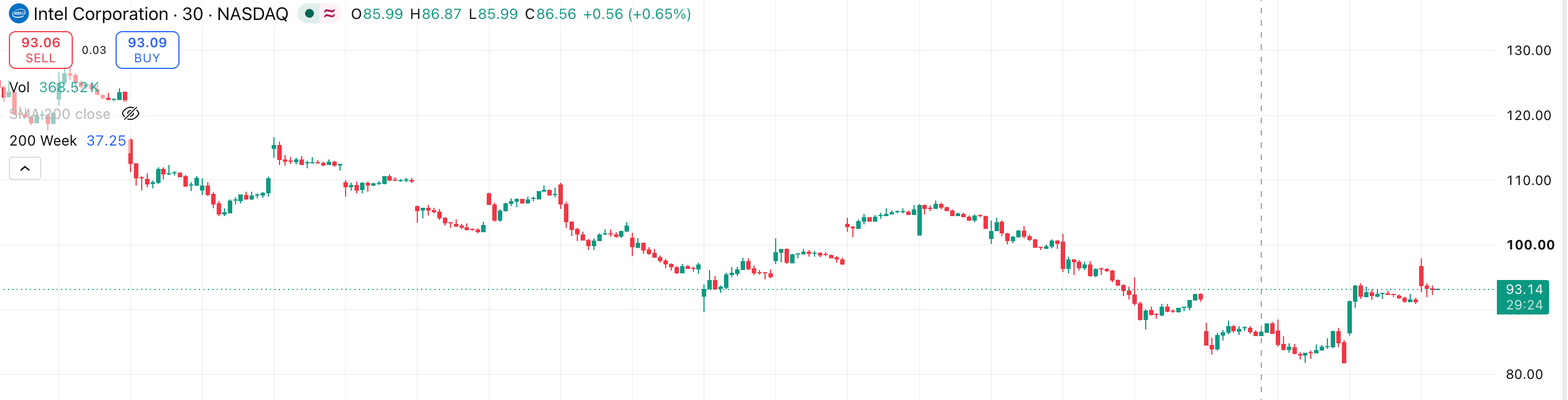
Price action reflected that tension. Before the report, Intel had fallen more than 2% in regular trading. After the results, the stock jumped more than 13% in after-hours trading. The rebound did not hold. As attention shifted to the capex increase, gains narrowed sharply, and the stock later swung to a drop of more than 7%. At one point, the gain had narrowed to only about 4%. The move captured a market still split on Intel's transition story.
Microsoft: Azure tops $100 billion in annual revenue, lower capex outlook lifts the stock
Microsoft reported fiscal fourth-quarter 2026 results after the close on July 29, covering the quarter ended June 30 and corresponding to the second quarter of calendar 2026. Among the five companies, Microsoft drew the strongest positive response.
Revenue for the quarter reached $90 billion, up 18% year over year and above the market estimate of $87.7 billion. GAAP net income came in at $35.766 billion to $35.8 billion, up 31%. Diluted earnings per share were $4.81, also ahead of the $4.24 consensus. Part of the profit growth came from a $3.2 billion gain on Microsoft's investment in Anthropic, along with lower-than-guided expenses tied to a voluntary departure plan.
Intelligent Cloud revenue rose to $39.3 billion, up 32%. Azure revenue increased 43%, helping Azure annual revenue top $100 billion for the first time in fiscal 2026. Commercial remaining performance obligation, a measure of future contracted revenue, climbed to $678 billion, up 84% from a year earlier and well above market expectations. Fourth-quarter capex reached $41 billion, up 69%, and full-year fiscal 2026 capex totaled $145.3 billion.
After Alphabet's stock was hit by higher capex guidance, investors were watching closely to see whether Microsoft would do the same. Instead, the company signaled lower spending. On the earnings call, Microsoft cut its calendar 2026 capex expectation from $190 billion to $175 billion. Management also said it expects positive free cash flow in fiscal 2027.
The company said its actual investment plan had not changed. The lower spending figure mainly reflected an accounting adjustment: Microsoft extended the estimated useful life for office buildings and data-center buildings from 15 years to 25 years.
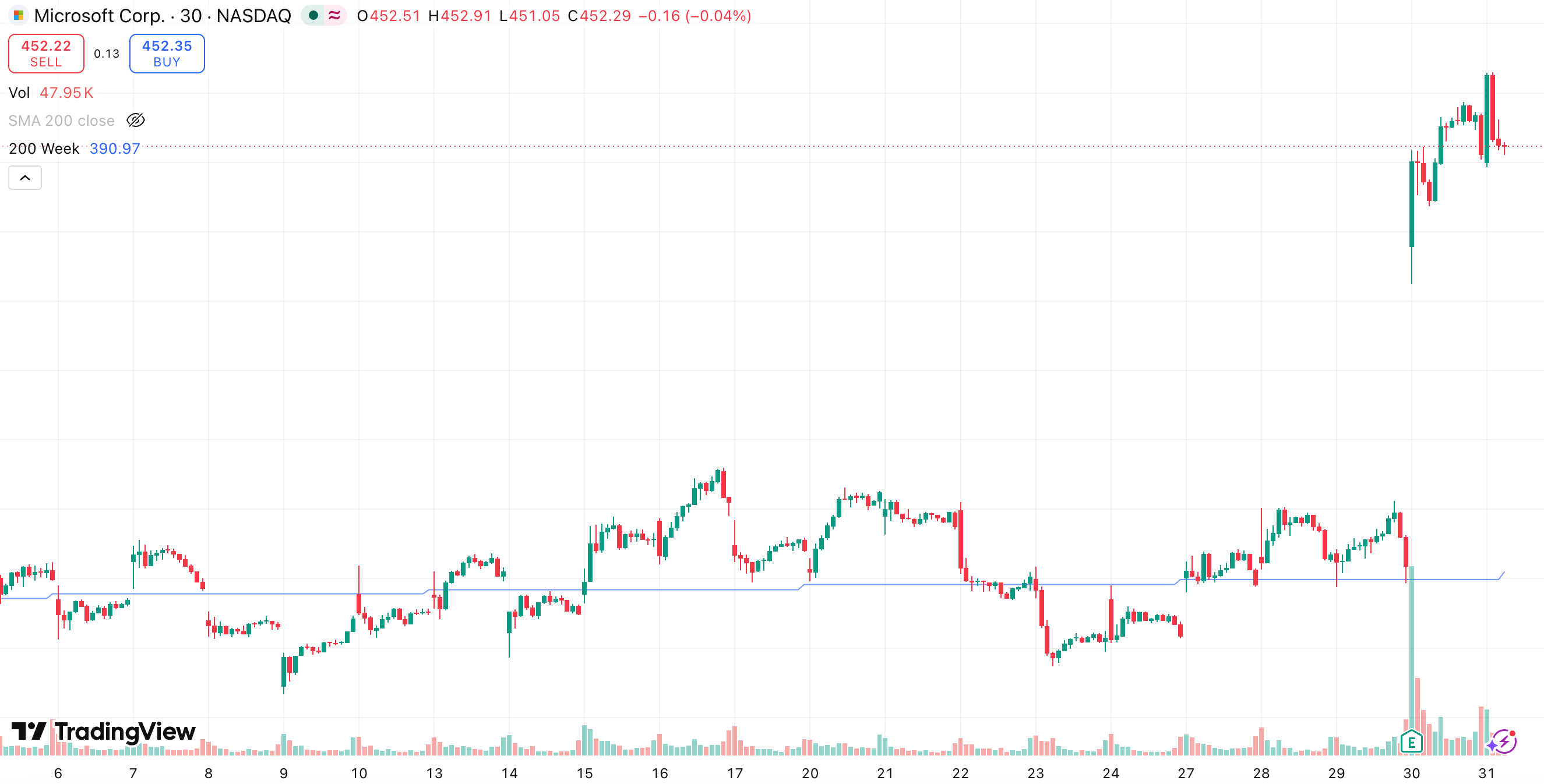
With both earnings and guidance supporting the case, Microsoft shares rose more than 8% in after-hours trading. On July 30, the next trading day after the report, the stock posted its best single-day performance in 18 years.
Meta: ad growth held up, but capex and free cash flow triggered the harshest selloff
Meta also reported after the close on July 29, and it drew the most negative stock reaction of the group. The core advertising business remained strong. Second-quarter revenue reached $60.801 billion, up 28% year over year and slightly above the market expectation of $60.17 billion.
Advertising revenue was $59.363 billion, up 27%. Ad impressions increased 14%, and average price per ad rose 12%. Meta said ad clicks and conversion rates improved after upgrades to AI ranking models. Revenue from other businesses in the Family of Apps segment topped $1 billion in a quarter for the first time, rising 73%, driven mainly by paid messaging and subscription revenue from WhatsApp.
Costs rose much faster than revenue. Total costs and expenses hit $42 billion in the quarter, up 55% from a year earlier. Operating income fell 8% to $18.775 billion. Operating margin dropped to 31% from 43% a year earlier. GAAP net income was $15.848 billion, down 14%, while earnings per share fell to $6.18 from $7.14 a year earlier.
The market focused on capex and free cash flow. Meta spent $31.08 billion on capital expenditures in the second quarter and generated $31.86 billion in cash flow from operations. After that offset, free cash flow was only $784 million, down more than 90% from $8.54 billion in the same period a year earlier.
The company raised the low end of its full-year 2026 capex guidance from $125 billion to $130 billion. It also lifted its expected tax rate for the remaining quarters of 2026 from 13%-16% to 15%-17%. Chief Executive Officer Mark Zuckerberg said selling compute externally for short-term profit would be "stupid" and argued that continued investment in compute capacity is not a gamble but a necessity, pointing to the possibility of more spending ahead.
Evercore ISI analyst Mark Mahaney said the lack of forward guidance for 2027 capex, along with limited disclosure on progress in frontier AI model development, were major drags on the stock.
Meta shares fell more than 7% in after-hours trading on the night of the report. The decline widened again before the next day's open, and by July 31 the selling had not let up, with the stock down nearly 10% at one point for the day. Among the five companies, Meta saw the longest-lasting pullback and the biggest cumulative drop.
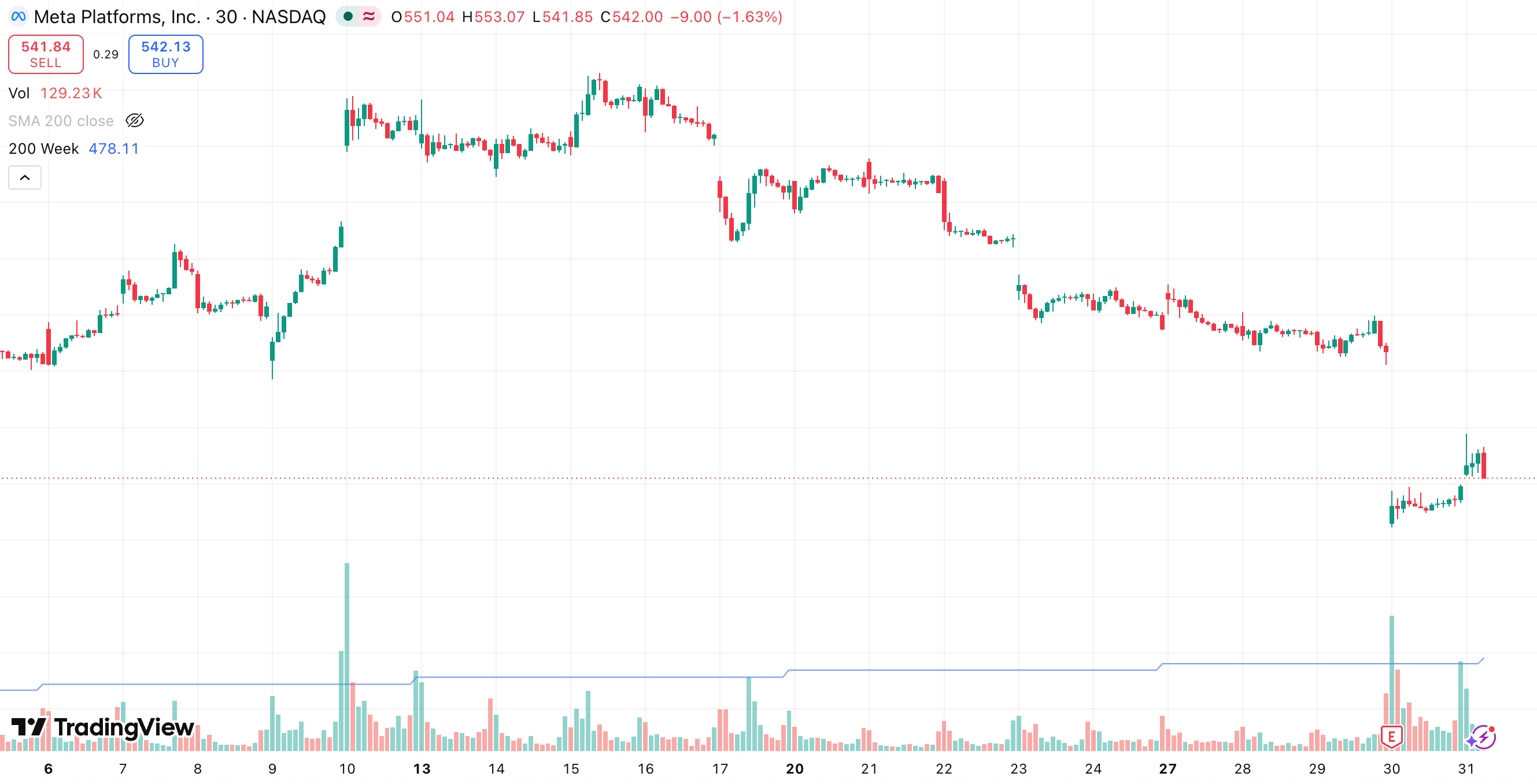
It was not the first time. When Meta reported first-quarter results on April 29, the company also raised full-year capex guidance, and the stock dropped more than 8% that night, erasing more than $100 billion in market value in a single day. For Meta, a higher capex outlook has become a repeat trigger for post-earnings selling over the past two quarters.
Apple: record revenue and profit, but guidance and supply constraints hit the shares
Apple's results captured the growing split between operating performance and stock performance. On July 30 local time, the company reported fiscal third-quarter 2026 results for the period ended June 27, corresponding to the second quarter of calendar 2026.
Total revenue came in at $109.42 billion, up 16% from a year earlier and above the market expectation of $108.65 billion. Net income rose 27% to $29.789 billion. Gross margin reached 50.1%, with tariff rebates adding about 2 percentage points. iPhone revenue totaled $54.25 billion, up about 22%, and Mac revenue reached $10.35 billion, up about 29%. Both topped expectations.
Chief Executive Officer Tim Cook said it was the best June quarter in Apple's history, with double-digit growth in iPhone, Mac, services, and every major geographic market.
The stock turned lower on the outlook. Apple said revenue for the fiscal fourth quarter ending in September would grow 9%-11% year over year. The high end of that range was clearly below the Wall Street consensus of 12.1%. The company also guided gross margin down to 47%-48% from 50.1% in the reported quarter.
On the earnings call, Apple pointed to two factors. Foreign-exchange moves are expected to reduce overall revenue growth by about 2.5 percentage points. At the same time, shortages in chips and memory are expected to have a much larger sequential impact, with capacity constraints affecting iPhone, Mac, and iPad. Delivery wait times for products including the Mac mini and Mac Studio had already lengthened, and the report tied that to sharply higher DRAM and NAND contract prices this year, along with ongoing shortages in memory chips and PC processors.
The guidance suggested supply-chain bottlenecks may be more severe and last longer than the market had expected.
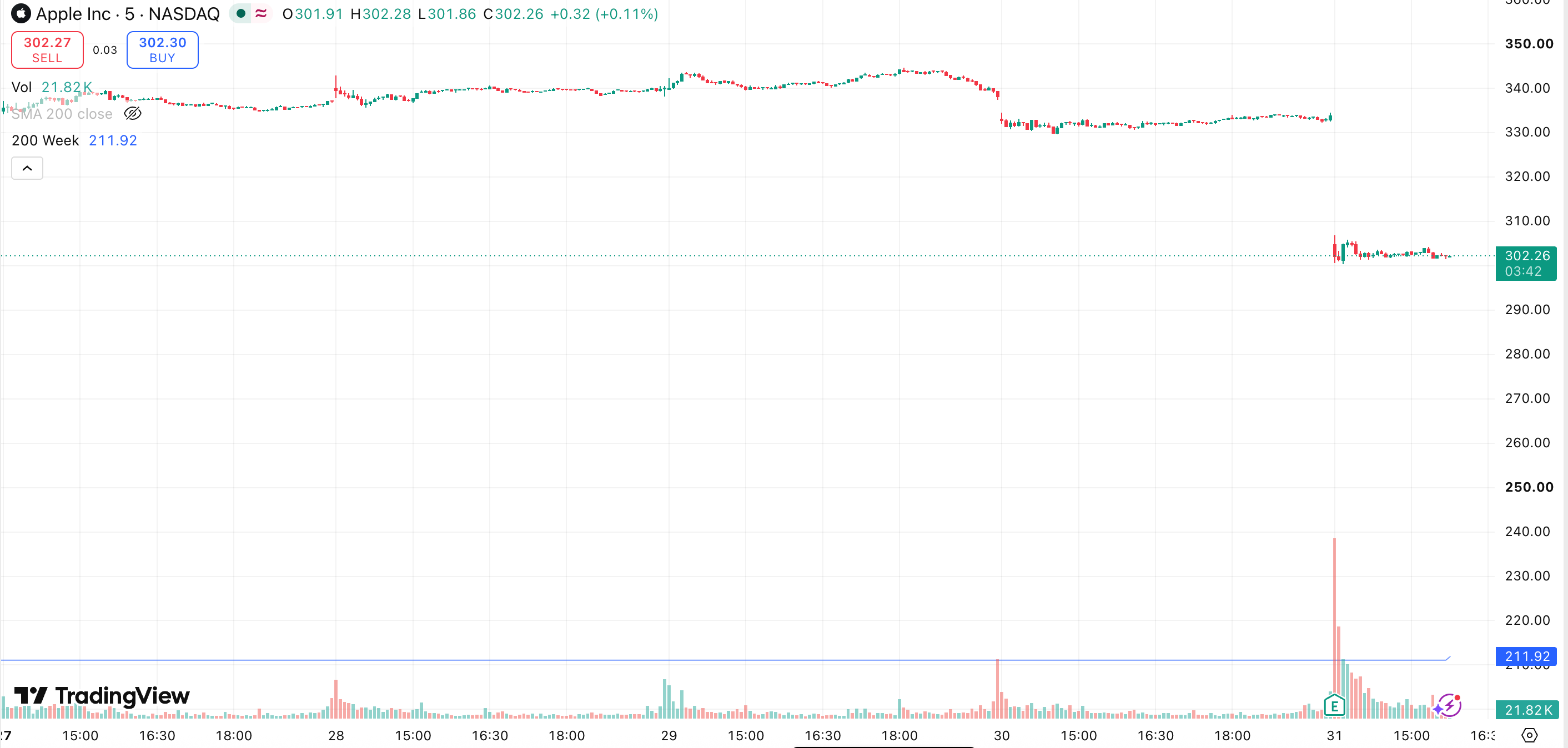
Apple shares fell more than 8% in after-hours trading, with the decline reaching 8.37% at its deepest point. That was the biggest single-day drop since April 2025. The closing price at one point fell into the $301-$312 range, and more than $300 billion in market value was wiped out in one day.
The market is shifting from AI demand to free-cash-flow discipline
Viewed together, the five reports tell a clear story. Revenue and profit mostly beat expectations, and AI-related businesses, whether cloud services, data-center chips, or enterprise AI tools, are still growing much faster than the broader companies around them. That suggests demand has not yet shown signs of slowing.
The divergence in stock performance shows where the market focus has moved. Investors are no longer centered on whether AI demand exists. They are watching whether capex can translate into free-cash-flow returns. Alphabet and Meta were sold off after higher spending plans pushed cash flow into a weaker position. Microsoft won support by lowering its capex outlook and saying free cash flow should stay positive.
If that pattern holds, the next earnings season may hinge less on revenue and profit alone and more on how each company explains the timing of its capital spending and the path to returns.
Other earnings reads mentioned in the original article
- Why SK Hynix's most profitable quarter ever still fell short of expectations
- Robinhood moves toward a “super financial app” with 13 business lines above $100 million in annualized revenue
- After STRC's major depeg, how Strategy is trying to repair its capital flywheel in its first earnings report since the event
- Cycle stock or growth stock? Coinbase Q2 results reopen the valuation debate