

Binance hit its ninth anniversary this week. The milestone comes as the exchange has increasingly used one term throughout the year: "Super App." In ABMedia's framing, that shift signals an ambition that stretches past crypto trading alone. As products linked to traditional assets — including commodities, stocks and tokenized equities — are brought onto the platform, crypto exchanges are being recast from trading venues into broader financial infrastructure.

The article defines a Super App as a single entry point that combines communications, payments, commerce, finance, lifestyle services and even AI agents. Instead of moving across dozens of apps, users operate through one account connected by a shared payment and settlement layer. That reduces switching costs between services.
WeChat, Alipay, Grab and Gojek are presented as the first successful Asian examples. ABMedia adds that by 2026, companies including Meta, X, Uber, Binance, Coinbase, OpenAI and Anthropic are all chasing the same position from different directions: becoming the first app users open each day.
It also offers a simpler analogy. A Super App works like a large department store. Once inside, a user can meet many different needs without walking between separate shops.
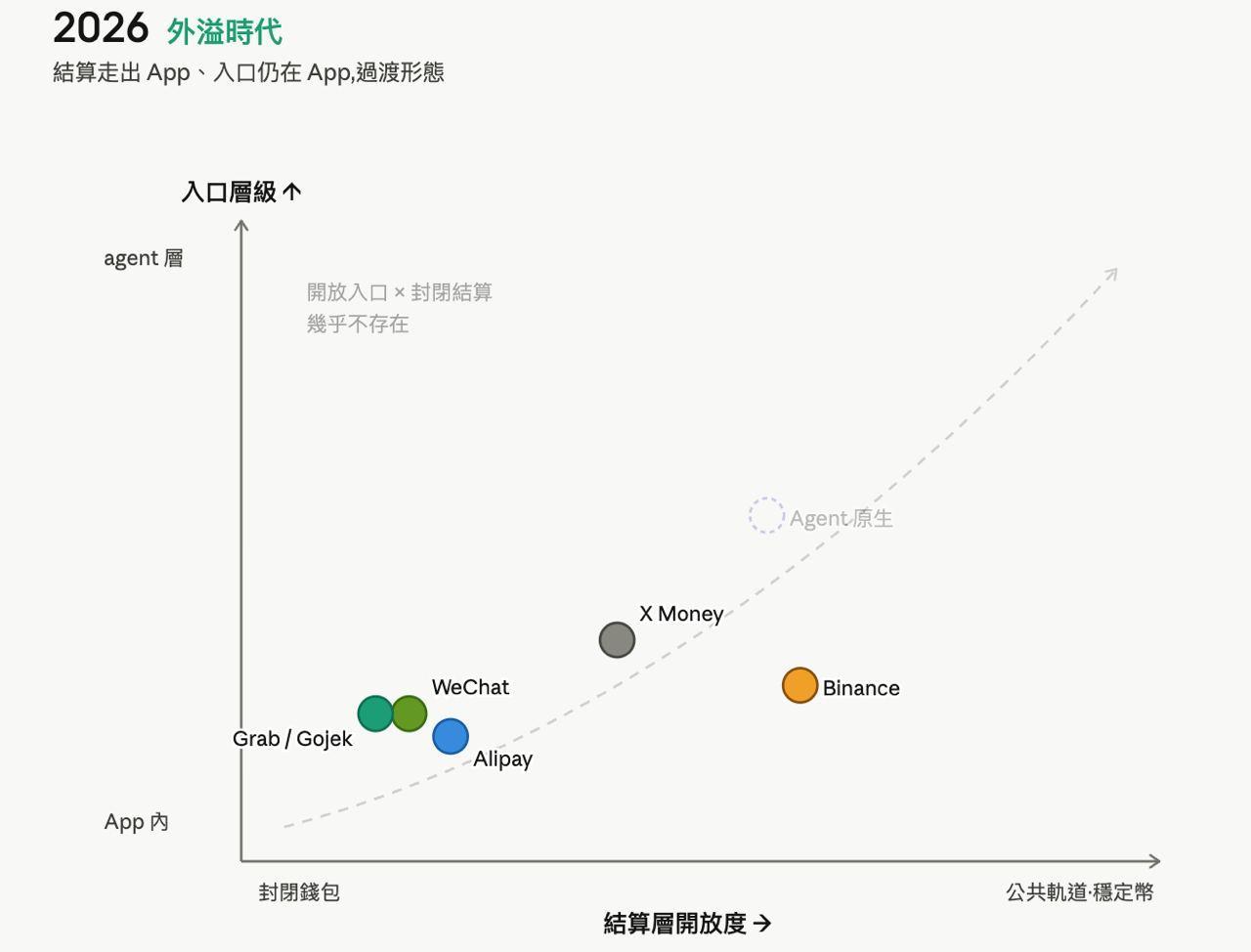
For financial Super Apps, the article says the story is no longer just about stuffing in more features. The path now runs along two dimensions: the entry layer moves upward, while the settlement layer opens outward. As stablecoins become part of the financial base layer and AI agents begin replacing actions once spread across many apps, fintech may be approaching a turning point from walled gardens to public rails.
Two variables: entry level and settlement openness
ABMedia breaks the history of Super Apps into two core elements: how often users naturally enter through the app, and how the system settles value underneath.
Every Super App needs both. One is a high-frequency entry point that gives people a habit of opening it every day. The other is a settlement layer, the ledger that ties all services together. In that framework, the evolution of Super Apps is the evolution of those two layers.
Phase one: control the entry point, keep the ecosystem closed
The first phase is summarized this way: the entry point sits inside the app, and settlement sits in a private wallet.
That model depended on moats. Users were kept inside a closed ecosystem. WeChat, with monthly active users above 1.4 billion, is described as the first app opened each day by most mobile internet users in China and, in that sense, the operating system of Chinese digital life. Alipay, Grab and Gojek came in through payments and transportation, but they shared the same structure: aggregation happened inward, mini programs had to live inside the platform's ecosystem, and money had to move through the platform's own payment rails.
ABMedia says that model was supported by several structural conditions: low financial service penetration, cash-heavy payment habits, relatively loose regulation in the early period and the rapid spread of mobile internet.
During the rise of WeChat Pay and Alipay, credit card penetration in China was about 16%, based on the World Bank's 2014 Findex data cited in the article. The People's Bank of China did not impose systematic regulation on third-party payments until the 2015 rules for non-bank payment institutions' online payment businesses. That earlier gap gave private wallets room to expand. The article says similar conditions were present in Indonesia, Vietnam and the Philippines, helping Grab and Gojek move from transportation into financial payments.
Set against that, Meta's Libra/Diem, Uber Money and Square's Cash App are cited as Western attempts that did not scale to the size once envisioned. The article references comments from a16z partner Connie Chan and Stratechery's Ben Thompson, who argued that the success of Eastern Super Apps did not simply come from stronger product design but from filling structural gaps that Western markets did not have.
Phase two: blockchain opens the financial layer
In the second phase, blockchain and crypto changed the settlement story. A settlement layer built on blockchain no longer depends entirely on the traditional financial system, and that produced an on-chain ecosystem where value can move more easily across borders, platforms and wallets.
Once the boundaries around money widened, the built-in advantage of phase one entry points came under pressure. ABMedia argues that phase two Super Apps need financial applications that are more open and flexible. Competition is no longer about piling on services. It is about letting more types of assets share the same liquidity and settlement capacity.
Binance is used as the main example. Beyond crypto trading, the article says the company launched Binance Stock Trading. Users can buy more than 7,000 U.S. stocks and ETFs on the platform with stablecoins such as USDC and USDT or with BNB, while receiving the same dividend distributions and corporate action rights.
At the same time, Binance also rolled out tokenized U.S. equity trading through bStocks. According to the article, the offering now includes tokenized shares tied to more than 30 listed technology names, including Tesla, Nvidia, SpaceX and Circle.
The comparison with traditional brokerages is not about having the broadest product shelf. IBKR, Schwab and Firstrade still hold an advantage in overall coverage, the article says. Binance's edge, in this telling, sits in settlement. Stablecoins connect crypto capital directly with U.S. equities, letting users who already hold crypto exposure extend allocations into stocks and ETFs inside the same app without moving funds out to a traditional broker.
ABMedia includes several figures to illustrate demand:
- Within 30 days of launch, Binance Stock Trading reached $1 billion in assets under management and more than $3 billion in cumulative trading volume, with 73% of activity coming from emerging markets.
- Within 15 days of launch, bStocks passed a $100 million market value, with 58% coming from emerging markets.
The article also notes that traditional finance platforms are changing too. Robinhood, eToro and Futu are named as online brokerages that have moved into crypto and incorporated services tied to stablecoins and other digital assets into their ecosystems.
In ABMedia's reading, blockchain enables instant cross-border payment and settlement, linking together use cases across the broader financial market. Stablecoins have moved from being trade instruments and investment targets to becoming on-chain financial infrastructure. That is where the boundary between traditional finance and crypto finance begins to blur.
Phase three: AI agents as the new front end
The article's final step is the most forward-looking one. If phase one was about the entry point and phase two was about the settlement layer, phase three may be about agency itself.
As AI agents develop, a financial Super App may no longer look like an app packed with features. It may become an intelligent agent that understands what the user wants, coordinates services across platforms and completes tasks directly on the user's behalf. In that model, stablecoins and other on-chain assets would function more like a public settlement layer, while AI agents become the front end.
ABMedia points to Binance AI Pro as an early, tangible version of that logic. The tool is built on the open-source OpenClaw framework. Rather than training its own model, Binance plugs in ChatGPT, Claude, Qwen, MiniMax and Kimi.
The goal, the article says, is not to build one smarter brain but to control the layer that orchestrates several brains. Just as important, Binance breaks trading functions into separate "Skills." Those include Binance's own Skills and third-party AI Skills, which an agent can combine and call based on user instructions. A complicated multi-step trading process is then compressed into one conversation.
In that setup, the entry point changes from a row of icons to a sentence. The unit of aggregation is no longer the feature page. It becomes whatever capability the agent can summon. Users do not need to open a particular function. They state what they want done, and the system pieces the workflow together.
ABMedia also makes clear that this remains constrained in practice. Most AI-driven commands are still limited to operations inside individual platforms, not true cross-platform execution. Letting agents carry out transactions for people raises unresolved issues in security, technology and law.
Even so, the article describes the direction as clear. AI, in its view, will be the next technology to change how people trade, which makes deeper integration with AI a likely path for major platforms.
Where Binance stands now
ABMedia closes by linking the three stages together. From closed first-generation Super Apps, to open finance built on blockchain, to a possible AI-agent front end, the central contest stays the same: whoever becomes the most natural daily entry point for users has the best chance to redefine the next generation of financial services.
Whether Binance becomes a defining representative of that third phase remains an open question, the article says. But in its assessment, the company is already standing near the front of that transition.