

A MarsBit opinion article argues that having more asset categories does not automatically translate into a stronger wealth effect for crypto exchanges.
The piece opens by placing two moments side by side. In 2021, CZ said that centralized exchanges were only an intermediate step on the way to on-chain DeFi. By 2026, the author says, the setting had changed sharply: meme trading was being pushed back into focus, while the peer-to-peer transfer system imagined by Satoshi had increasingly become a backdrop for player-versus-player market behavior.
According to the article, if the history of exchanges is drawn as a single line, 2026 may mark one of the weakest periods for both liquidity and reputation. It cites BitMEX, described as the inventor of perps, as having failed to sell itself and ultimately shutting down; AB Finance as failing early; and OKX as becoming absorbed by compliance while neglecting its core identity. In that reading, the choice between becoming an all-in-one brokerage and going deeper on-chain is no longer ideological. It has become a survival question.
The author adds that no one knows whether a crypto market without centralized exchanges would rely on on-chain systems to overturn traditional finance or instead destroy confidence the way Mt. Gox and FTX did. Even so, the piece says this is the right time to write an interim summary of the exchange era, because turning points in market structure often feed directly into specific wealth opportunities.
Coinbase expanded its product menu, but that did not guarantee a second growth curve
The article says the story that began in 2025 around the “universal brokerage” model carried into 2026 through perp DEX products, PM, stock exposure, Pre-IPO offerings, and the incorporation of U.S., Korean and even A-share-related assets into centralized exchange narratives. Still, the author argues that a richer SKU mix has never been enough on its own to create outsized profit opportunities. Trust and excess returns, in this view, come from screening standards rather than shelf size.
Coinbase and Robinhood are presented as opposite cases. The piece says Coinbase has made broad efforts to defend itself, from pushing “Web3 meme social” through Base to acquiring options lines such as Deribit and Opyn. Yet the bigger the “Everything Exchange” slogan becomes, the wider the gap appears between ambition and reality.
Alongside an image captioned “You can’t buy fighting power,” the author says a close reading of Coinbase’s financial data would leave little room for easy optimism around institutional DeFi. The article notes that banks and pension funds can control tens of trillions of dollars, but says the key question is how much of that capital can actually become usable liquidity for crypto markets. Coinbase is used as the example behind that caution.
The same skepticism is applied to the idea of institutions trading against prediction markets or joining incentive races around stock perps. By contrast, the article says Robinhood’s embrace of Meme, NFT and DeFi, as well as its introduction of Arcus, a new perpetual DEX product built with dYdX, looks more aligned with crypto-native playbooks. The author’s conclusion is blunt: adapting to outside expectations is less effective than leaning into what the market already understands.
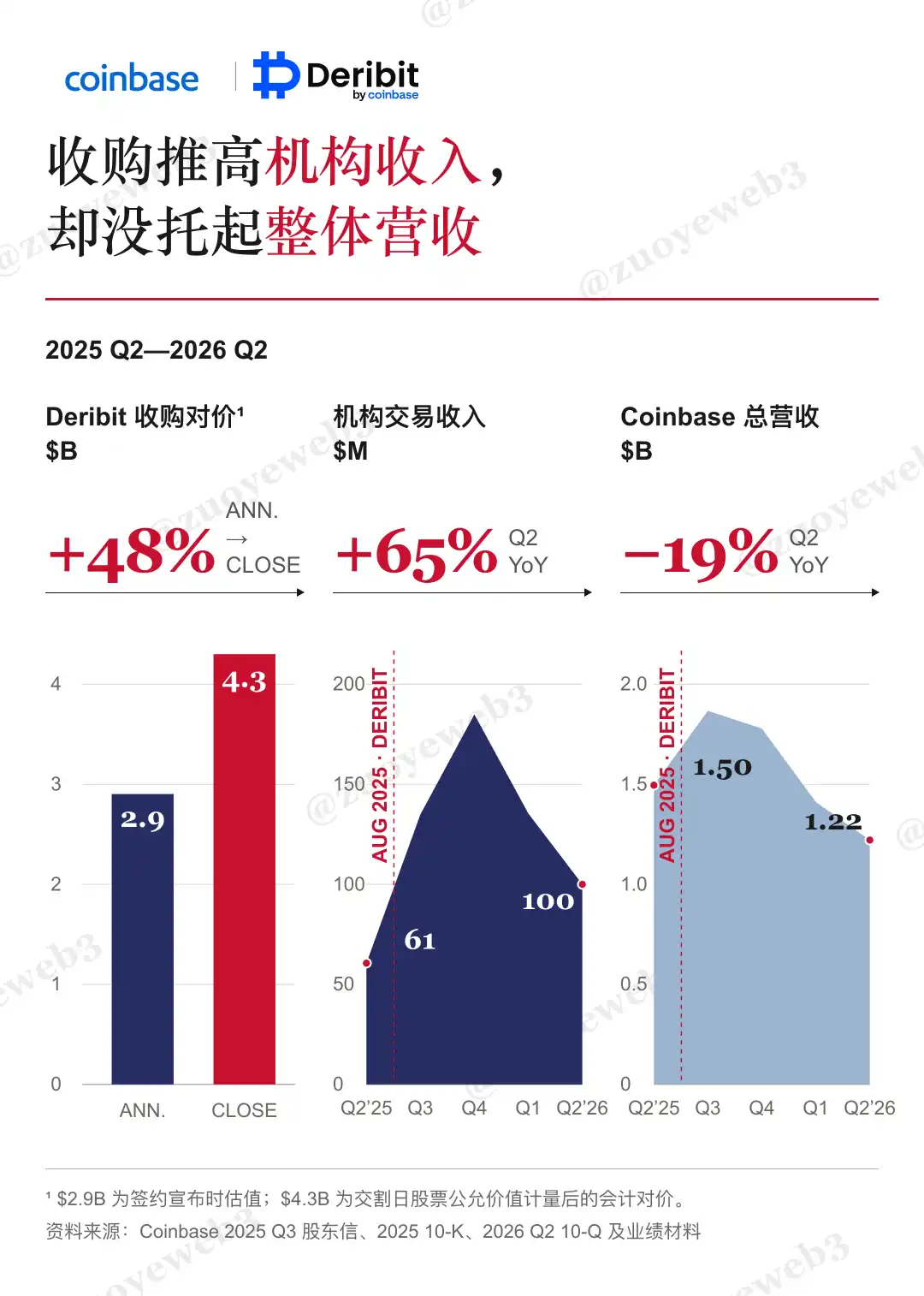
In the article’s framing, Coinbase and Robinhood in the West are now moving toward a real split in positioning, something it describes as the biggest change since Binance rose to the top in 2017. But the piece says this shift is not mainly the result of major product breakthroughs from U.S.-backed exchanges. Instead, it reflects weaker growth at offshore exchanges associated with Chinese founders, including Binance.
Binance is facing slower growth, while options show early signs of change
The article says Binance’s problems do not require heavy external data to identify. It points to repeated cuts in Binance VIP requirements and says BTC trading volume on Binance has stalled multiple times.
At the same time, options, a segment long dominated by Deribit, are showing some changes. MarsBit says Bitget is trying to build out lines such as FCN fixed-coupon notes, which the author characterizes as a repackaged version of dual-currency yield products. Bybit’s options line is also described as moving quickly. The article further says Deribit has even been dragged down by Coinbase, leaving its overall share under more pressure.
That does not lead the author to a simple “East rises, West falls” conclusion. Options and other complex derivatives, the piece says, have long held less than 5% share compared with easier-to-understand perpetual products. Against that backdrop, the article asks whether simpler distribution of complex financial products can support the next phase of exchange development. It leaves the question open, while suggesting that this route may become a rational post-crypto choice for second-tier exchanges.
Large platforms such as Binance may still need to think about the all-in-one brokerage route, the author writes, but many second- and third-tier venues are more likely to depend on wider SKU coverage simply to find a regional market where they can survive and earn passage fees. As one example, the piece says if Alpaca behind bStock already counts as a mini partner, then Atomic Vaults, the channel behind Bitget Stock+, may have fewer than 10 people. The point is not the exact ranking of products, but the limited commercial depth behind some of these narratives.
DeFi, CEX and traditional finance are rearranging their boundaries
In a section headlined around the convertibility of structured yield products and perpetual contracts, the article says centralized exchanges are going through a kind of role swap.
- Between DeFi and CEX, the article says the TGE business has cooled, and on-chain DeFi now needs centralized exchanges to distribute real businesses. It gives the example of R25 distributing the Phraos token through Binance, tied to consumer lending in Southeast Asia.
- Between CEX and TradeFi, the article says RWA perps and stock perps are only the brightest examples. Traditional finance is already moving on-chain, but centralized exchanges are not seeing much real business expansion from that shift.
The author says this looks very different from CZ’s 2021 idea that Binance would eventually become a DEX. In the current market, the DeFi financial stack is no longer something that can be summarized by only a few forms such as DEX and lending.
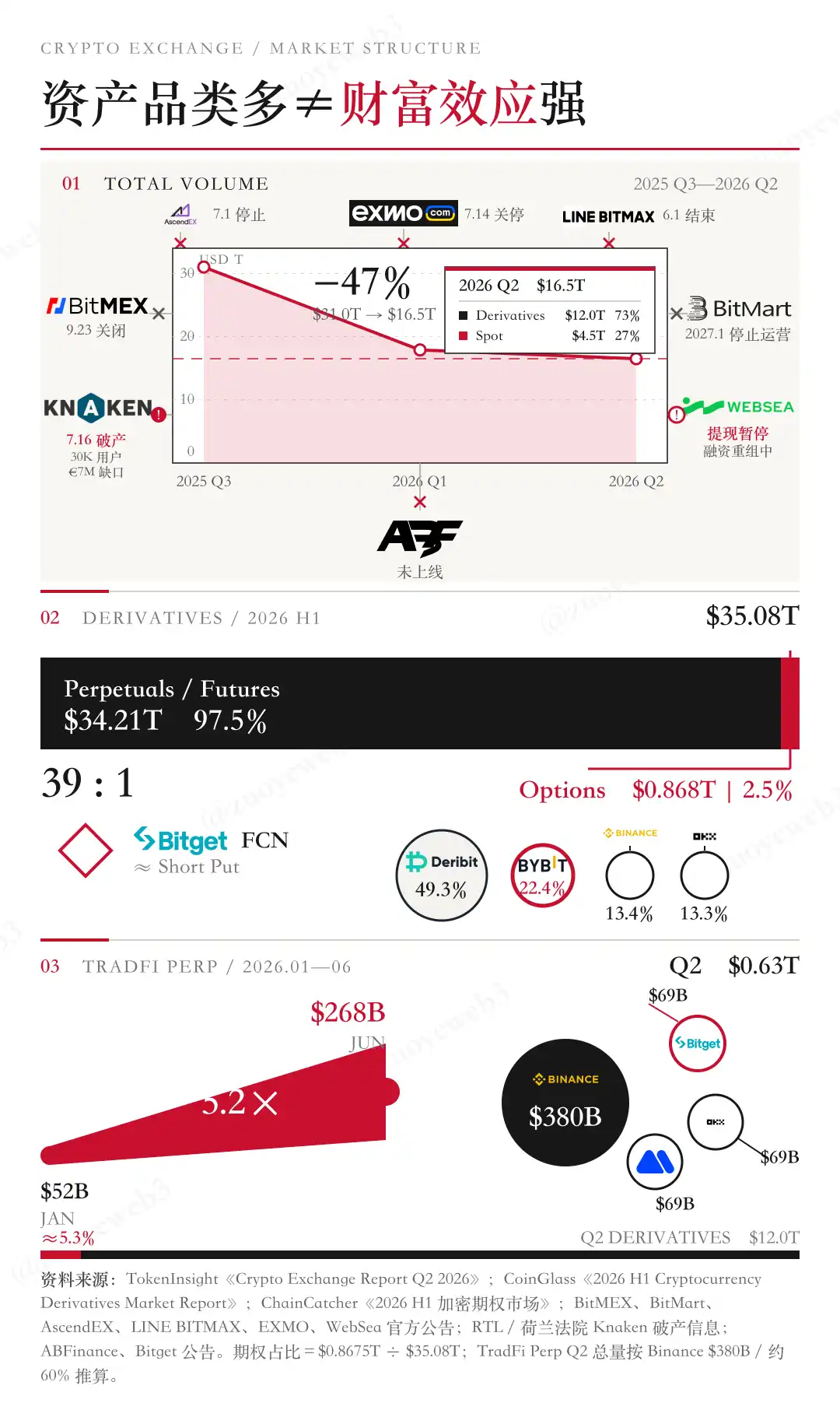
From the article’s perspective, Coinbase proved that retail trading remains indispensable, while Binance proved that new assets do not necessarily need old platforms. The incremental business for CEXs is now concentrated in a small number of areas, including stocks. Yet outside KOL posts and paid reports, the article says total exchange trading volume has almost been cut in half, and dominating a shrinking market cannot offset broad, industry-wide blood loss.
The piece also mentions Bitget Wallet’s million-level BD marketing campaign, describing it as a sign that the chill has reached the distribution layer. Even teams focused on bringing in users, the author argues, now have to prove they can directly make money.
On Pre-IPO and stock perps, the article says it will not fully restate why those products are “destined to fail,” but offers a core reason: exchanges do not control price discovery for stocks and similar new assets. That point leads to a broader question in the piece—whether crypto can still regain pricing power over certain assets at all.
As examples, the article says Changxin, a memory company, was priced first by TradeXYZ, while Unitree Robotics may become another case to watch in seeing whether a globally accepted valuation can emerge through market trading. In that framing, reclaiming asset pricing power “stolen” by Wall Street becomes the real beginning, middle and end of the next contest. Pre-IPO is only the opening exam question.
The author makes clear that this does not mean Pre-IPO and stock perps are unimportant. Instead, the article says IPO underwriting, subscription, trading and prime brokerage services all remain firmly inside the traditional financial system. Occasional on-chain arrangements do not change that. It also says blockchains and stablecoins have not gained much from the process either, and that Robinhood Chain, after using Meme to complete its cold start, will still move toward real financial business.
Exchanges are still profitable, but the era of easy windfall margins is fading
The article then returns to liquidity. It says Coinbase’s institutional DeFi narrative is a story Wall Street can understand, and when combined with the natural advantage the U.S. holds in shaping public discourse, that story can quickly turn into an industry consensus.
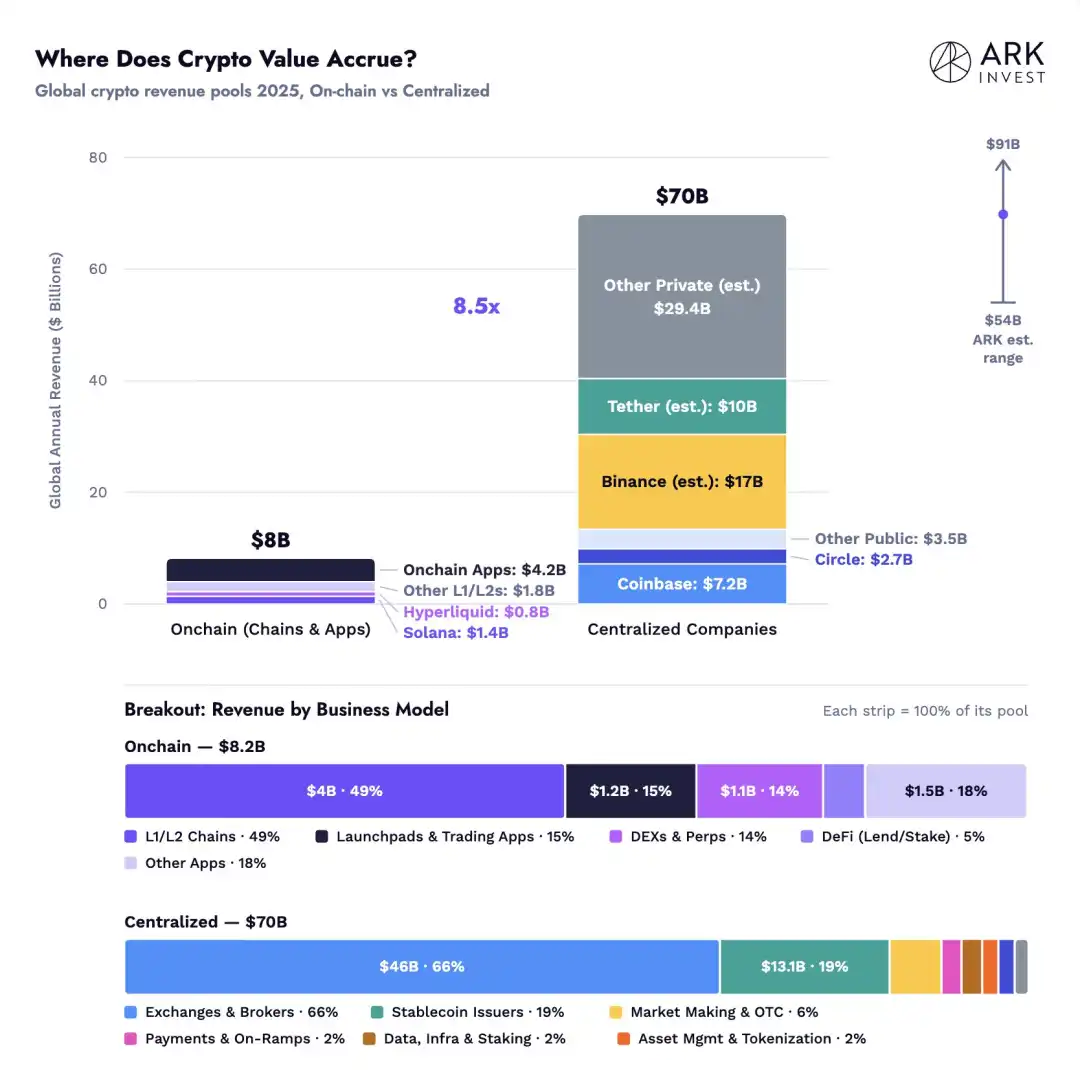
But the author also tries to correct what it sees as a common misunderstanding. The problem for exchanges is not that they have stopped making money. The problem is that they can no longer easily sustain extreme profit levels. In the article’s telling, exchanges still make more money than DeFi and stablecoins combined when the industry’s revenue split is viewed as a whole.
The piece continues by saying that institutionalization in U.S. finance is already a fixed path, and crypto is mostly moving in step with U.S. equities. In the role swap between CEX and traditional finance, Nasdaq is planning overnight trading and has designed those hours to sit in Asia’s daytime, with 5X23 h meant to serve Asian investors. The article says competition around technology stocks and international liquidity will create new opportunities in that environment.
It also notes that Binance has listed contracts tied to Changxin, but argues that Asian investor demand has never been only about adding leverage. The article says the fact that A-shares do not allow short selling does not by itself produce either market frenzy or market weakness.
The conclusion in this section is that the apparent “home-field attack” from crypto exchanges on Wall Street may look like an attempt to sell Pre-IPO and super-brokerage products back to U.S. institutions. The deeper issue, though, is how to arbitrage global markets from within a regulated financial system.
The article’s ending: exchanges are moving toward matching and record-keeping roles
MarsBit closes by saying exchanges are gradually being pushed into the second line, where their role is closer to matching trades and keeping records. In that model, they become launch venues for products such as Pre-IPO and stock perps, while equities and DeFi form a new financial stack around them.
The article says the historical mission of exchanges will not end with OKX’s compliance path, nor with Bitget’s later move into C2C. Instead, the author ties the turning point to what it describes as CZ’s market manipulation behavior using Meme, arguing that exchanges no longer have the capacity to create a new asset issuance model.
The final line of the piece is that one era has ended. What the market is seeing now, in the author’s words, is closer to a struggle inside a sinking ship than the start of a new cycle, and the real task is to look for newer ways to issue assets.