

The Bank for International Settlements published an eight-page research brief on Oct. 1, 2026 titled Circular Relationships Between AI Companies, focusing on how money now moves inside the AI industry. The paper describes a pattern in which a cloud provider invests in a model company, and that company then spends part of the capital on cloud services; a model developer invests in a compute supplier to lock in future capacity; or two companies buy from each other while also taking equity stakes in one another.
This kind of arrangement existed in older industries, but BIS argues AI has pushed it to a larger scale. Chips, data centers, cloud infrastructure and foundation models all require heavy, continuous capital spending, while order cycles are long. That makes one-off procurement contracts less effective as a basis for long-term cooperation. Equity, loans, long-duration purchasing commitments and reserved compute capacity are increasingly being bundled into the same commercial relationship. An investment can create orders, those orders can support revenue and valuations, and companies across the supply chain can end up linked through both capital and trade.
Money is beginning to circulate along the AI supply chain
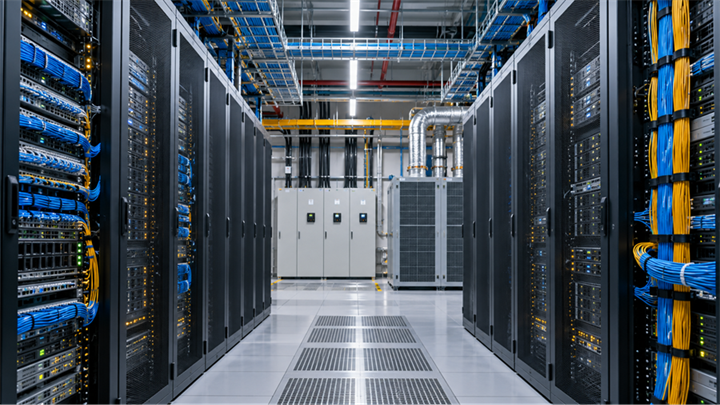
Figure 1 shows servers, networking equipment and cooling systems, the physical layer where AI investment first lands.
BIS compiled a universe of 1,246 AI companies spanning five segments: compute, infrastructure, data tools, models and applications. It combined PitchBook financing records with FactSet supply-chain data and then added transaction-by-transaction manual verification. The result was the identification of 972 intra-AI investment relationships between 2021 and 2025.
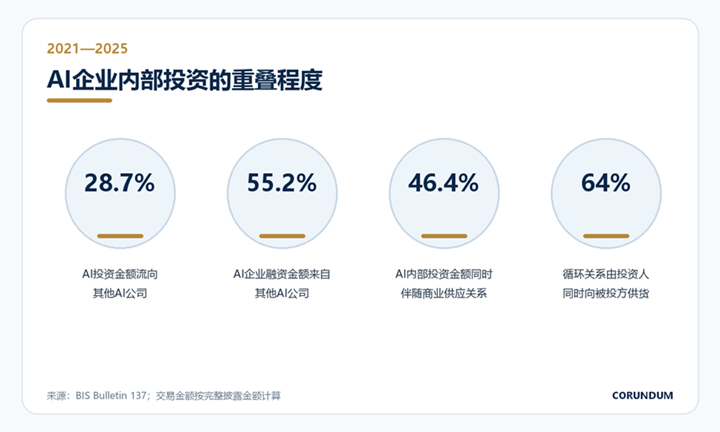
Measured from the investor side, 28.7% of the dollars deployed by AI companies went to other AI companies. Measured from the funding side, 55.2% of the capital raised by AI firms came from other AI firms. BIS says that points to frequent internal capital circulation, with upstream giants, model developers and infrastructure providers often appearing on both investor lists and customer lists.
The brief defines a “circular relationship” as one in which two AI companies are connected by both an investment relationship and a supplier-customer relationship during the same period. The definition is meant to capture persistent business ties over a five-year window. It does not require a specific investment to be contractually tied to a specific purchase. BIS says that makes the framework closer to how the industry actually operates: one company may invest first and sign a procurement deal months later, or the companies may cooperate commercially before using equity to reinforce the relationship.
This network can also change how dependence on a single customer appears. The larger the revenue contribution from one customer, the more important cross-holdings and long-term purchasing commitments become. Management teams then face more pressure to explain where future demand will come from and whether contracts would still hold if the sector cools. In turn, markets may reassess revenue quality and customer concentration.
Three common forms of circular ties
Figure 3 lays out three recurring structures in circular investment relationships among AI firms.
The first starts with the supplier. A chipmaker, cloud provider or data center operator invests in its customer, and the customer then purchases compute, chips or cloud services. Capital and products move in the same direction. Suppliers can monitor real usage and expansion pace more closely than a financial investor would, while customers with fresh funding are in a stronger position to commit to long-term orders.
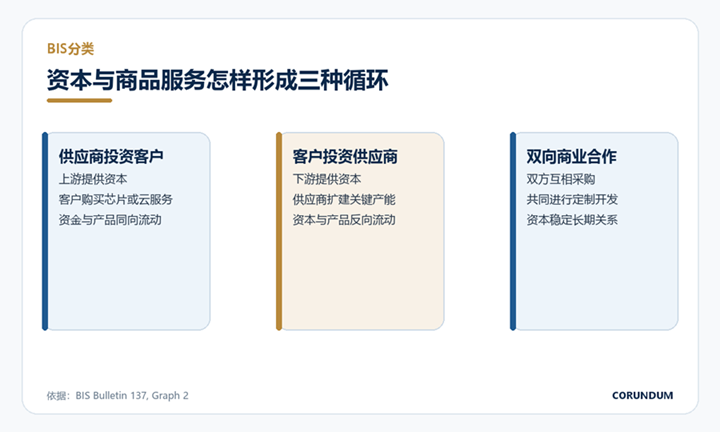
The second begins with the customer. A model company or large technology group invests in a key supplier, sending capital upstream while chips and compute services flow back downstream. The central issue here is resource security. High-end chips, facility power and specialized data centers all require buildout time. An investment can secure more stable capacity allocations and give the customer earlier visibility into the supplier’s expansion plans.
The third form is more entangled. Both sides buy products or services from each other. A model may be optimized for a particular chip architecture, a cloud platform may integrate that model into enterprise offerings, and the model developer may also buy training and inference services from the same cloud platform. Equity ties connect these contracts and make both sides more willing to fund custom development, dedicated equipment and long-term operations.
BIS links this to what economics literature calls “relationship-specific investment.” These are assets built for a particular counterpart and worth materially less when reassigned elsewhere. A data center cluster designed around one model or a software stack rewritten for one chip family falls into that category. Equity ties can stabilize expectations and lower the incentive to renegotiate once the infrastructure is already in place.
Public partnerships already show what the network looks like
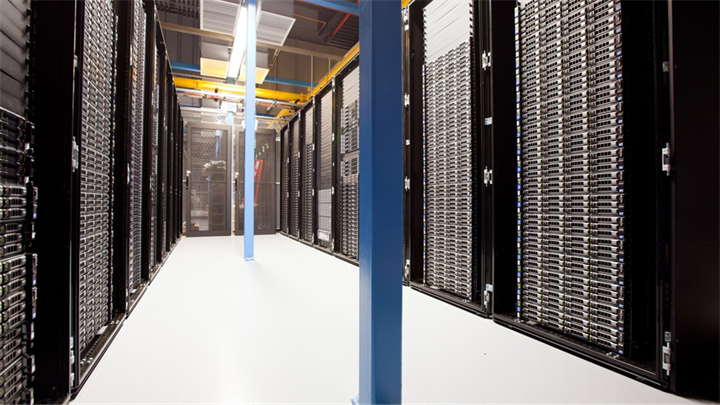
Figure 2 shows a Wikimedia server room, a reminder that AI demand for compute ends up as large-scale spending on racks and equipment.
Microsoft and OpenAI are among the most visible examples. Microsoft said in 2023 that it would continue a multiyear investment worth tens of billions of dollars and named Azure as OpenAI’s exclusive cloud provider. The capital supports model development and compute expansion, while the cloud contract channels a significant share of spending back to Azure. Microsoft also distributes model capabilities through its own products, so the same relationship contains investment, procurement, infrastructure and product distribution.
Amazon and Anthropic follow a similar structure. Amazon said it would invest up to $4 billion, while Anthropic made Amazon Web Services its main cloud provider and used Trainium and Inferentia chips to train and deploy models. For Amazon, the deal brings model access and cloud usage. For Anthropic, funding, chips and customer access sit inside one long-term framework.
Large partnerships also embed technical switching costs. Once a model has been trained and optimized on a particular class of chips, inference tools, data pipelines and monitoring systems are built around that environment. Moving to another cloud provider can affect engineering workflows and product stability. An investment relationship extends the time horizon and makes both sides more willing to absorb upfront adaptation costs together.
CoreWeave, a compute leasing company, shows another version of the pattern. Nvidia supplies the GPU ecosystem to CoreWeave while also participating in its financing and expansion arrangements. CoreWeave continues to build out data centers, and Nvidia gains a stable deployment channel at scale. BIS says the relationship can directly shape equipment purchases, capacity utilization and the next round of capital spending.
Contract structures differ from deal to deal, and these partnerships are at different stages. Still, the common thread is clear: scarce AI resources are concentrated in a small number of companies, and spot purchasing alone is not enough to cover multiyear build cycles and product timelines. Capital ties become an extension of supply contracts.
46.4% of disclosed investment value also overlaps with commercial ties
Figure 4 summarizes the key numbers from AI investment relationships between 2021 and 2025.
BIS found that 16.1% of AI-to-AI investment deals, measured by count, also had a commercial supply relationship attached. Measured by disclosed deal value, that share rose to 46.4%. The overlap is stronger in large transactions. Within circular relationships, 64% involved cases where the investor also supplied products or services to the company receiving the investment.
The concentration is strongest upstream. About 73% of circular investment relationships came from compute or infrastructure companies. Chipmakers, cloud platforms and data centers control resources that are expensive and slow to build. Model companies want to secure supply in advance, while upstream providers want evidence of long-term demand. Each side absorbs part of the risk, and financing becomes a natural extension of that arrangement.
The brief also compares AI with older sectors. Across more than 10,000 customer-supplier relationships in the United States, only about 3.3% involved direct equity ownership in a trading partner. In AI compute, cloud and related infrastructure submarkets, the ratio reached 15.2%. BIS attributes the higher frequency of capital ties to AI’s capital needs, concentrated supply and high degree of customization.
The authors also flag a methodological limit. BIS uses the full disclosed value of a funding round and cannot separate the exact amount contributed by each investor. That means the 46.4% figure shows a strong overlap between large financings and commercial relationships, but it does not mean the same percentage of money was explicitly earmarked to buy the investor’s products. The paper’s narrower point is that commercial ties have become an important backdrop for AI financing.
Order growth can include demand supported by capital
The most direct financial effect of circular relationships is that the source of demand becomes harder to identify. After a supplier invests in a customer, that customer may use new funds to buy the supplier’s products. The supplier books revenue in the current period while also holding the customer’s equity or debt on its balance sheet. Revenue, expectations for investment gains and the valuation of the customer become tied together.
As long as end users keep paying, the structure can accelerate industry expansion. Model developers get compute earlier, data centers gain long-term orders and chipmakers can plan output around that demand. If final demand falls short, the stress can show up in several places at once. Customers may cut purchases. Suppliers then lose orders and may also face equity write-downs, loan losses or guarantee obligations.
BIS points to a historical parallel in late-1990s telecom equipment. Companies such as Lucent and Nortel financed network operators, which then bought their equipment. During the buildout phase, sales and loan assets rose together. When end-market revenue slowed, operators’ ability to repay and keep purchasing weakened at the same time, leaving equipment makers exposed to both weaker sales and financial losses.
The web of exposures may be broader in AI. Some infrastructure is financed through private credit, special purpose vehicles and long-term residual value guarantees. Risk may be spread across listed firms, private companies, credit funds and project entities. Looking only at an announced investment amount or a procurement contract may not be enough to reconstruct actual funding, future commitments and guarantee obligations.
Contract pricing matters too. Long-term compute agreements may include prepayments, minimum usage levels, discounts and expansion options, while an equity investment can alter expectations around future orders. BIS says that when assessing the quality of an AI company’s customer base, analysts need to view cash revenue, contract liabilities, remaining performance obligations and purchases from affiliated counterparties on the same table. That is how the duration of orders and the true ability to pay become visible.
Regulators and investors need the full contract chain
Figure 5 corresponds to the brief’s discussion of disclosure, oversight and market analysis.
BIS does not describe circular investment as inherently problematic. The structure serves real industrial needs. The policy issue is whether disclosure shows the full picture. When a company announces an equity investment, investors may also need to know whether the same relationship includes minimum purchase volumes, cloud service credits, reserved compute capacity, residual value guarantees or exclusivity provisions. Revenue recognition, customer concentration, contingent liabilities and investment impairment can all be affected by those terms.
Competition questions also enter the discussion. Companies that control chips, cloud platforms or model distribution can use investments to bind key customers and suppliers more closely. That can speed up product coordination, but it can also shape the terms under which other firms access compute, connect to models or compete for customers. Competition authorities, securities regulators and banking supervisors may each see only one part of the same network, and BIS says information sharing across agencies will become more important.
For markets, the more practical way to read the sector is to look at financing and orders together. How many outside customers came with the new investment? How much revenue comes from portfolio companies? How long do procurement commitments last? Who finances the related assets? BIS suggests those questions reveal more about the quality of AI demand than valuation tracking alone.
The brief breaks the AI investment boom into a set of relationships that can be checked rather than assumed. Compute suppliers, model companies and application platforms are using capital to secure demand, access resources and stabilize cooperation. In the years ahead, BIS says, this network is likely to remain a driver of AI growth. It also leaves the market with a recurring question: how much of any reported revenue comes from end customers, and how much comes from capital that was deployed earlier inside the supply chain itself?