



Bitcoin rebounded hard after sliding to $77,700 over the weekend, briefly climbing to $81,280 before meeting resistance again on another test of its 50-week moving average. The market is now centered on one question: can BTC actually hold above that line on a weekly basis?

The 50-week moving average is back at the center of the chart
The 50-week moving average is currently sitting near $81,000. DeFi Dad said the level is often treated as a "bull market support band" and a simple gauge for whether Bitcoin has re-entered a bull market. In his view, a clear move above it in the coming weeks would be an important signal.
Colin Talks Crypto said BTC has not yet printed a higher high, so the broader structure still needs confirmation. If a higher high does appear, the odds that a cycle low is already in place would rise sharply. If not, and if the first major rebound tops out before turning lower again, the historical median retracement is about 18.1%, with a range of 17.5% to 21.1%. Based on a pullback from $81,200, that would point to roughly $66,500, a level the article says lines up with the neckline of an inverse head-and-shoulders pattern.
Ash Crypto described the short-term structure as still bullish overall, with both highs and lows moving up. Traders are watching a defined set of levels. Local support sits at $77,800 to $78,000, stronger support is seen at $75,500 to $76,000, and the key resistance overhead is $81,270, where the 50-week moving average is located.
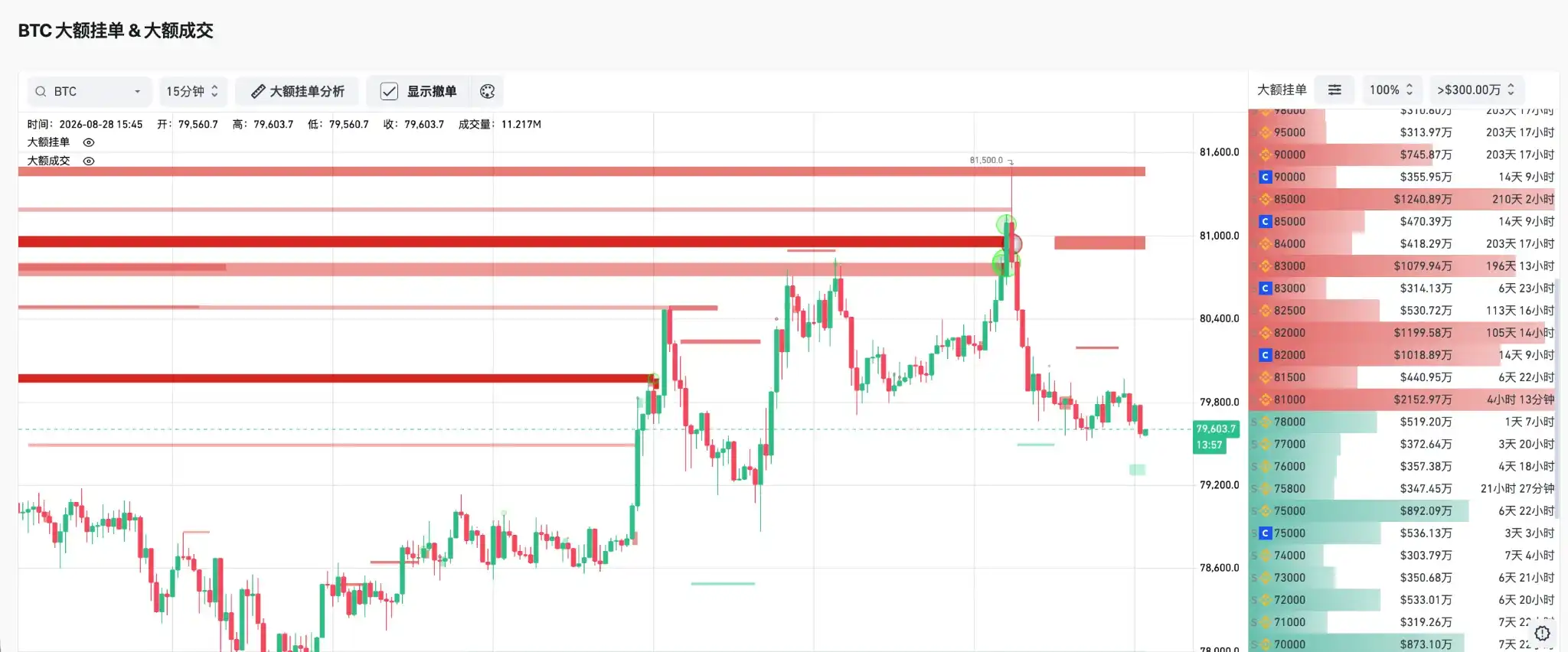
He outlined two near-term paths:
- If BTC holds $78,000 and breaks above the descending trendline, the next target would be $83,000.
- If BTC loses $78,000, it could test $76,000 before Friday.
With Jackson Hole approaching, the current range is not expected to last much longer.
Supply between $81,000 and $82,000 is colliding with options positioning
The report says technical resistance at the 50-week average is only part of the story. Structural pressure from derivatives markets is also making the $81,000-$82,000 area harder to clear. On-chain and options data show that between $83,307 and $84,569, nearly 975,000 BTC in profit-taking and trapped supply is stacked overhead. Above $82,000, there is also about $3.6 billion in negative gamma exposure in derivatives.
That forces market makers to hedge by selling as spot prices move closer to $82,000, adding friction to any upside attempt. A concentrated $6.44 billion Bitcoin options expiry on Deribit later today is described as the event most likely to break the stalemate.
The article also notes that 30-day call options are now priced above puts across the board. If the suppressive gamma pressure locked into the options book is released after expiry, and Bitcoin breaks through $82,000 on heavier volume while reclaiming the 50-week moving average, dealer hedging flows could help drive a faster move toward $85,000 and even $100,000. If that breakout fails, the piece says the market could face a historically deep stage pullback.
Crypto market items for the day
The report lists several market items:
- GameFi project DeFi Kingdoms said DFK Chain will shut down on Aug. 28.
- Falcon Finance (FF) is unlocking about 77.14 million tokens worth about $6.2 million.
- Upbit’s 24-hour trading volume ranking was XRP, TRUMP, BTC, ETH, and SOL.
- Spot Bitcoin ETFs recorded $242 million in net inflows, extending the streak to nine straight days.
- Spot Ethereum ETFs recorded $235 million in net inflows, also for a ninth straight day.
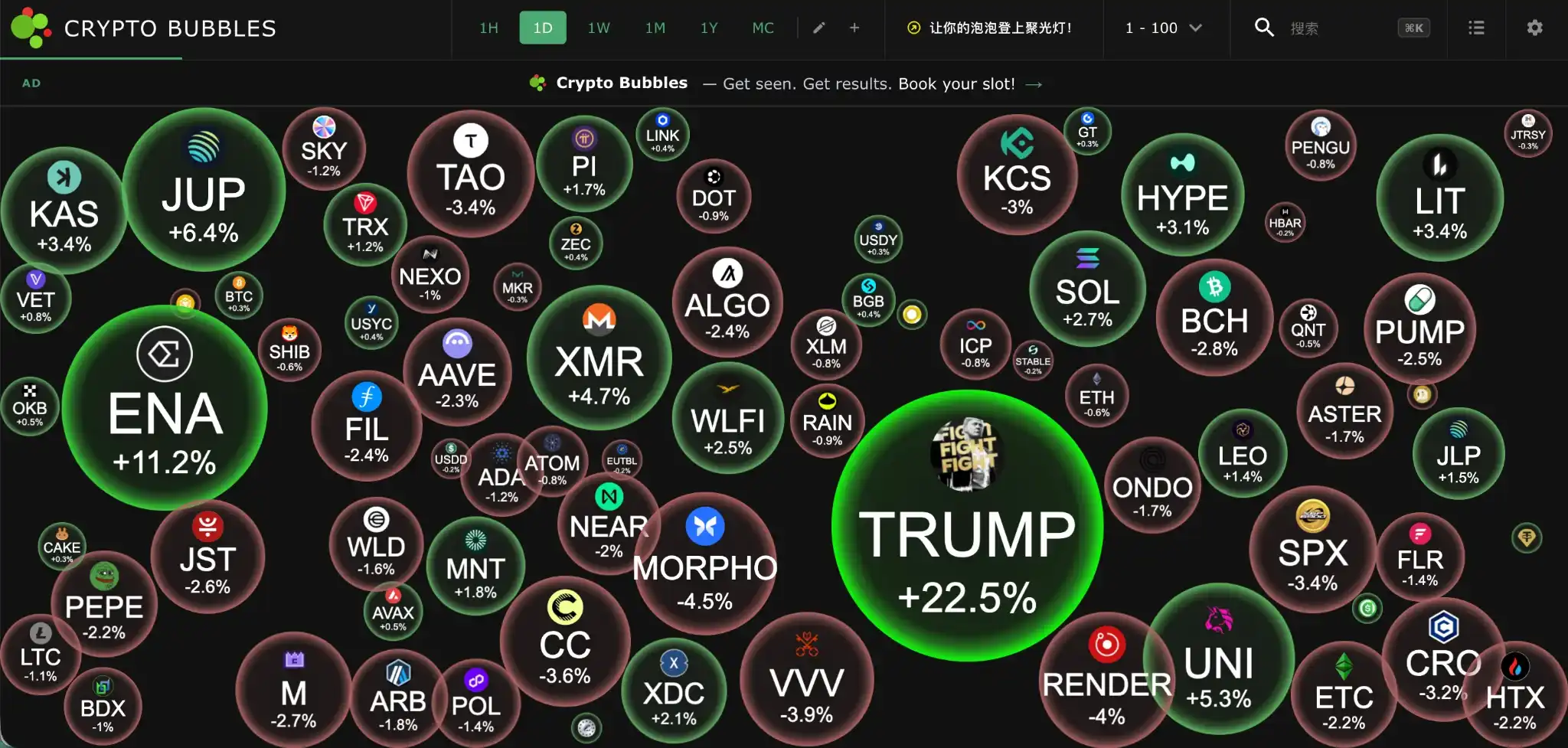
Among the top 100 cryptocurrencies by market capitalization, the biggest gainers were TRUMP, up 22.5%; ENA, up 11.2%; JUP, up 6.4%; UNI, up 5.3%; and XMR, up 4.7%.
U.S. index futures wobble as overnight trading turns selective
U.S. stock index futures were mixed, with Dow futures up 0.14%, Nasdaq 100 futures down 0.28%, and S&P 500 futures down 0.08%. After Nvidia’s earnings reignited the AI trade, attention shifted toward Jackson Hole and market mood turned more cautious.

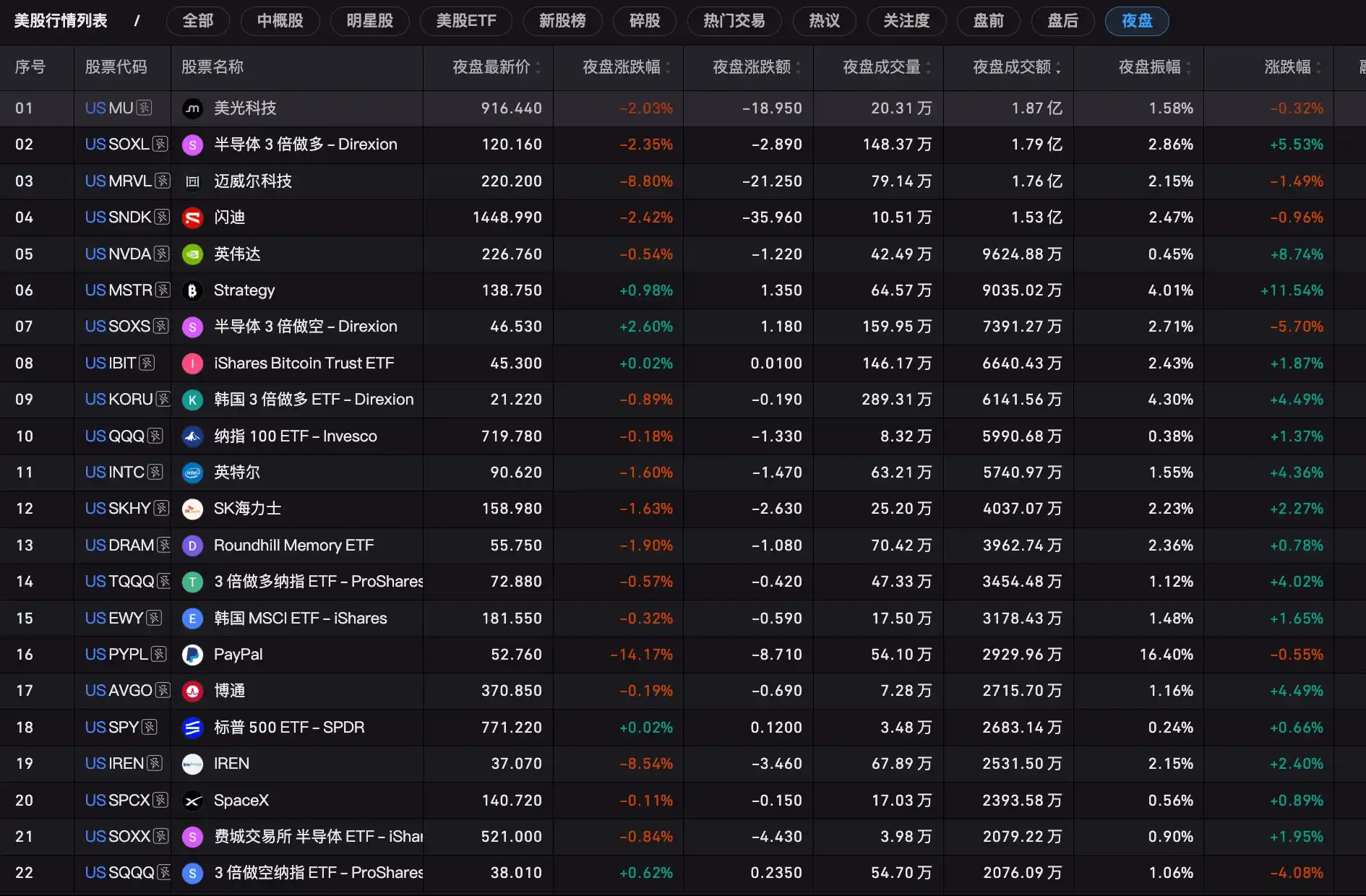
BIT overnight data showed profit-taking in AI-related names. Nvidia fell 0.54%, Micron Technology lost 2.03%, Marvell Technology dropped 8.80%, SanDisk fell 2.42%, Intel lost 1.60%, and SK Hynix was down 1.63%.
PayPal plunged 14.17% in overnight trading after reports said Stripe and Advent had abandoned plans to acquire the company. IREN lost 8.54%. While the company disclosed strong contracts in its AI cloud business, its FY27 capital expenditure target of $25 billion to $30 billion raised concern about cash burn. Marvell fell 8.8% after earnings. The report said results and guidance topped expectations, but the stock’s gains earlier this year had left little room for disappointment.
Nvidia lifts the Nasdaq, but the Fed remains the larger question
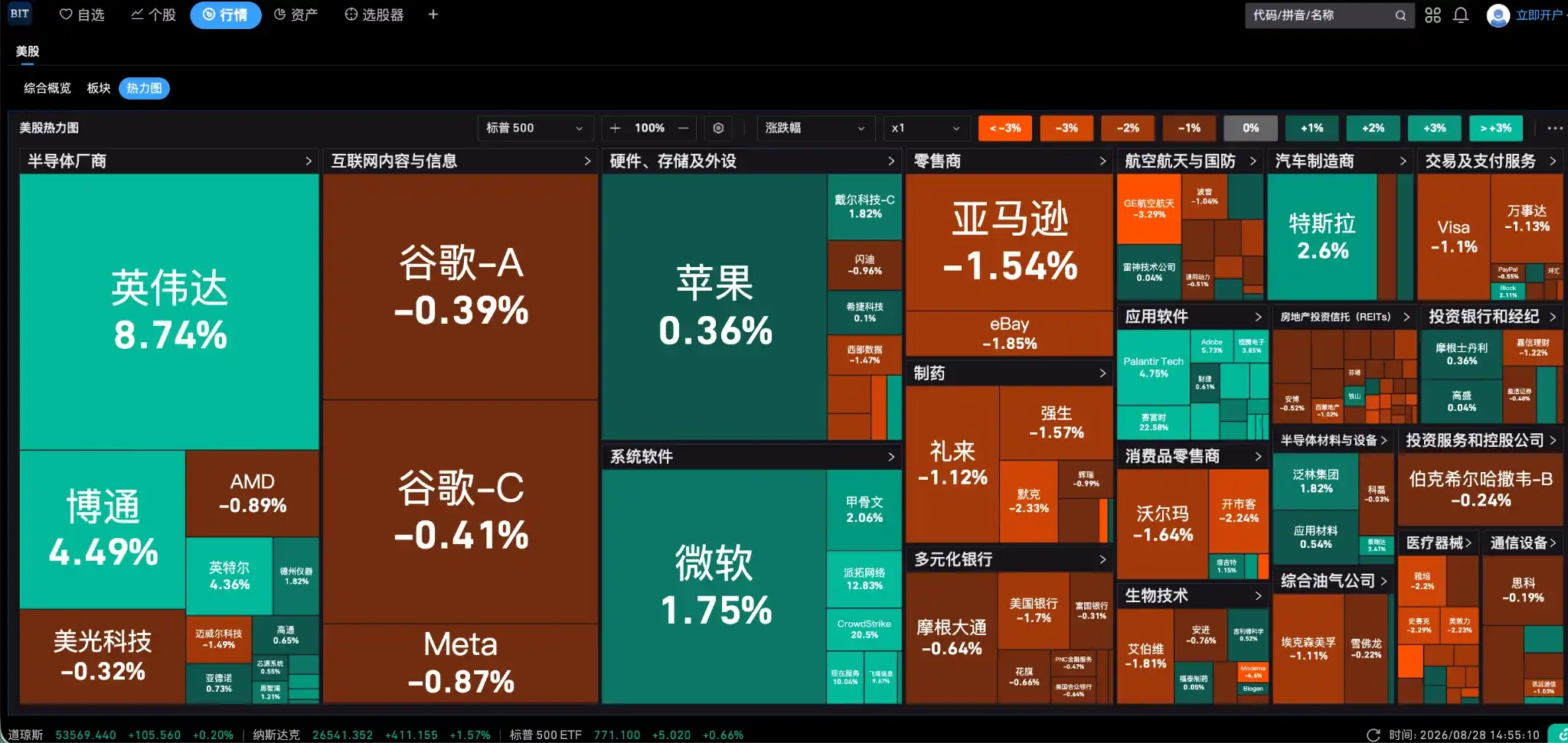
U.S. stocks the night before were driven by what the report called a one-line AI rescue. Nvidia helped push the Nasdaq up 1.57% after reporting Q2 revenue of $96.22 billion and issuing Q3 guidance that was well above expectations. Its market value increased by about $442 billion in a single day, the second-largest one-day gain ever for an individual stock. Goldman Sachs and JPMorgan both said the guidance looked conservative and argued that supply constraints, not demand, remain the real bottleneck.
Michael Burry, often referred to as "The Big Short," bought Nvidia call options yesterday, but he said the trade was only a hedge against his large short exposure and did not mean he had turned bullish. He still warned that AI infrastructure investment carries risks tied to self-reinforcing financing and overstated demand. His short equity exposure now accounts for more than 21% of the portfolio.
Software stocks also staged a strong rebound. Salesforce jumped 22.58%, Okta rose 28.63% to a four-year high, CrowdStrike gained 20.50% for its best day since listing, and Synopsys added 13.39%. Goldman Sachs said "software is not dead," arguing that AI is becoming a new tool for pricing power and expanding security budgets. CrowdStrike CEO George Kurtz said securing AI is the biggest market opportunity in history.
Macro focus has now shifted to 22:00, when Federal Reserve Chair Kevin Warsh is scheduled to deliver his first Jackson Hole keynote since taking office. The report says a hawkish speech could push Treasury yields and the dollar higher, putting pressure on richly valued technology stocks and Bitcoin. If he emphasizes inflation control without sending a strong signal on rate hikes, risk assets may keep extending their rebound.
Crypto-linked stocks and miners outperform
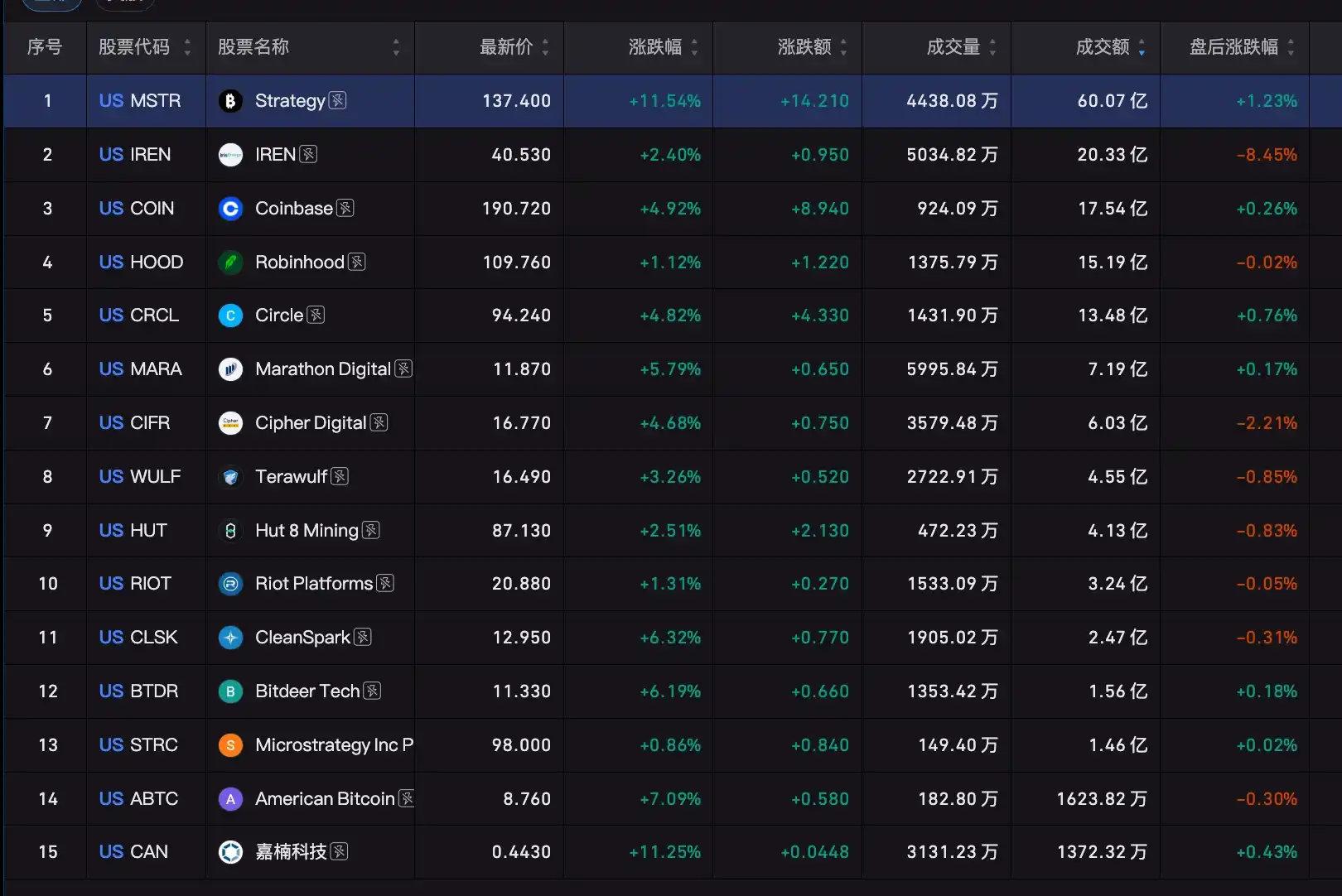
According to BIT U.S. stocks data, crypto-linked names moved higher across the board. Strategy climbed 11.54% to its highest level since June 2. Coinbase rose 4.92% as improving trading volumes, ETF inflows, and a return of the Coinbase premium were said to support revenue expectations for the exchange. Robinhood added 1.12%, with stronger crypto trading activity backing both order flow and its digital asset business. Circle gained 4.82%.
Mining stocks were stronger. MARA rose 5.79%, CleanSpark gained 6.32%, Bitdeer added 6.19%, Cipher Digital climbed 4.68%, Terawulf rose 3.26%, Hut 8 gained 2.51%, Riot added 1.31%, American Bitcoin rose 7.09%, and Canaan jumped 11.25%.
BlocksBridge said Bitcoin’s roughly 23% gain over the past week helped drive sharp rallies of 41% to 67% in previously pressured miners including Canaan, American Bitcoin, and Cango, with some even outperforming AI infrastructure shares.
Asia trades unevenly before Jackson Hole
Market sentiment across Asia-Pacific turned cautious ahead of Jackson Hole. Japan’s Nikkei 225 closed up 0.41%, while South Korea’s KOSPI fell 1.79%.
In Japan, the main variables remained inflation and the yen. Japan’s July unemployment rate fell to 2.4%, below the market expectation of 2.5%. Core inflation in Tokyo was broadly in line with expectations, which kept alive bets that the Bank of Japan could tighten policy further. At the same time, the tail on Japan’s two-year government bond auction widened to the largest since 2016, showing that the bond market is increasingly sensitive to policy normalization.
In South Korea, an unexpected rate hike from the central bank and fading AI momentum led to weakness in semiconductor heavyweights. SK Hynix fell 3.87% and Samsung Electronics lost 2.81%. SK Hynix CEO Kwak Noh-Jung said tight memory chip supply is expected to last through the end of 2030, but the market was more focused on short-term profit-taking.
Mainland China markets and what comes next
In mainland China, the ChiNext Index gave up early gains and closed down 1.41%. Agricultural stocks moved higher against the broader tape, with Dunhuang Seed, Xisai Shares, and Wanxiang Doneed among the names hitting the daily limit. Chemical shares also rallied, including Jinniu Chemical, Chitianhua, and Lutianhua. Innovative drug and CRO names weakened, with Wabang Pharmaceutical and CanSino down more than 10%. Semiconductor and computing hardware shares also retreated along with broader Asia tech stocks.
China’s National Development and Reform Commission said it will push for decisive breakthroughs in key integrated circuit technologies across the full chain, while also warning that the robotics industry must develop according to local conditions and avoid blind herd behavior. The report described this as a policy signal that supports the theme while also cooling speculation.
The next events on the calendar include Kevin Warsh’s Jackson Hole speech at 22:00 on Aug. 28, which the report says will shape how markets reprice interest rates; the final August reading of the University of Michigan consumer sentiment index and the preliminary benchmark revision to nonfarm payrolls at the same time, both of which could affect long-end rate pricing; earnings from Meituan, BYD, and PetroChina; and, on Aug. 29, the first post-listing interim report from CXMT parent ChangXin Technology.