


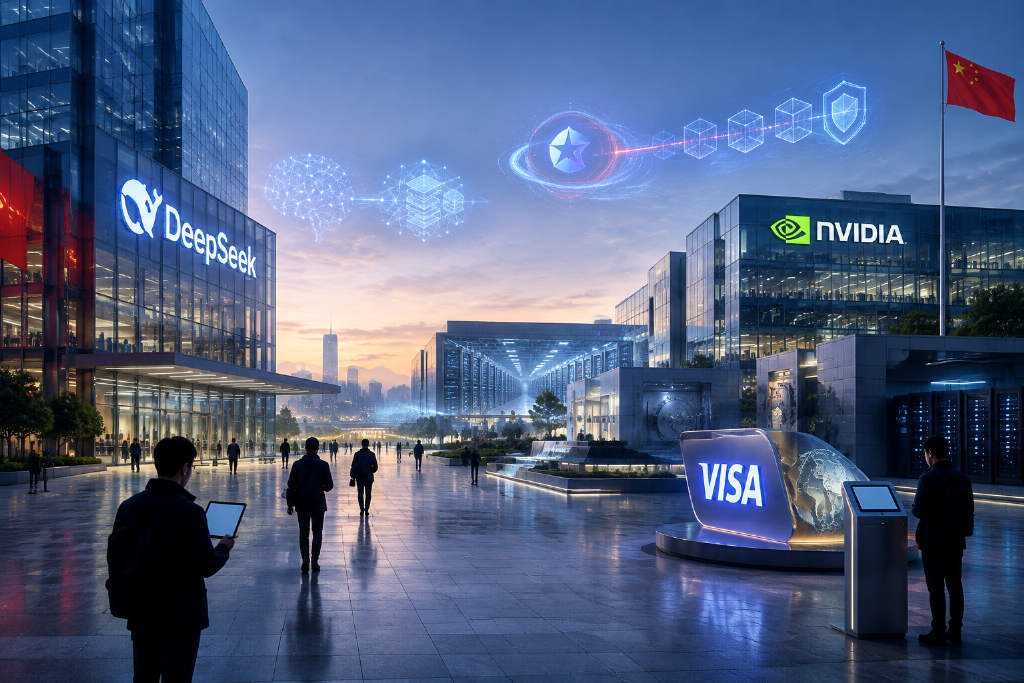
TechFlow’s Oct. 18 intelligence roundup highlighted a cluster of developments across AI, crypto, chips and macro markets, with the sharpest focus on Starknet’s governance signal, DeepSeek’s model controversy and fresh data around stablecoin payments and inference costs.
DeepSeek V4.1 Flash draws GPT-6 Astra wrapper accusations
In the AI and large-model section, TechFlow said community fingerprint testing found DeepSeek’s latest Flash version to be highly similar to OpenAI’s GPT-6 Astra. That sparked questions over whether the model was distilled from OpenAI technology or directly calling it.
TechFlow also noted a pricing gap at the center of the debate. DeepSeek’s official API is priced at $0.75 per 1,000 requests, far below OpenAI’s pricing. If the product were in fact a wrapper, the report said, the economics of that business model would be difficult to justify.
Discussion split quickly. Some argued the episode could show that model distillation has become much more capable. Others insisted that a product at that price point could not plausibly be built that way. TechFlow cited discussions on Zhihu and Hacker News.
Nvidia lifts Kimi K3 inference throughput by 68%
Nvidia engineers rewrote the vLLM decoding kernel with a 12,000-line Megakernel implementation, according to TechFlow. On the same GPU hardware, that pushed throughput for the 2.8 trillion-parameter Kimi K3 up by 68% to 423 tok/s.
The report said the gain directly lowers inference costs, making it relevant for any company running large models. The item was attributed to SemiAnalysis.
Gavin Baker compares today’s GPU market with the 2000 fiber era
TechFlow also pointed to Gavin Baker’s latest version of his “last window” argument. Baker said top players are moving faster to lock in compute capacity, contrasting the current market with the U.S. fiber buildout in 2000, when 97% of fiber capacity sat unused.
Today, he argued, there are almost no idle GPUs, and chips inside training clusters are running hot. TechFlow, citing a16z, framed the contrast this way: the 2000 bubble was built on fiber nobody used, while in 2026 GPUs are all being used, even if someone still has to pay the bill.
Starknet community vote shows 99.95% support for a standalone quantum-resistant L1
In crypto and Web3, a non-binding Starknet community vote showed 99.95% support for shifting the network into an independent, quantum-resistant Layer 1.
TechFlow said the vote does not yet force implementation, but the signal is hard to miss. In its reading, Starknet is now likely to move away from Ethereum and pursue a standalone Layer 1 path centered on quantum resistance. The report added that this would add another blow to the narrative of Layer 2 networks leaving the Ethereum orbit. The source cited was StarkWare.
Large HYPE unstaking and Trump’s public mention put Hyperliquid in focus
TechFlow said linked addresses unstaked two batches of HYPE from a Hyperliquid validator, with a combined value of $56.6 million. Of that amount, 360,000 HYPE was worth about $28.3 million. The report described it as the first large-scale unstaking event for the token.
Once unstaked, the HYPE became liquid, prompting community attention on whether the tokens could move to exchanges and create selling pressure.
In a separate development, Trump mentioned Hyperliquid in public and said the SEC chair was working to bring it into the United States. Hyperliquid’s official account reposted the remark, according to TechFlow. As the decentralized exchange with the largest perpetual futures trading volume, formal SEC recognition would be a major signal for the DeFi derivatives sector, the report said. That item was sourced to HyperliquidNews.
Solana leads stablecoin transfers while Visa gets initial approval in China
Solana remained the leading chain for stablecoin transfers. Citing Solana data, TechFlow said the network processed 557 million stablecoin transfers in September, up 33% from the previous month, or about 18.6 million per day.
The report said Solana continues to widen its lead over other chains in payment and stablecoin settlement use cases.
On the traditional payments side, Visa received preliminary approval through its Beijing subsidiary to prepare renminbi-denominated bank card clearing operations. TechFlow called it a substantive step in the opening of China’s payments market and said it could also widen compliant channels linking stablecoins such as USDC with traditional payment networks. The source cited was Crowdfundinsider.
AMEC tests equipment with South Korean chip companies as BofA’s Hartnett shifts stance
In semiconductors and hardware, TechFlow reported that AMEC’s MOCVD equipment is being tested with SK keyfoundry and Magnachip. The report said AMEC had previously been unable to enter Samsung and SK hynix factories in South Korea, making this a potentially important breakthrough for Chinese semiconductor equipment if the tests succeed. The cited source was zdnet.
On market strategy, Bank of America strategist Michael Hartnett said the earlier “sell signal” had ended and pointed to mid-November as the time to watch for a return to technology stocks. According to TechFlow, Hartnett said chip pricing is the key variable. If DRAM and NAND prices stabilize, capital could rotate back into compute and semiconductor names. That item was attributed to Wallstreetcn.
Tesla, TikTok and Musk-related stories land on the same day
In the technology company section, TechFlow said Tesla lost more than 620 billion yuan in market value over five days. Musk’s flying car event did not lift the stock, the report said, and instead raised concern that Tesla could be losing focus. At the same time, a startup posted a video showing its own vehicle flying over a Tesla and claimed it was “11 years ahead.” TechFlow cited Zhihu and Wallstreetcn for that item.
Another report said TikTok permanently banned the advertising account for Alex Gibney’s Musk documentary for “violating advertising policies.” TechCrunch and The Verge both covered the move, putting Musk’s influence over social platforms back into focus.
Separately, Cailian Press reported that Musk, reflecting on his time in the White House’s Department of Government Efficiency, or DOGE, said deficits could not truly be solved from inside government and that he was now betting on productivity gains from AI and robotics.
Asian AI supply chains face financing pressure as gold and shipping risks rise
On the macro side, Bloomberg reported that the sell-off in U.S. technology stocks had started to spill into Asian “picks and shovels” names. Rising financing costs, TechFlow said, could cut off the spending needed to sustain the AI boom and threaten profitability across the region’s supply chain.
In precious metals, Japan is moving to require traceability for gold exports as part of an anti-tax-evasion push. TechFlow added that central bank gold buying in Poland and China surged in 2026, showing that sovereign competition over gold reserves is still accelerating. The cited sources were FirstSquawk and FintechTimes.
In energy shipping, the Strait of Hormuz crisis remained unresolved. Iran said it would not reopen the strait unless the United States withdrew from the Middle East. TechFlow, citing Polymarket and MarketScreener, said about 97% of ships had not been attacked, but that risk premiums had already been priced into oil. It also linked that to a 39.4% jump in China’s refined oil exports in September, with diesel exports reaching a three-year high.
AI-generated games on Steam and Husk 2.0’s iPhone-to-Android gaming layer
In new products and trends, TechFlow said Steam is seeing a growing number of low-quality games generated entirely by AI. Valve does not currently ban AI content, and debate is building over whether the platform should use AI detection tools to limit such releases. That item was sourced to Zhihu.
Another project drawing attention was Husk 2.0. According to IT Home, the open-source project uses a self-developed translation layer to let iPhones run Android games and is already compatible with more than 150 titles. TechFlow described the technical route as similar to a reverse version of Apple’s Game Porting Toolkit.
TechFlow’s read: infrastructure competition is splitting into decentralization and compliance tracks
In its closing note, TechFlow tied several of the day’s stories together. Starknet’s 99.95% vote, Visa’s clearing approval in China and Solana’s record stablecoin transfer volume all point to the same shift, it said: infrastructure competition is accelerating along two tracks, disintermediation and compliance.
At the same time, DeepSeek’s GPT-6 wrapper controversy, Nvidia’s 68% inference-cost improvement and rising financing pressure across Asia’s AI supply chain suggest that compute, models and capital are tightening at once. TechFlow added one more marker from the old system: while Starknet is talking about a quantum-resistant Layer 1, Oracle’s CDS has climbed to 300 basis points. Everyone wants to become foundational infrastructure for the next cycle, but the bills from the old one are starting to come due.