
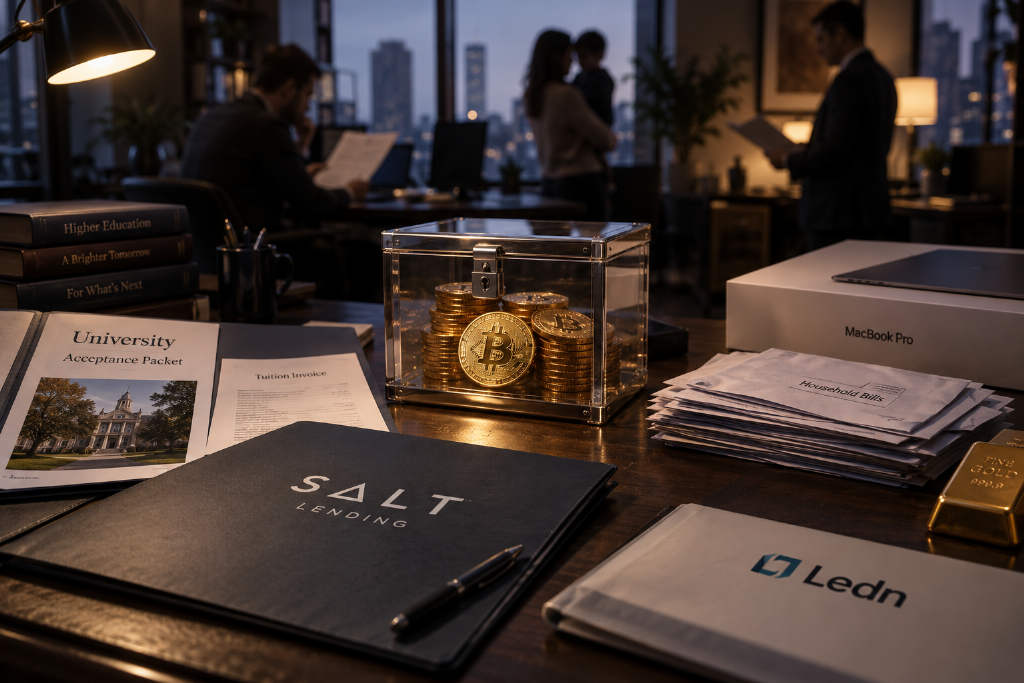
Bitcoin-backed lending is being used for more than trading. According to CoinDesk and comments from two long-running lenders, borrowers are increasingly using BTC-collateralized loans to cover tuition, emergency expenses, business cash flow gaps and major purchases, rather than selling their bitcoin.
The report says loans secured by locked bitcoin are being used to fund real-world expenses as crypto-backed finance starts to look more like conventional lending. At the time referenced in the article, BTC was listed at $82,574.89.
Borrowers are using BTC loans for tuition, emergencies and business needs
Hunter Albright, chief revenue officer of SALT Lending, told CoinDesk that both his conversations and the company’s data show a change in borrower behavior.
「What I am seeing, both in the conversations I’m having and in the data, is that more people are starting to borrow against their Bitcoin for real-world needs. That includes emergency expenses and larger life decisions, such as funding college tuition or a once-in-a-lifetime trip. We also see people using it to supplement their cash flow.」
SALT began offering bitcoin-backed loans in 2016. The company initially served bitcoin miners, the entities that verify blockchain transactions in exchange for BTC rewards. More recently, Albright said, the lender has seen an influx of institutional borrowers, along with “Gen Xers and baby boomers who own bitcoin and want help understanding the loan process.”
SALT did not disclose its total historical loan volume. CoinDesk noted, however, that the broader centralized lending market is already producing large numbers.
Ledn says it has funded more than $11 billion in loans
Ledn, a centralized lender that launched in 2018, said it has funded more than $11 billion in loans to date. The company expects that figure to grow to $1 trillion in the coming years as more clients choose loans that are not tied to trading activity.
Adam Reeds, Ledn’s co-founder and CEO, told CoinDesk that the borrower base spans several groups.
「Our borrowers range from traditional investors seeking to get more from their bitcoin position, to entrepreneurs who want to access working capital, to institutional players.」
He said Ledn’s private wealth clients borrow larger sums for “larger tickets such as investments, real estate, their businesses or their children’s education.” Retail borrowers, by contrast, tend to take smaller loans for near-term needs, such as covering a month of expenses when primary income falls short.
The main appeal is liquidity without selling bitcoin
The central reason for borrowing against BTC is to unlock liquidity from a passive investment without selling the asset and giving up exposure to future price moves.
Albright said SALT’s core purpose has stayed the same since the company started.
「We don’t believe people should have to sell their most valuable assets to get the value out of it.」
Reeds said Ledn clients are motivated by the same idea.
「People borrow against their bitcoin because they believe it will be worth more in the future, and they also want to be certain they’ll get it back.」
That view also helps explain why many borrowers renew their loans instead of closing them out.
「Most clients renew their loans, because the whole premise of this type of lending is not selling bitcoin and continuing to hold the position.」
Albright said a strategy long used by the ultra-wealthy and large corporations is now becoming available to a broader group of people based on the assets they own and hold.
Fixed-rate products are becoming a focus
Lenders are now trying to make borrowing costs more predictable. SALT said its long-term goal is to make crypto loans behave more like mortgages.
Albright told CoinDesk: 「Our ultimate goal is to have loan products behave much more like a mortgage, where someone can take out a loan, at a fixed rate over a longer term and have greater predictability around the cost of borrowing, even while Bitcoin remains volatile.」
Large industry players are already moving in that direction. On Sept. 22, Coinbase added fixed-rate bitcoin-backed loans to its retail app through Morpho’s Midnight protocol. Users can borrow USDC against bitcoin, with the interest rate and repayment date set at the outset.
Those fixed-rate loans sit alongside Coinbase’s existing variable-rate loans on Morpho, which have more than $1.4 billion outstanding against roughly $3 billion in collateral. CoinDesk noted that Coinbase’s fixed-rate loans are short-dated, while SALT is aiming for much longer terms.
The model could expand beyond bitcoin to gold
Looking ahead, Ledn sees the collateralized lending model extending beyond bitcoin to other hard assets, including gold. Reeds described precious metals as the logical next step.
「The next stage is lending against hard assets more broadly.」
He added: 「Gold is the obvious next example. It’s a twenty-trillion-dollar asset, yet borrowing against it has largely been an institutional privilege. For most everyday holders, the way to get cash from gold has been to sell it.」
Reeds said the distinction between digital and physical alternative assets is becoming less rigid for modern investors.
「Our clients increasingly think in terms of hard assets they want to hold for the long term, and borrow against rather than sell.」