
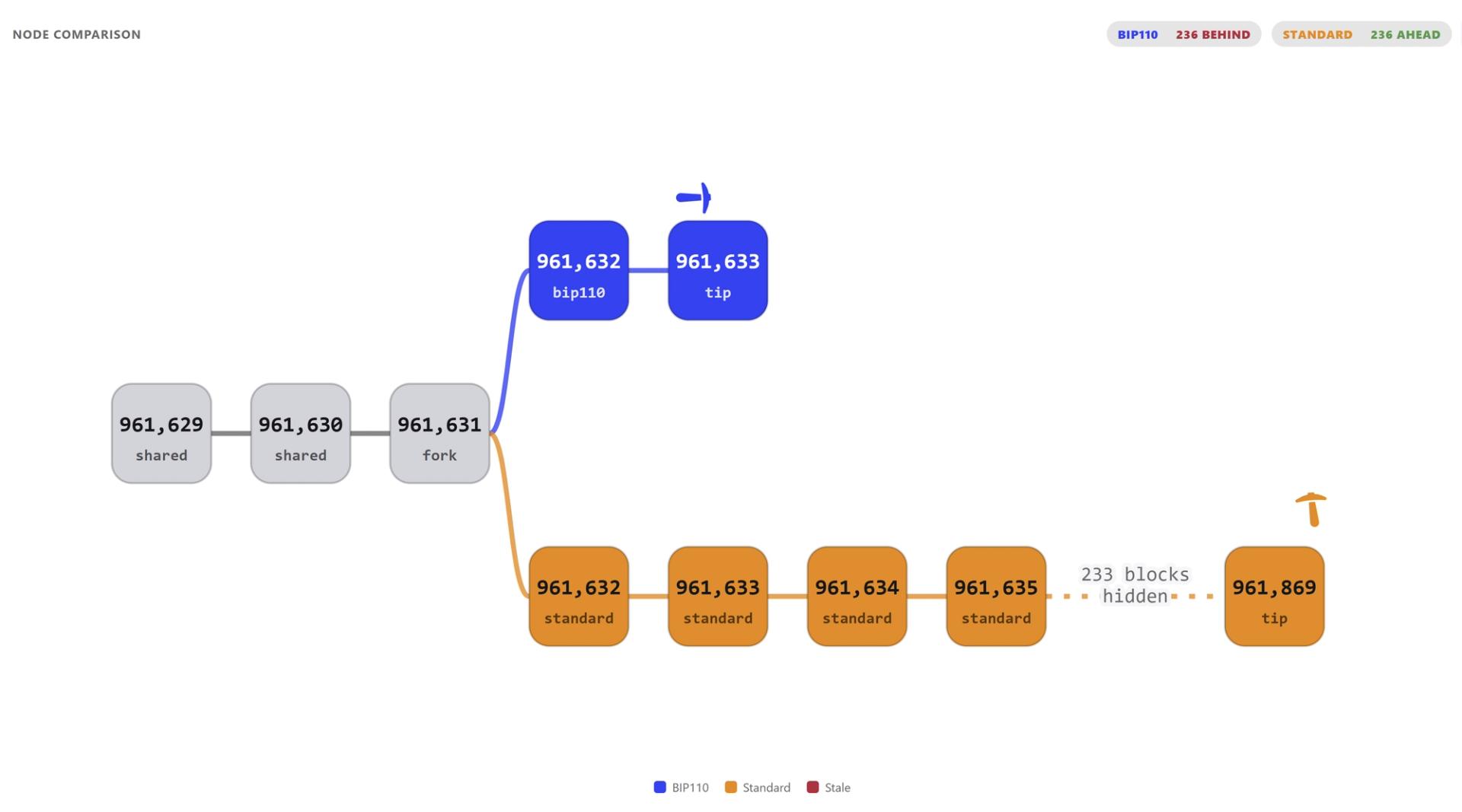
CoinDesk said in its Aug. 10 Daybook that the fight around Bitcoin Improvement Proposal 110, or BIP-110, showed Bitcoin’s permissionless market structure in action: proposals can be aired in public, rejected if they fail to win broad support, and replaced by voluntary chain splits rather than decisions imposed by a regulator or a central committee.
BIP-110 failed to gain broad backing
The proposal started as an attempt to limit non-financial data on Bitcoin, including Ordinals inscriptions that some participants view as spam, in order to free up space on the blockchain.
CoinDesk said the plan was debated openly in the developer community but did not secure broad support. It was, in the publication’s words, effectively denied by distributed consensus. The point, the article stressed, is that no regulator and no central authority stepped in to ban it.
Supporters launched a fork at block 961,632
The story did not end with the failed proposal. CoinDesk said supporters exercised what it described as their right to form their own blockchain by forking away from the original Bitcoin chain.
That split took place at block 961,632. The goal was to implement their preferred rule set on a newer version of the chain, and CoinDesk described the move as voluntary rather than something forced by regulators or intermediaries.
Miners stayed with the original chain
Miners quickly picked the more profitable version, which was the original Bitcoin network. The newer chain inherited Bitcoin’s very large mining difficulty, but it attracted only a tiny fraction of total hashpower and produced just two blocks before grinding to a halt, according to the article.
The original Bitcoin network, by contrast, continued without interruption and retained virtually all activity, liquidity and security.
Michael Saylor, founder of bitcoin-holding company Strategy (MSTR), wrote on X: 「Bitcoin worked exactly as designed.」
CoinDesk contrasted Bitcoin with government-managed economies
The article set that episode against what it called the so-called free-market economies of the real world. It argued that when corporate profitability falls, the normal adjustment would be cost cutting and layoffs, but electoral politics often pushes governments to block that process, leading to prolonged industrial weakness.
It also said that when inflation runs high, governments may issue subsidies that artificially support demand and can push inflation even higher. In that framing, the usual free-market response of lower consumption and price discipline never gets a full chance to play out.
CoinDesk’s takeaway was direct: a free-market economy works when it is allowed to run its course.
BTC stayed near $65,000 with U.S. inflation data ahead
On spot pricing, the newsletter said bitcoin continued to trade near $65,000 while demand for downside protection remained in place. U.S. inflation data due this week was described as a likely influence on the next move in price.
The piece also highlighted several market items:
- CoinDesk reported that hedge funds trading bitcoin futures on CME had turned net long. The article said the rare positioning change suggested professional traders were increasingly betting on a rise in bitcoin prices.
- Another CoinDesk report said XRP fell about 5% to $1.03 last week even as bitcoin, ether and solana each moved higher. The underperformance stood out because XRP exchange-traded funds recorded net investor inflows for a fourth straight week.
- Reuters reported that global equities edged higher while oil stayed broadly steady after Iran said a final pact with Oman was near for shipping through the Strait of Hormuz.
Chart section pointed to consolidation inside the Ichimoku Cloud
The chart in the newsletter showed bitcoin price swings in candlestick form with the Ichimoku Cloud overlaid.
CoinDesk said BTC remained inside the cloud, which is commonly read as a sign of consolidation. The cloud, or Kumo, usually acts as dynamic support when price is above it and resistance when price is below it. Once price moves into the cloud, that area is treated as an equilibrium zone where buyers and sellers are roughly balanced and the trend is neutral.
In trading practice, the article said, market participants often treat crossovers and closes above the cloud as bullish signals, while moves below it are seen as bearish. Price action inside the cloud is often classified as no-trade or range-bound territory until a clear breakout appears.
The indicator was created in the late 1960s by Japanese journalist and technical analyst Goichi Hosoda, according to the article.
Other Daybook items listed in the same piece
CoinDesk also included a ranked list of related coverage and schedule items:
- Bitcoin steadies above $65,000 as Iran-Oman deal talk eases Hormuz concerns and lifts risk assets — 53 minutes ago.
- Bitcoin volatility is in meltdown, but downside protection still commands a premium — 1 hour ago.
- A rare CME shift: hedge funds abandon structural shorts to bet on a bitcoin rally — 2 hours ago.
- U.S. CPI inflation, Securitize and Gemini among items in Crypto Week Ahead — 2 hours ago.
- Inside stablecoin firm BVNK’s journey to a $1.8 billion acquisition by Mastercard — 3 hours ago.
- Robinhood brings crypto trading to the U.K. in an AI-powered all-in-one app — 4 hours ago.
- Live updates: BTC above $65,000 even as the Senate punts the CLARITY Act to the fall — 4 hours ago.
- This bitcoin miner rejected BIP-110 despite mining through a pool that supported it — 5 hours ago.
- Bitcoin tops $65,000 with U.S. inflation data due this week — 6 hours ago.
- XRP is getting left behind in the crypto bounce even as ETFs keep attracting investor money — 7 hours ago.
Zcash Tachyon preview appeared at the end
The Daybook excerpt ended with a preview titled “Building the Zcash Machine: Tachyon and Quantum Readiness.” It said Zcash’s Tachyon upgrade aims to scale shielded payments, improve quantum readiness, and test whether its funding, security and governance can hold.