whale2026-09-06 08:30:42Whale Loracle Launches Pons Fork 'pez.family' with Zero Fees Using Fable 5.1 AI ModelWhale Loracle announced on X that it has used the Fable 5.1 AI model to create a fork of the Pons token launch platform, named 'pez.family', and claims zero platform fees.740
Bitcoin2026-08-31 18:26:59David Schwartz says post-vote BIP-110 chain amounts to an attack on BitcoinRipple former chief technology officer David Schwartz said on Aug. 31 that backers of the Bitcoin BIP-110 fork crossed the line from governance into attacking the network after rejecting the soft-fork outcome and continuing to run an independent proof-of-work chain. In his view, losing a consensus dispute does not justify launching a separate Bitcoin chain, and doing so is itself an attack. The BIP-110 fork chain was activated at block height 961,640 through a flag-day hard fork. It replaced the SHA256d mining algorithm with BLAKE2b, introduced a new 164-byte block header, and added temporary rules that cap block size at about 300 KB until September 2027. Bitcoin Knots developer Luke Dashjr defended the changes, saying BLAKE2b lacks known weaknesses associated with SHA256d and that the redesigned block header closes a block-withholding flaw that previously required miner monitoring to detect. The fork grew out of Bitcoin Core removing old limits on OP_RETURN data, which opened more block space to non-monetary content including Ordinals and Runes. BIP-110 supporters wanted to preserve that space for payments. After the split, supporting mining pool Roughnecks produced only two blocks before the branch stalled, and the gap with the main chain widened to hundreds of blocks within weeks.940
Bitcoin2026-08-10 23:42:12BIP-110 fork stalls after two blocks, reviving the question of who can change BitcoinBitcoin reached block height 961,632 in the early hours of Aug. 9 Beijing time, triggering BIP-110’s mandatory signaling phase and a split between nodes enforcing the proposal and the main chain. The result was brief. The BIP-110 branch produced only two blocks before stalling, while Bitcoin’s main network continued operating normally. In the previous difficulty period, the proposal had received support signals from just 51 blocks, or 2.53%, far below its self-defined 55% threshold for voluntary early lock-in. BIP-110, submitted by pseudonymous developer Dathon Ohm with early draft input from Luke Dashjr, aimed to impose temporary consensus-level limits that would raise the cost of writing large amounts of continuous data to Bitcoin, including Ordinals-style inscriptions. Supporters argued that full nodes bear the burden of downloading, validating, and in some cases storing this data, while critics said changing consensus rules to target an unpopular but fee-paying use of Bitcoin would create a dangerous precedent. The fork’s failure has not ended the dispute. Debate continues over on-chain data, protocol neutrality, user-activated soft forks, miner support, and Bitcoin’s development process. For ordinary holders, the short-term concern is replay risk: because the minority chain lacks built-in replay protection, developers and Ledger have warned that moving or selling forked coins could also move corresponding BTC on the main chain if users are not careful.1950
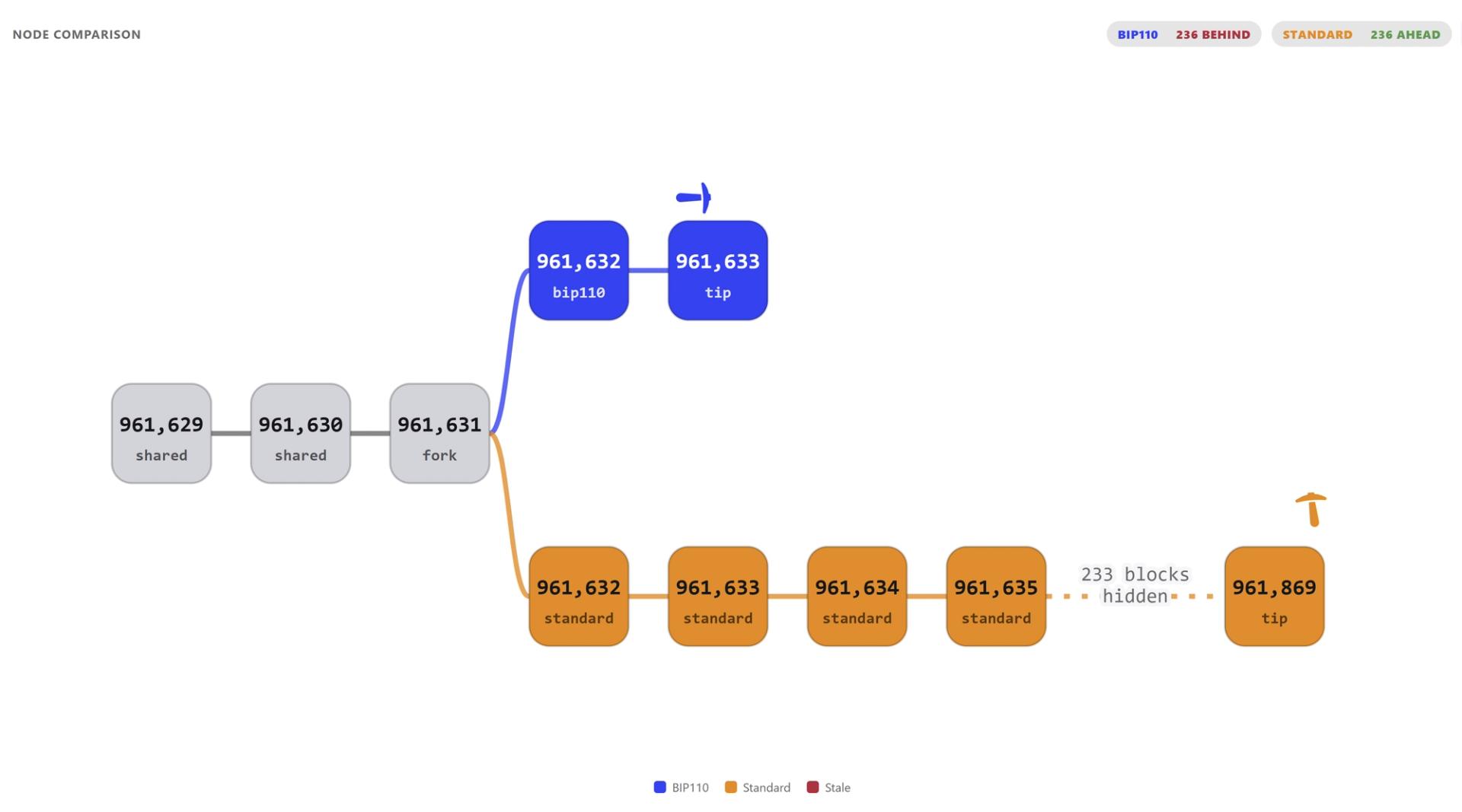
Bitcoin2026-08-10 15:12:36BIP-110 fork stalls after two blocks as miners stay on Bitcoin’s main chainBitcoin’s BIP-110 fork quickly lost momentum after nodes enforcing the proposal split from the main network over the weekend and produced only two blocks. The chain split began at block 961,632, when BIP-110 entered its mandatory signaling window and nodes running the software started rejecting blocks that did not signal support via version bit 4. A pseudonymous mining group, Roughnecks, mined blocks 961,632 and 961,633 using Ocean’s DATUM protocol, but the enforcing branch then stalled. By Sunday afternoon, it remained stuck at 961,633 while Bitcoin’s main chain had advanced to 961,744, leaving a gap of 111 blocks and about 17 hours without a new block on the fork. Support for the proposal had already been weak: only 51 of the previous 2,016 blocks, or about 2.53%, signaled for BIP-110, far below the 55% needed for voluntary lock-in. Ocean later told clients that some miners using its Stratum templates may have unknowingly mined on the BIP-110 chain and said it would reimburse affected miners for rewards they would have earned on the non-BIP-110 chain during that period.1940
Bitcoin2026-08-10 11:33:44BIP-110 Split Stalls as Bitcoin’s Main Chain Keeps Control of Hashpower and ActivityCoinDesk’s Aug. 10 Daybook framed the BIP-110 dispute as a live demonstration of Bitcoin’s permissionless and market-driven design rather than a system governed by regulators or a central committee. The proposal began as an effort to restrict non-financial data, including Ordinals inscriptions that some participants regard as spam, with the stated aim of freeing up blockchain space. After open debate in the developer community, BIP-110 failed to win broad backing and was effectively rejected through distributed consensus. Supporters then took the next step available inside Bitcoin’s rule set: they launched their own chain at block 961,632 to try to enforce their preferred version of the rules. According to CoinDesk, the market response was swift. Miners gravitated to the more profitable original Bitcoin chain, while the new network — despite inheriting Bitcoin’s high mining difficulty — drew only a tiny share of total hashpower and managed to produce just two blocks before stalling. The newsletter also said BTC spot remained near $65,000, with downside protection still in demand ahead of U.S. inflation data due this week. CoinDesk paired that with broader market notes on hedge funds turning net long bitcoin futures on CME, XRP falling about 5% to $1.03 even as its ETFs posted a fourth straight week of net inflows, and a Reuters report linking firmer global equities to talk of an Iran-Oman shipping pact near the Strait of Hormuz.1910
Bitcoin2026-08-10 05:22:00BIP-110 fork stalls after producing only two blocks in eight hoursBitcoin split into two chains at block height 961632 on the night of Aug. 7, after nodes running BIP-110 software began rejecting blocks that did not signal support for the proposal. AntPool mined the first standard block at that height and remained on the main network, while a miner working through Ocean produced an alternative block that the BIP-110 chain followed. Eight hours later, the minority chain had advanced only to block 961633, with just two blocks mined in total. Over the same period, Bitcoin’s main chain had reached block 961681, a lead of 48 blocks. The article argues that the fork had effectively failed on technical grounds in less than a day. BIP-110, formally titled “Reduced Data Temporary Softfork,” sought to temporarily restrict non-financial data storage in Bitcoin blocks for about a year, targeting Ordinals inscriptions, BRC-20 tokens, Runes, and similar uses of transaction scripts and witness data. Supporters said these uses crowd out block space and raise costs, while critics argued that any valid transaction paying sufficient fees should be allowed. The report also highlights why the minority chain stalled, including low signaling support of 2.53% versus a 55% activation threshold, inherited main-chain difficulty, and the absence of replay protection, which it says creates risks for users who attempt to transact on the forked chain.1820
Bitcoin2026-08-09 19:33:09Bitcoin’s BIP-110 Fork Stalls After Mining Only Two BlocksA contentious Bitcoin network proposal produced an actual chain split over the weekend, but the breakaway branch lost momentum almost as soon as it began. The fork tied to BIP-110 mined just two blocks over roughly eight hours before stalling, leaving it far behind Bitcoin’s main chain. The split was triggered at block 961,632, when nodes running BIP-110 software began rejecting blocks that did not signal support for the proposal. An AntPool block without that signal stayed on the main chain, while an Ocean pool miner produced the block followed by the minority branch. The fork now faces a structural problem. It inherited Bitcoin’s current mining difficulty but appears to control only a small share of network hash power. Decrypt said about 2.53% of recent blocks signaled support for BIP-110, far below the 55% threshold needed to activate without a split. At that rate, the forked chain could take roughly 350 days to reach its next difficulty adjustment. The proposal has divided the Bitcoin community over whether non-financial data such as images and text should be filtered out of transactions. Michael Saylor and Casa co-founder Jameson Lopp both criticized BIP-110 supporters on X, while holders of the fork’s coins also face replay risk because both chains currently accept identical transactions.1840
Bitcoin2026-08-09 09:52:56Saylor Says Bitcoin Is Working as Designed; BIP-110 Fork Trails by 80 BlocksAccording to ChainCatcher, Michael Saylor, founder of Strategy, said in a post that Bitcoin is operating exactly as designed around the BIP-110 fork. He argued that BIP-110 is free to fork and that Bitcoin's network is equally free to ignore it. According to the figures Saylor shared, roughly 99.85% of Bitcoin's hashrate stayed on the original chain. The BIP-110 branch has managed to mine only two blocks so far and currently trails the original network by more than 80 blocks. Saylor also noted that the fork drew only about 0.15% of Bitcoin's hashrate. Before the first difficulty adjustment, the branch still needs to mine another 2,015 blocks. At the current block speed, he estimated, that process would take about 25 years. He added that a fork without security, utility, capital and users means nothing. Anyone can fork Bitcoin, he said, but consensus has to be earned, not declared.1680