

Bitcoin reached block height 961632 on Aug. 9, formally entering the BIP-110 enforcement window, which runs from 961632 to 963647. At that point, nodes running BIP-110 began rejecting non-compliant blocks, including blocks carrying non-monetary data transactions. That split Bitcoin into two competing chains: the main chain and a minority chain supporting BIP-110.

BIP-110 failed to gain longest-chain consensus
In the day after the soft fork took effect, the BIP-110 chain produced only two blocks, 961632 and 961633. It fell more than 200 blocks behind the main chain. Under Bitcoin’s longest-chain rule, that meant the BIP-110 chain did not become the consensus chain, and the network as a whole would not converge on the new BIP-110 rules.
On that basis, the article said the soft fork effort led by Bitcoin Core developer Luke Dashjr can, in practical terms, be viewed as failed.
The result was largely in line with earlier expectations. Before the enforcement window began, miner signaling support across the network was only about 2%, far below the 55% activation threshold cited in the report. Even so, BIP-110 supporters led by Dashjr did not accept the outcome and began planning a proof-of-work change. If that happens, the BIP-110 chain would stop using SHA-256d, turning the fight from a soft fork dispute into a hard fork path.
The report also noted that Dashjr said in June that he would not pursue a BIP-110 hard fork or any change to, or removal of, proof of work. The situation has since shifted. Wang Chun, co-founder of F2Pool, criticized the move directly, saying: “Luke Dashjr is bankrupt not only financially, but also in terms of personal credibility. Trying to change the PoW algorithm will not end well either.”

Why supporters are discussing a new PoW algorithm
Odaily said it had outlined three possible scenarios for BIP-110 in an analysis published in mid-July. What has now happened is the third scenario, which the article described as the worst one: the BIP-110 chain could not overtake the main chain, and Dashjr called on supporters to turn it into a permanently separate chain, manually adjust mining difficulty and launch a new network token.
The reason the BIP-110 chain struggled to produce blocks is straightforward. It inherited Bitcoin main-chain mining difficulty of about 127.48 trillion, while attracting only a very small share of the SHA-256d hash power securing the main chain. According to the article, Ocean, the only mining pool supporting BIP-110, controls just 1.6% of network hash power and can produce at most two to three blocks per day.
The response from Dashjr and other supporters has been what they described as “fire the miners” — replacing the BIP-110 chain’s proof-of-work algorithm. That would prevent main-chain miners from mining on the BIP-110 chain, making pro-BIP-110 hash power the effective total hash rate on that chain and giving it control over block production. The tradeoff, the article noted, is that block rewards on that chain would no longer be Bitcoin worth more than $60,000.
In the Bitcoin Knots Discord channel, Dashjr and BIP-110 supporters have been discussing which proof-of-work mechanism could keep the BIP-110 chain running without relying on current Bitcoin miners. Bitcoin Knots is a Bitcoin full-node software version created by Dashjr. Participants discussed RandomX, KT256, various BLAKE3 and BLAKE2 variants, Scrypt, Autolykos v2, and CPU and GPU mining.
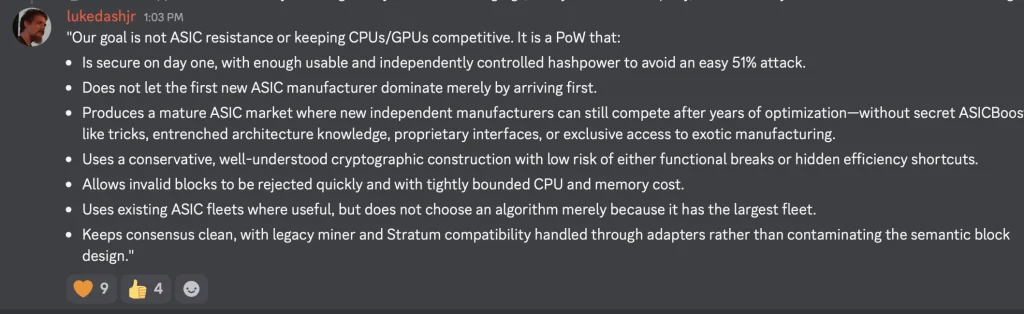
Dashjr eventually proposed selecting the final algorithm from the list of candidates through a deterministic random process. His stated reason was: “that way, no one knows in advance until everyone knows,” which he said would reduce the risk of some miners preparing specialized hardware for the BIP-110 chain ahead of others.
As of publication, the BIP-110 chain had not enabled or approved any PoW change, and Dashjr had not announced either the chosen algorithm or the activation block height. Experimental code related to the idea has already been ported into the recent Bitcoin Knots codebase. In short, the hard fork has not been executed, but the report said the probability of it happening is now higher than at any previous point.
The governance fight is getting sharper
At the same time, the conflict between BIP-110 supporters and opponents has kept escalating.
Dathon Ohm, the author of BIP-110, argued that the move toward a hard fork was forced by coordination among large mining pools. In a post on X, he wrote: “Large mining pools have colluded, executing a secret hard fork on the Bitcoin node network and turning Bitcoin from a monetary network into a toxic data dumping ground.” In that framing, the side carrying out the real hard fork is not BIP-110, but the large mining pools that, in his view, defied the community’s will. A new proof-of-work system, supporters argue, would help remove that centralized control.
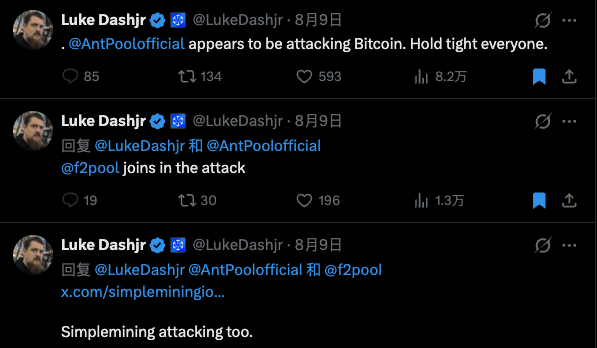
Dashjr used even sharper language. The article said he still believes BIP-110 has community backing and views the competition for block production by large pools that do not support BIP-110, including Antpool and F2Pool, as a malicious attack by a very small minority. In that view, changing the PoW mechanism is a way to remove their centralizing threat.
The current line from BIP-110 supporters is that Bitcoin governance should be decided by nodes and the community, not miners and hash power. They argue that the main chain run by large pools with a hash-power advantage is no longer the real Bitcoin chain, and that what it produces is only a “Core altcoin,” while the new BIP-110 chain represents the real Bitcoin.
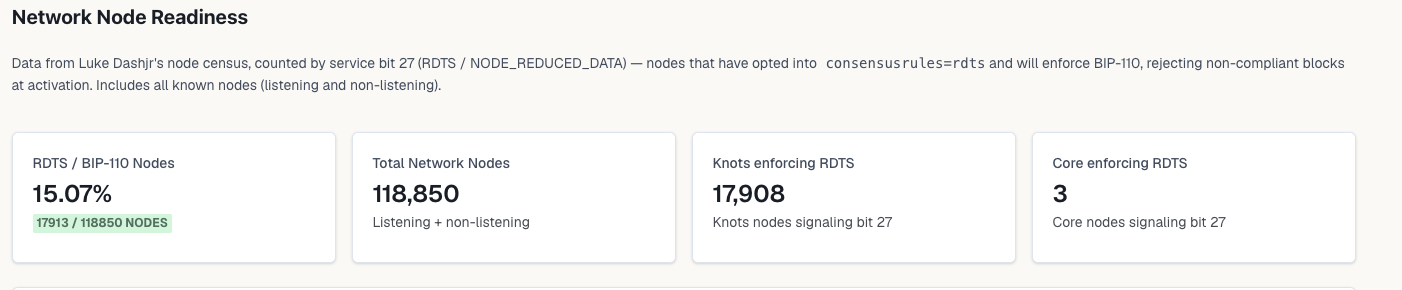
The article argued that the biggest weakness in that position is that, even if miners are set aside, the nodes and community supporting BIP-110 are still a minority within the broader Bitcoin community. True community support is difficult to measure, but node support is easier to count. Out of 118,850 Bitcoin nodes across the network, only 17,913 were willing to enforce BIP-110, or 15.07%. The article added that the share would be even lower after excluding “zombie nodes.”
Those figures, the report said, make it hard to argue that most Bitcoin nodes and the community support BIP-110 while only large mining pools are opposed.
How critics responded
Michael Saylor, founder of Strategy and an opponent of BIP-110, said the proposal’s failure was always the likely outcome. He said BIP-110 is free to fork, but other network participants are equally free not to follow. He added that BIP-110 currently has only 0.15% of the hash power of the Bitcoin main chain. “Anyone can fork Bitcoin, but without security, utility, capital, and users, the fork is meaningless. Consensus is earned, not declared,” he said.
Cypherpunk pioneer Adam Back also rejected what he described as the “persecution complex” aimed at large mining pools by BIP-110 supporters. He said it was wrong to claim that “Bitcoin elites,” governments or mining groups had conspired against Bitcoin and caused Bitcoin to suffer. He also said the belief that nodes control protocol changes and miners will simply submit is deeply mistaken. In his words, “BIP-110 has not achieved consensus, so economic nodes and the market ignored it, and therefore miners did not mine it.”
For now, the BIP-110 chain has not displaced the main chain, and no proof-of-work change has been formally activated. The broader dispute over whether miners, nodes or the community hold the decisive voice in Bitcoin governance remains unresolved.