
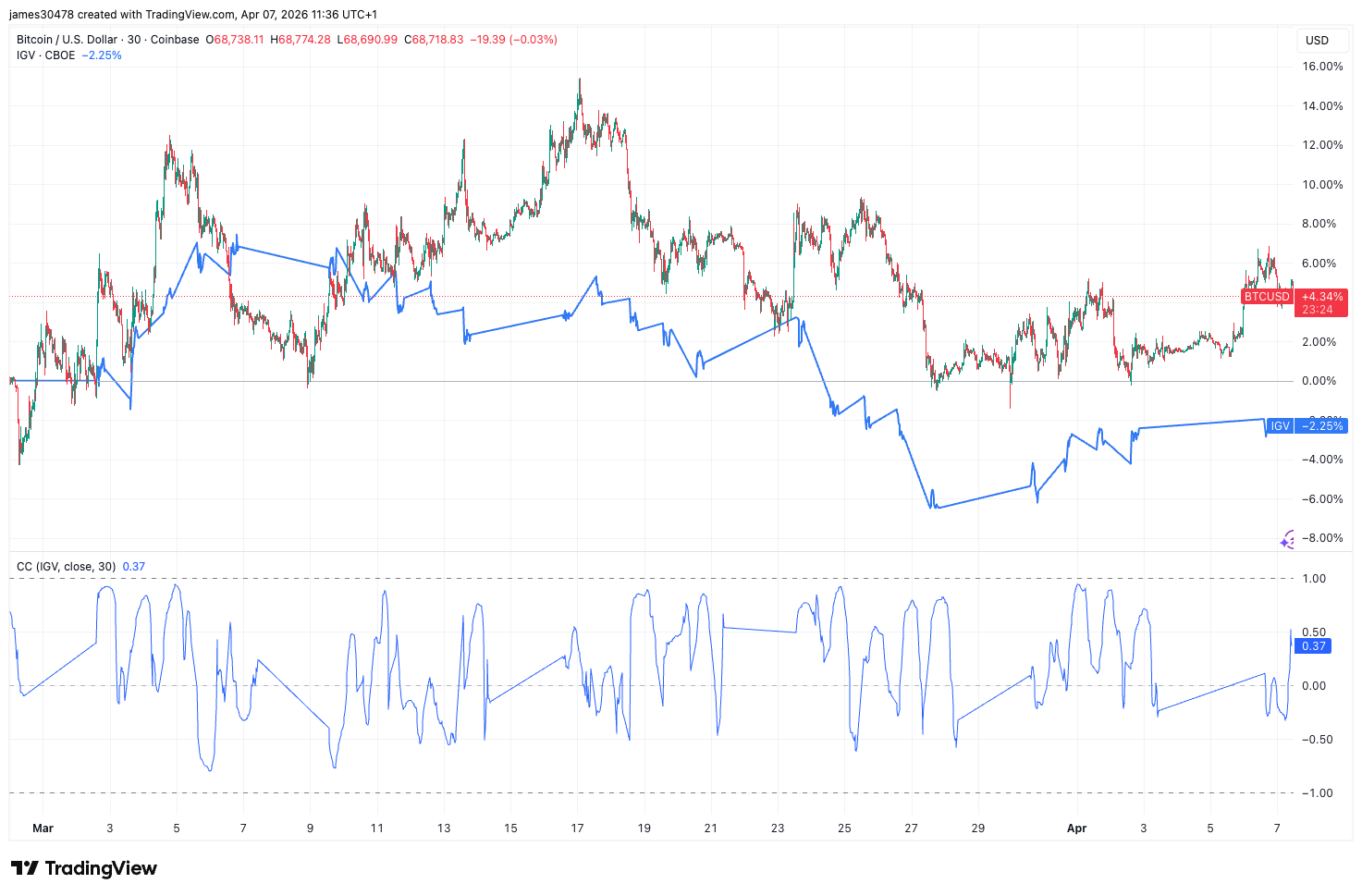
Since the war with Iran began on Feb. 28, bitcoin has started trading differently from software equities. The cryptocurrency has gained more than 5% over that stretch and moved back above $69,000, including a rise of more than 0.5% in the past 24 hours. The iShares Expanded Tech-Software Sector ETF, or IGV, has moved the other way, falling more than 2%. The gap points to a short-term shift in how investors are pricing bitcoin against software stocks.
Bitcoin and IGV had been moving closely for months
The divergence stands out because the two assets had shown a similar pattern until recently. Over the past three months, bitcoin fell 26% while IGV lost 23%. On a year-to-date basis, both are down about 21%. Over the past five years, bitcoin is up 18% compared with 10% for IGV. The broad direction was often the same, but bitcoin moved with much larger swings.
The drawdowns tell that story clearly. Bitcoin had fallen about 50% from its October all-time high. IGV, which reached its peak a bit earlier, dropped roughly 35% from its own top. So even when the two traded in step, the risk profile was not identical.
Correlation dropped sharply after the conflict began
Correlation data shows how fast the relationship changed. From early February, bitcoin and IGV were almost perfectly correlated, near 1.0, meaning their moves were nearly identical. After the war started, that reading fell sharply to 0.13, a level close to decoupling, before rebounding to around 0.7. On this scale, correlation ranges from -1.0 to +1.0, while 0 means no correlation at all.
AI concerns weigh on software while bitcoin trades as a macro asset
IGV is heavily concentrated in large software and services names such as Microsoft, Oracle, and Salesforce. Investor concern has centered on artificial intelligence and its effect on the sector. The worry is that AI could squeeze margins and valuation multiples across software companies, especially in SaaS, as competition increases and barriers to entry decline.
Bitcoin is being priced through a different lens. According to the report, it has traded more like a macro asset during this period and has benefited from geopolitical uncertainty. That shift helps explain why bitcoin and software stocks have separated in the near term.