

The crypto market turned sharply higher last week after spending much of the past year in a lull. Bitcoin jumped from around $62,800 at the start of the week to an intraday high of $79,500 on Aug. 21, with its biggest weekly gain topping 26%, the strongest such move since March 2023.
In an article written by Joe Zhou and published by Foresight News, the central question is not only whether the bull market is back, but which assets actually led the rebound and what that says about the next phase of trading.
Three patterns the rebound reinforced
The article argues that every extreme move acts as a stress test for market structure, and this rally again brought several recurring rules into focus.
Short-term turning points are increasingly tied to the U.S. policy cycle
Looking back over the past four years, the piece says major crypto inflection points — including the approval of spot Bitcoin ETFs, shifts in the Federal Reserve’s rate cycle, and the latest U.S. Treasury buyback operation — have largely moved in step with U.S. fiscal and regulatory policy. In that reading, pricing power is moving away from crypto-native leverage cycles on-chain and toward macro liquidity and regulatory expectations.
For this rebound, the article points to two main drivers.
First, a long-dated Treasury buyback shifted expectations around liquidity. On Aug. 19, U.S. Treasury Secretary Bessent said the single-operation buyback size for 10- to 30-year Treasuries would rise from $2 billion to at least $4 billion in response to a surge in long-end yields and heavy selling in long-dated bonds. The market read that as a sign that the U.S. government was using looser operations to ease its own borrowing-cost pressure, a chain that was then interpreted as negative for the dollar and supportive for alternative stores of value such as gold and Bitcoin. The article says Bitcoin stood out because of its higher-beta risk profile.
Second, Donald Trump’s push on crypto legislation helped revive risk appetite. Around the same time, Trump met executives from Coinbase, Kraken, and Ripple at the White House and publicly urged Congress to move quickly on the Digital Asset Market Clarity Act, or CLARITY Act, to define the boundary between SEC and CFTC oversight of digital assets. The article says the market treated that as a sign of falling regulatory uncertainty.
It also adds that on Aug. 18, the SEC proposed draft rules for public crypto token sales. The market, according to the article, viewed that as a constructive step toward clearer issuance rules and referred to it as a “legal ICO 2.0.” The piece describes the framework as one with fundraising caps, disclosure requirements, and exit mechanisms.
Spot ETFs led again
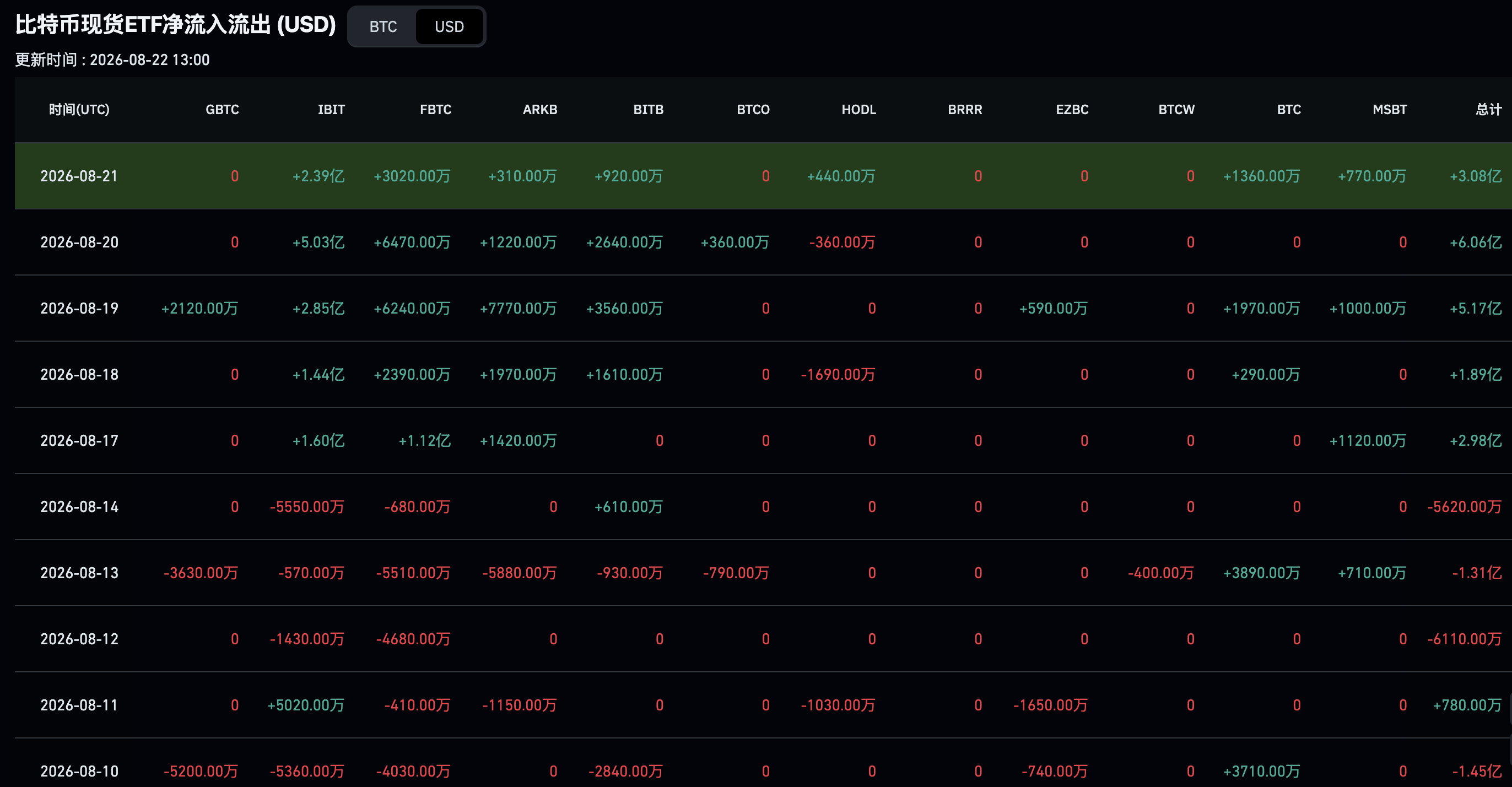
The article says spot Bitcoin ETFs have become one of the clearest structural signals in crypto over the past two years. In this round, the broader market breakout began on Aug. 19, while spot Bitcoin ETFs had already shown steady net buying several days earlier.
For the week through Aug. 21, U.S. spot Bitcoin and spot Ether ETFs recorded combined net inflows of $2.6 billion, the biggest weekly total since October 2025. Spot Bitcoin ETFs accounted for about $1.9 billion of that amount. Weekly trading volume jumped from $6.9 billion in the previous week to $22.1 billion, up 219%, while total net assets rose from $76.6 billion to $96.1 billion.
Spot Ether ETFs also strengthened, posting $697.2 million in net inflows, the highest weekly level since the week ended Oct. 3, 2025. Their weekly trading volume climbed from $1.9 billion to $6.9 billion, up 259.4%.
Both ETF categories posted their largest weekly net inflows of 2026. The article contrasts that with the prior week, when the two groups together saw net outflows of $392 million. In its telling, the synchronized pickup in flows and turnover signaled a pronounced return of institutional money and reinforced spot ETFs as a lead indicator in this bull cycle.
Bitcoin breaks higher, then capital rotates outward
The third pattern is the familiar spillover from Bitcoin into the rest of the market. Once Bitcoin breaks out, the article says, capital tends to rotate from majors into altcoins and then into meme tokens, producing a visible ladder of gains.
It points to Ether’s near-30% weekly rise, ENA’s jump of nearly 100%, and the BNB Chain meme token Niu Lai, which rose 30.3% in a single day on Aug. 21 and briefly reached a $70 million market capitalization. In the article’s view, the rebound spread from large-cap blue chips to smaller high-beta names without much exception.
Ether outpaced Bitcoin once the move broadened
Bitcoin lit the initial spark, but the article says the bigger price elasticity showed up in the follow-through from major altcoins and smaller tokens.
Ether started the week near $1,900 and reached as high as $2,546, for a weekly gain of 29.8%, ahead of Bitcoin’s 22.9%. The ETH/BTC ratio recovered to around 0.031, and Ether’s market capitalization moved back above $280 billion.
The article gives three reasons for Ether’s stronger rebound. One was heavy inflows into spot Ether ETFs, which brought in about $697 million last week, the strongest weekly reading since October 2025. Another was tightening exchange supply: exchange-held Ether fell from about 7.7 million ETH in early June to about 6.54 million by mid-August, a decline of roughly 15%. At the same time, more than 42 million ETH had been staked, shrinking liquid supply available for trading. The third factor was regulatory support from the SEC’s Aug. 18 proposal on public crypto token sales, which the article says improved risk appetite toward the Ethereum ecosystem.
The piece argues that while a 22% weekly rise in Bitcoin and a near-30% move in Ether were already notable, the more dramatic performance was found deeper in the altcoin market.
ENA, PUMP, STX, TRUMP, and ZEC led among top-50 altcoins by market value
Citing multiple data platforms, the article says that for the week through Aug. 23, the five best-performing tokens among the top 50 altcoins by market capitalization were ENA, PUMP, Stacks, TRUMP, and Zcash.
ENA: up 100.75% on the week
ENA topped the list with a 100.75% weekly gain. The article says the token has long been viewed as one of the market’s highest-beta rebound trades.
It identifies two key catalysts. Coinbase announced a strategic partnership with Ethena and said it plans to offer USDe-based products to more than 100 million users, while also making its first investment in Ethena through open-market purchases of ENA tokens. FalconX, meanwhile, launched a $1 billion secured warehouse facility that deploys USDe’s underlying assets into institutional lending, broadening the protocol’s business scope.
Even after the rally, the article notes that ENA still trades about 89.2% below its all-time high.
PUMP: up 88% to 99%
PUMP gained between 88% and 99% over the week, pushing its market capitalization above $2 billion. The article says Pump.fun, as one of Solana’s most active meme-token launch platforms, benefited directly from the meme-token wave. A steady stream of new tokens and rising trading activity helped lift the platform token.
It adds that PUMP remains about 39.7% below its all-time high.
STX: up 82% to 94%
STX rose about 82% to 94% during the week and was described as one of the strongest performers in the Bitcoin Layer 2 segment. The article ties the move to a renewed Bitcoin-ecosystem narrative. As Bitcoin moved above $77,000, attention returned to Bitcoin scaling solutions, and Stacks, as one of the more mature BTC Layer 2 projects, benefited from that shift.
STX still trades about 94% below its historical peak, the deepest gap to a prior high among the five names listed.
TRUMP: up 79% to 91%
TRUMP advanced between 79% and 91% on the week. The article says the rebound in the politically themed meme token moved in step with news around Trump’s support for crypto legislation.
It also notes that the token had previously been under pressure after criticism from U.S. lawmakers and Nansen data showing that nearly one million investors had accumulated roughly $3.8 billion in losses. In the article’s assessment, the latest move reflects a rebound from depressed levels rather than an improvement in fundamentals. TRUMP remains about 96.4% below its all-time high.
ZEC: up 75.15% and at a record high
Zcash rose 75.15% over the week, traded at $851, and set a new all-time high during the period. The article says ZEC was the only token among the top five to reach a record high in this advance and the only one to fully recover its historical drawdown.
That performance, in the article’s reading, shows that older projects also drew strong capital interest in this rebound rather than leaving leadership entirely to newer themes. It adds that privacy-focused tokens can attract extra defensive premium when macro uncertainty rises.
Meme tokens kept their high-beta edge
The article also points to strong moves in the meme-token segment. On BNB Chain, the new meme token Niu Lai jumped 30.3% in a single day on Aug. 21 and briefly touched a $70 million market capitalization. On Solana, Book of Meme (BOME) posted a weekly gain of 95.57%, making it one of the stronger meme-token performers in this rally.
The article’s final map of capital rotation is straightforward: Bitcoin moved first, major tokens followed, and altcoins and meme coins then delivered the biggest percentage gains. On the numbers cited in the piece, that ladder of returns was one of the clearest features of last week’s rebound.