

Grayscale puts Zcash back in the frame
Stablecoins, on-chain payments and AI are changing financial systems at the same time. Money moves faster, but it is also easier to trace. Public ledgers, address labels and AI analytics make account balances, counterparties and business relationships easier to follow over time.
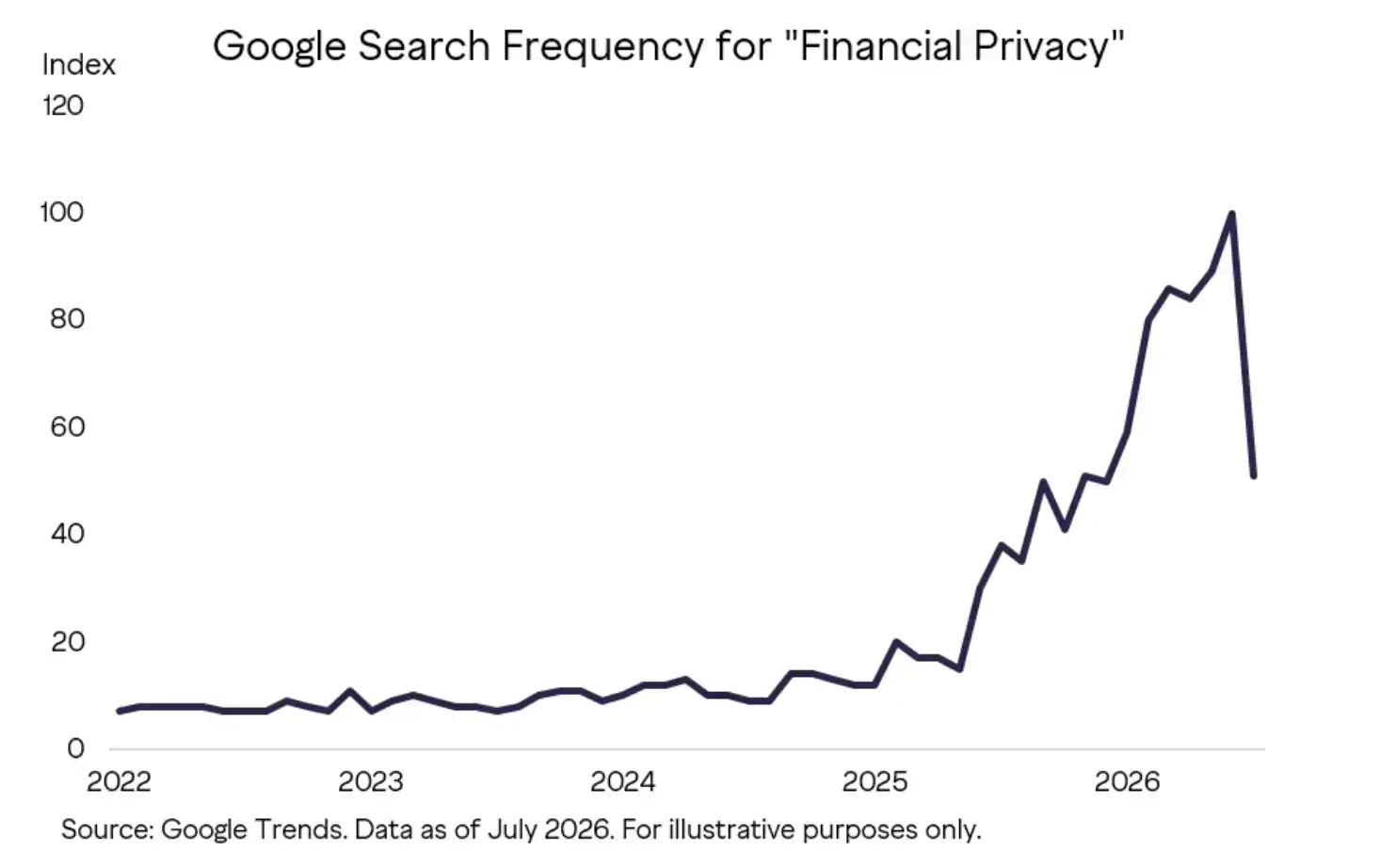
That is the backdrop for Grayscale’s latest look at Zcash. The report is not really asking whether privacy coins are about to enjoy another hype cycle. It asks a more basic question: as digital finance becomes more traceable, does privacy stay a niche feature, or does it return as a core property of money?
AI may drive a third round of privacy debate
Grayscale says stablecoins, public blockchains and AI tools are pushing financial privacy back into the conversation. In the report, researcher Michael Zhao argues that AI could trigger a third wave of attention after bank digitization and the spread of the internet.
Zcash has been live for nearly a decade. Shielded transactions, wallets and mining infrastructure have improved recently, but market share is still low. If investors start pricing privacy again, ZEC could see a re-rating.
That case is still clearly directional. There is no proof yet that AI will materially lift demand for privacy coins, that shielded features will turn into sustained use, or that exchanges and regulators will be willing to support the asset class.
Bitcoin solved scarcity, not privacy
Privacy is not an extra feature in money. It is part of whether money works at all. Cash has it by default. In banking, personal accounts and transfers are not usually open to public inspection, and law enforcement generally needs legal process to obtain records.
Technology has kept shifting that balance. In the 1970s, digitized financial records and the U.S. Bank Secrecy Act renewed debate over privacy. Later, the rise of the internet and online banking brought encryption and two-factor authentication into the mainstream as leakage and surveillance risks grew.
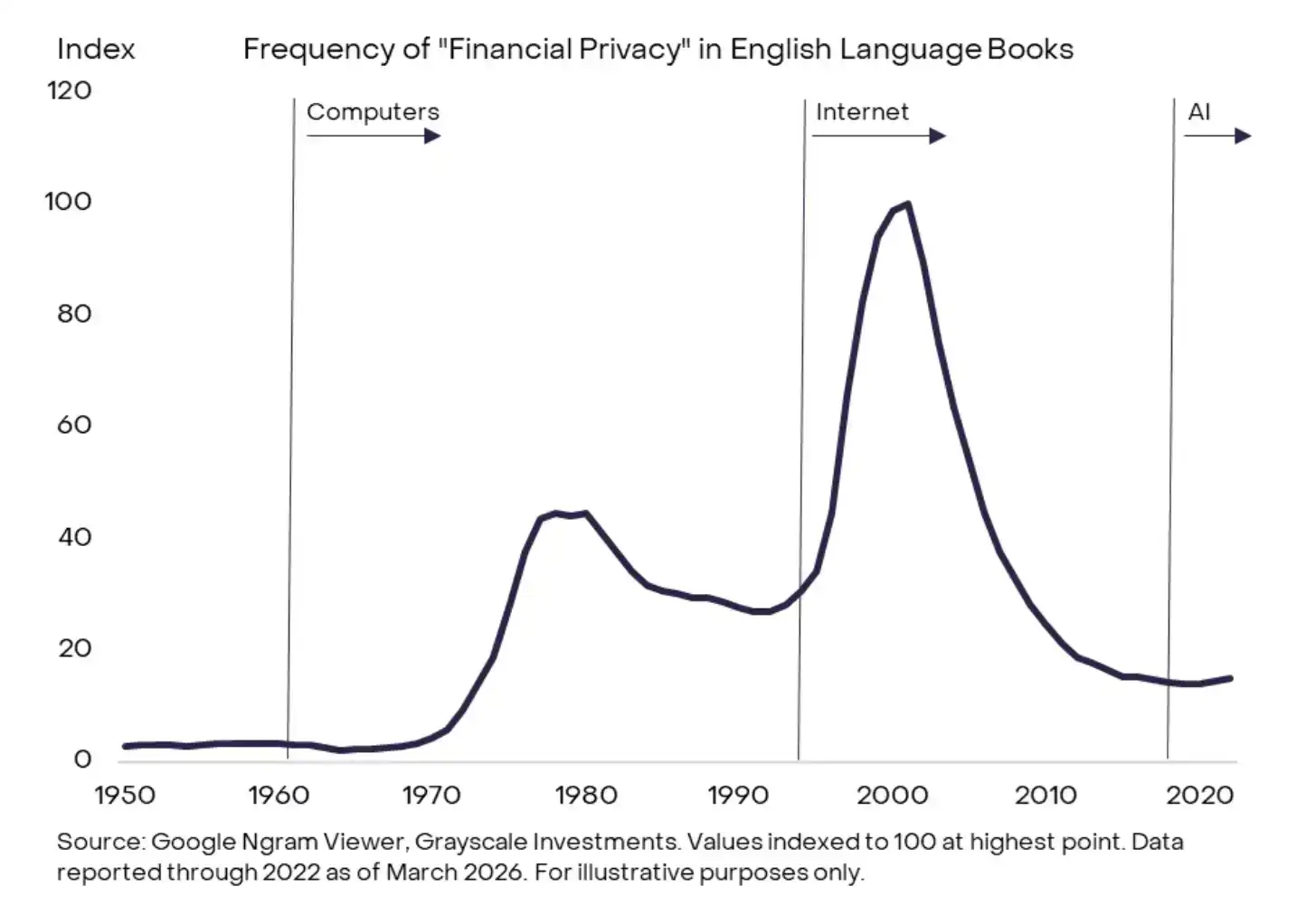
Grayscale argues that stablecoins, blockchain applications and AI may spark a third phase of that debate. On public blockchains in particular, AI can combine addresses, exchange records, wallet behavior and counterparty data to identify users who were meant to be pseudonymous.
That is why Zcash is framed as more than a cryptographic trick. Its value lies in whether it can become private digital cash outside the public ledger.
Bitcoin created verifiable digital scarcity through a public ledger, but that transparency also limits its use in some payment settings. Balances, counterparties and history can remain visible for a long time on-chain. Even when users do not attach their names directly to addresses, exchange accounts, transfer patterns, wallet habits and blockchain analytics can still link those addresses to real identities.
This affects more than individuals. Companies often do not want suppliers, payroll, treasury moves and customer relationships exposed to competitors in real time. Institutions may also prefer not to reveal wallet structure or trading strategy. In that sense, financial privacy is less about total anonymity than the confidentiality needed for normal business activity.
Zcash lets users choose what to reveal
Zcash shares a similar monetary design with Bitcoin: a 21 million coin supply cap, proof-of-work consensus and a primary use case of peer-to-peer value transfer. The key difference is that Zcash lets users decide whether transaction data is public.
The network supports two types of transfers. Transparent transactions reveal sender, receiver and amount, much like Bitcoin. Shielded transactions are valid on-chain, but the sender, receiver and amount are hidden.
That is possible because of zero-knowledge proofs. A user can prove a transaction follows the rules without revealing the raw data used to verify it. The network can check that the spender is authorized, that balances remain in sync and that no new coins were created out of thin air, all without seeing the transaction itself.
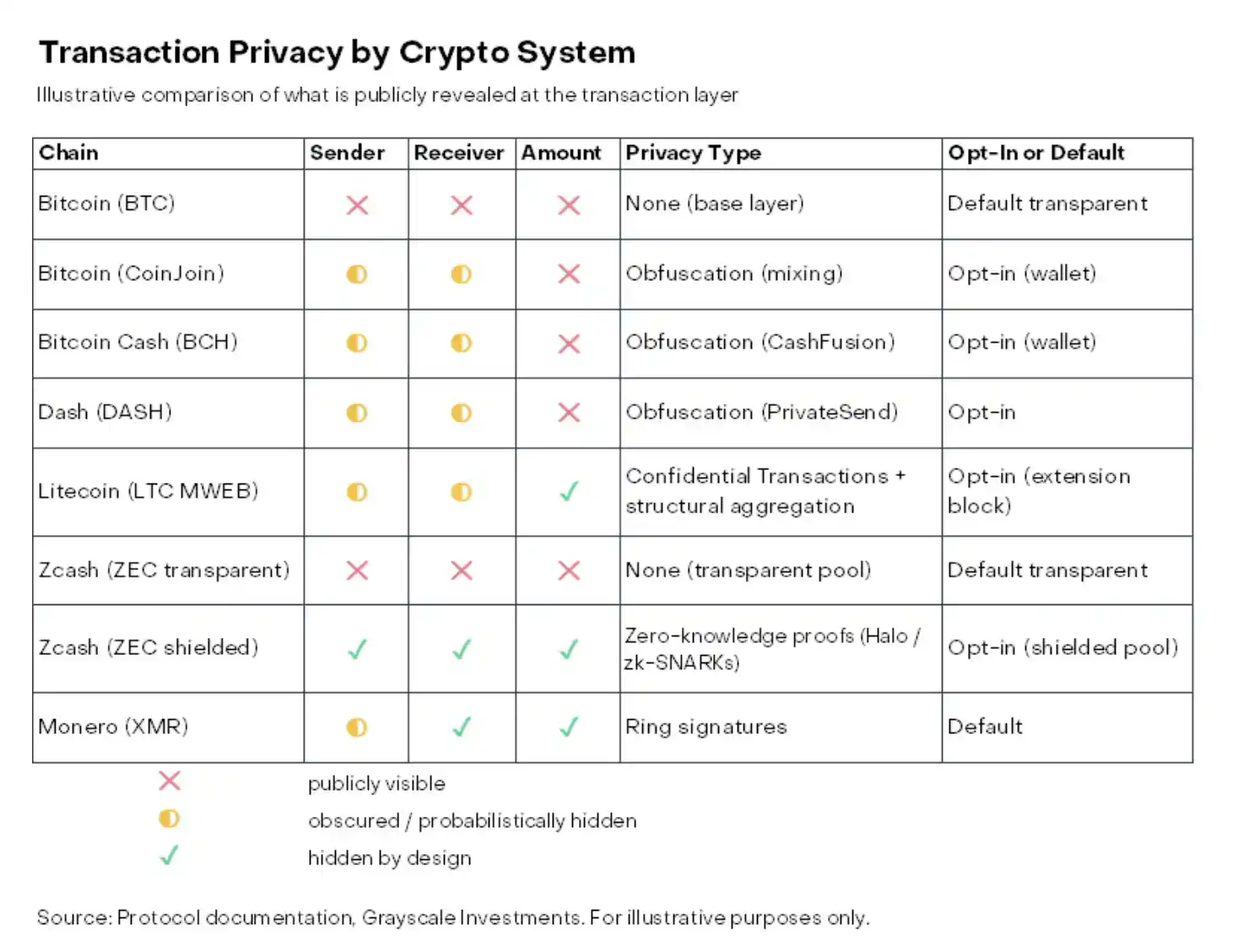
Zcash also supports selective disclosure through viewing keys. Users can choose to share parts of shielded transaction history with an auditor, a counterparty or any other designated third party. The design is not about making transactions permanently unviewable. It is about putting disclosure rights back in the user’s hands.
Ten years in, usability is still the bottleneck
Zcash launched in 2016 and was one of the first projects to use zero-knowledge proofs directly at the base layer of a digital currency. The early problem was not whether private transfers could exist. It was that they were too hard to use.
Shielded transactions initially required long proof times and a large amount of memory, which made for a poor experience on ordinary wallets and mobile devices. Later upgrades focused on lowering that barrier. Sapling, in 2018, cut the time and memory needed for shielded transactions. NU5, in 2022, introduced the Orchard shielded protocol and Halo 2, removing the need for a trusted setup in the new shielded pool. Unified addresses then improved how transparent and shielded addresses interact.
The Zodl wallet added cross-asset swaps, cross-asset payments and cold storage for shielded balances, trying to keep users private across the full transaction flow. Mining infrastructure has also expanded. In March 2026, Foundry announced a U.S. Zcash mining pool aimed at institutions and public miners, adding more standardized operating and compliance support.
Grayscale says these changes may mark a new stage for Zcash, but better wallets and more mining infrastructure only show that the base layer has improved. They do not prove that end-user demand has scaled.
The next question is whether privacy can scale. Tachyon is intended to reduce the compute and sync costs of shielded transactions. Crosslink is meant to improve finality and network reliability. If shielded asset plans move ahead again, Zcash’s privacy features could also extend beyond native ZEC to other assets.
What the 90% shielded share really shows
Grayscale’s main evidence comes from on-chain usage. Using the report’s methodology, shielded transactions accounted for about 90% of Zcash transaction count as of July 20, 2026. Roughly 4.2 million ZEC sat in the shielded pool, about 25% of circulating supply at the time.
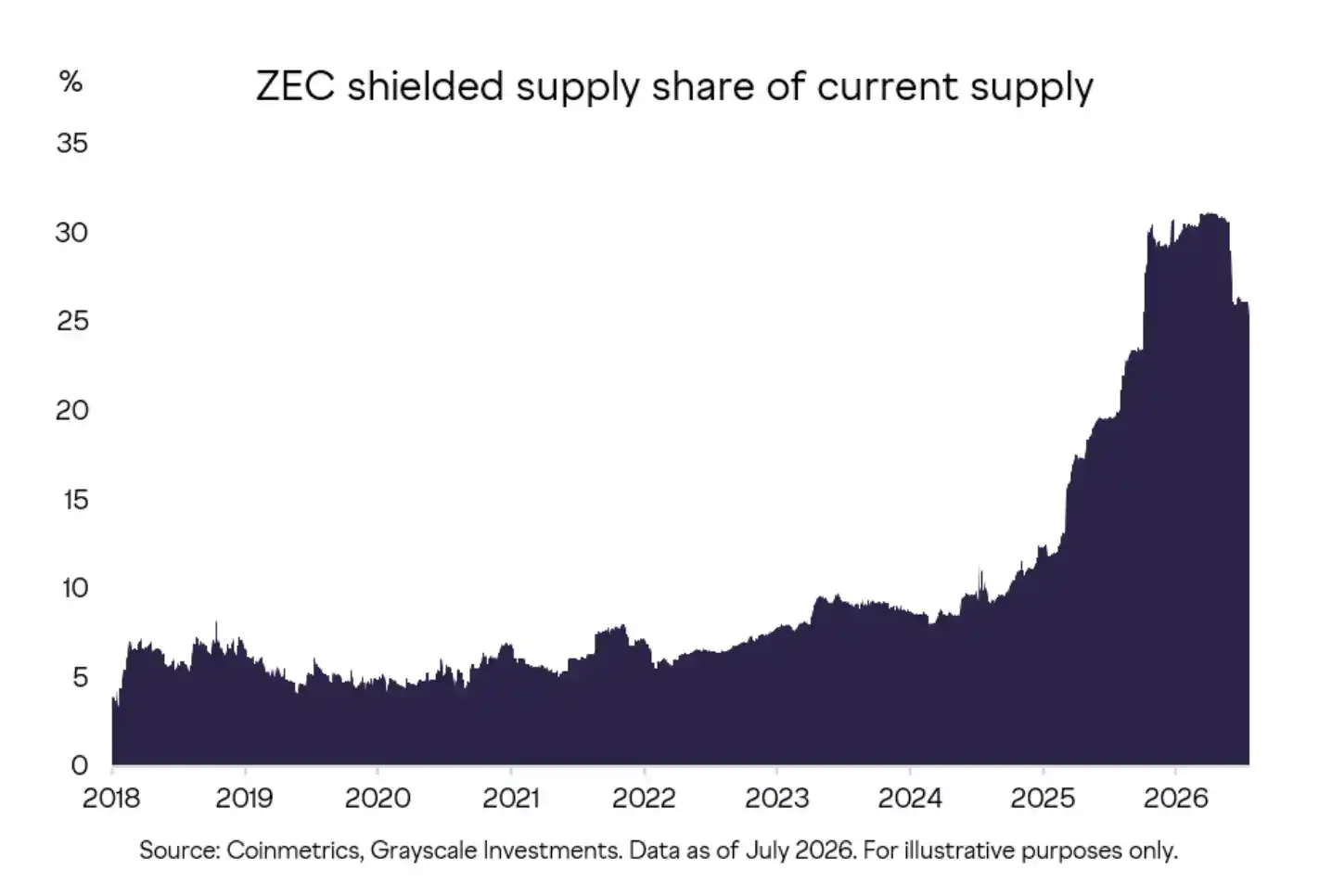
That suggests shielded transfers are not just a product story. They are visible on-chain behavior. But the figures need caution. Different data providers classify shielded transactions differently, use different dates and may or may not combine multiple shielded pools. A higher transaction count does not automatically mean more users, more payment volume or more economic activity.
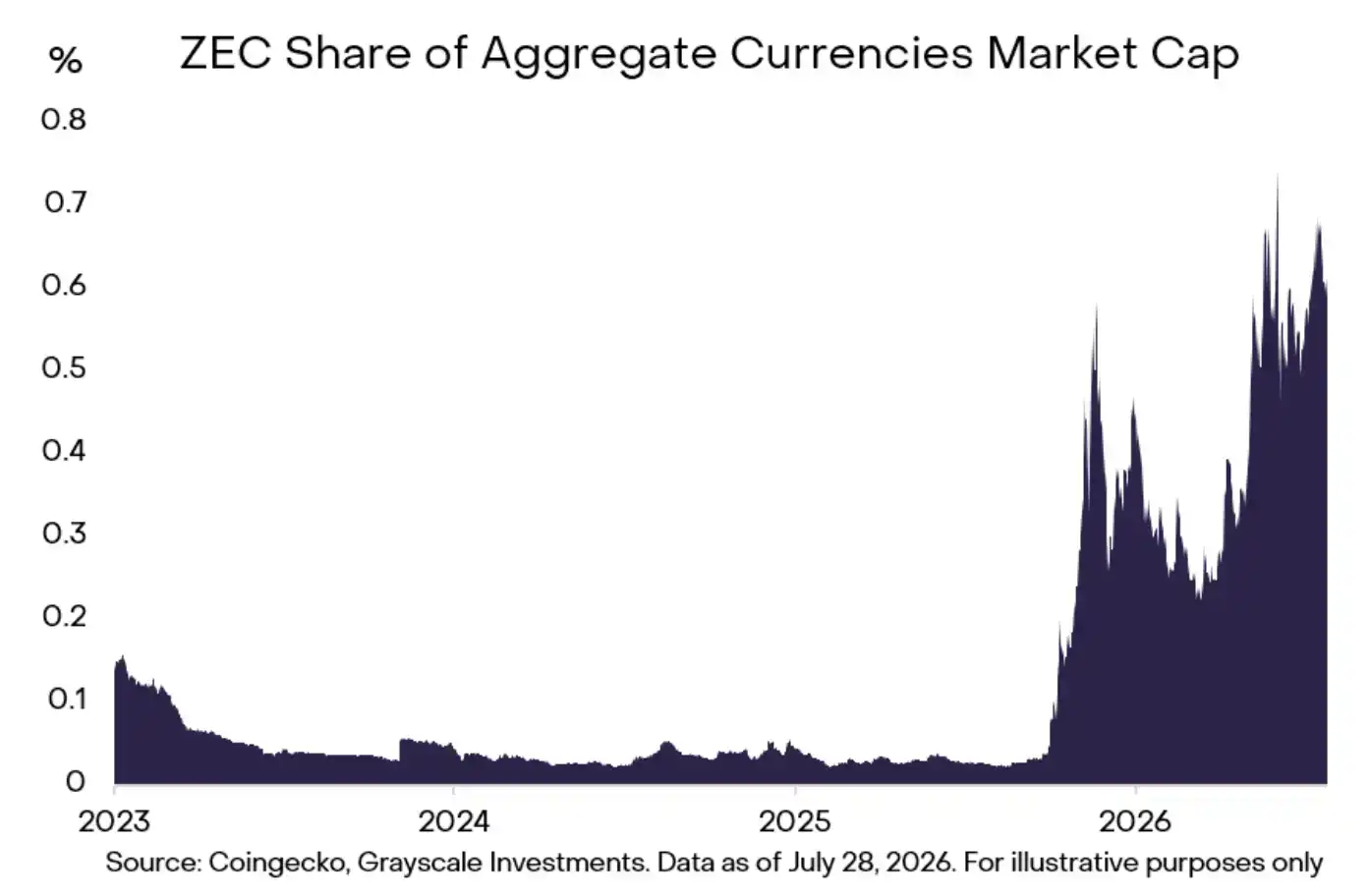
Grayscale is not betting on Zcash already having mass adoption. It is betting on a future shift in how privacy is valued. Based on July 2026 data, the firm’s “digital currency” crypto segment had a total market value of about $1.4 trillion. Bitcoin accounted for about 90% of that, while ZEC had a market cap of about $8 billion, or roughly 0.6% of the segment.
From there, the report lays out a scenario: if ZEC were to reach a 5% share of that segment, its market value would be about $70 billion, or 8.75 times its level in the report, rounded to roughly 9 times. This is not a price target. It is a sensitivity exercise based on market share, and it assumes, among other simplifications, that the size of the digital-currency segment stays unchanged and that ZEC supply and competition do not shift materially.
More precisely, Grayscale is arguing that today’s valuation reflects a belief that privacy will remain on the edge of the market. If investors start treating privacy as a basic property of digital money, ZEC’s low share could leave room for valuation upside.
Regulatory, security and execution risks remain
Rising demand for privacy does not mean Zcash automatically benefits. The first risk is regulation and distribution. Viewing keys can help users disclose transaction history to a specific party for compliance review, but the information is still user-controlled and is not the same as public ledger transparency.
The Financial Action Task Force still requires virtual asset service providers to conduct customer due diligence, keep records, file suspicious activity reports and follow the travel rule. Selective disclosure may reduce some compliance friction, but it does not guarantee support from exchanges, custodians or regulators. The stronger the privacy, the more likely ZEC faces limits at listing, custody, wallet integration and fiat on- and off-ramps.
The second risk is protocol security. In 2026, developers found a soundness bug in the original Orchard circuit that could, in theory, have been used to create undetectable counterfeit ZEC. NU6.2 fixed the circuit. The later Ironwood shielded pool further limited new funds from entering the old Orchard pool and added a migration path to restore verification of shielded supply integrity.
This was a theoretical vulnerability, not evidence that ZEC had already been counterfeited. Ironwood improves the future security structure, but the old shielded pool and the migration of funds remain legacy risks to watch.
Quantum computing is the longer-term issue. The mechanisms introduced in Ironwood help preserve a recovery path for a future quantum-resistant migration, but the official technical proposal says the change does not make Zcash fully quantum-resistant.
Execution is the final risk. Zcash’s investment case still depends on wallets, protocol scaling and ecosystem distribution improving together. Any delay, coordination failure or lack of user adoption could weaken the idea that privacy can scale.
The real test is demand, not just price
Zcash’s bullish case does not require it to replace Bitcoin. Grayscale is betting on a different possibility: if on-chain money flows keep getting more transparent and AI keeps getting better at analysis, the market may start paying up for digital money that is verifiable but not public.
To test that view, the next things to watch are not only whether ZEC keeps rising. The more relevant signals are whether shielded balances and real users keep growing, whether wallets make private transactions easier to use end to end, whether upgrades like Tachyon arrive on time, and whether exchanges and custodians expand support instead of pulling back.
If privacy usage grows but liquidity and compliant access keep deteriorating, Zcash may still struggle to build a larger market. If usage, infrastructure and market access improve together, ZEC could shift from a legacy privacy coin into a pricing tool for digital financial privacy.