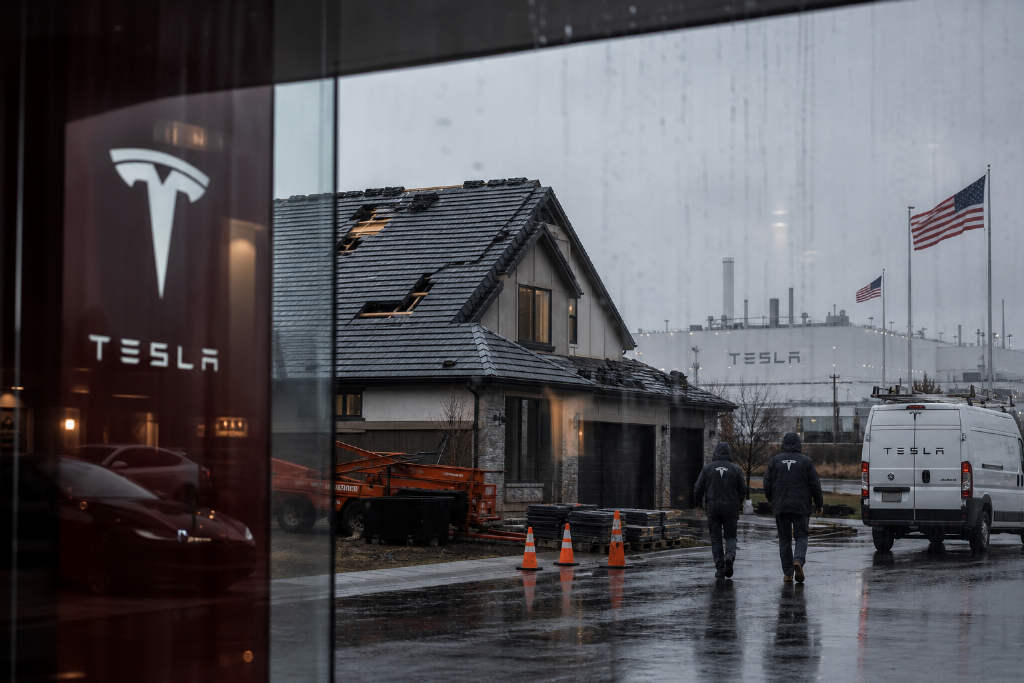
Tesla has ended its Solar Roof project, six years after Elon Musk said the company would be installing 1,000 units a week by the end of 2019.
According to Protos, the highest weekly installation count Tesla ever reached was 32. Total installations came to about 3,000. If the company had actually hit Musk’s 1,000-per-week target, that figure would now be around 345,000.
The shutdown did not come with a press release or a regulatory filing. Journalists noticed that tesla.com/solarroof now redirects to a separate solar panels page, and Solar Roof has disappeared from the Tesla Energy menu. One source told Protos that Tesla had finished an internal review and concluded the product was “not financially viable.”
How the Solar Roof story began
Protos traced the rise and decline of the product back to SolarCity.
On June 16, 2014, SolarCity agreed to acquire panel maker Silevo for $200 million in stock plus $150 million in earnouts. On September 23, 2014, New York broke ground at RiverBend and committed $750 million for a plant that SolarCity would lease for $1 a year, the first major government subsidy in what Protos described as a long-running pattern.
In October 2015, an amended state agreement cut SolarCity’s direct manufacturing commitment in Buffalo from 1,460 jobs to 500.
On July 31, 2016, Tesla signed a stock merger agreement for roughly $2.6 billion to acquire SolarCity. Before the deal, Musk and two of his cousins were controlling shareholders. A shareholder lawsuit alleged that “Musk knew SolarCity was going broke before merger with Tesla.” At the time, Musk also had more than $475 million in personal loans backed in part by SolarCity stock.
On October 28, 2016, Musk unveiled four roof tile styles at Universal Studios. Protos said he left out several points during the presentation: the tiles generated no electricity, were “conceptual in nature,” and had been built not for solar power generation but for “demonstration of the aesthetics.”
Tesla shareholders approved the SolarCity acquisition on November 17, 2016. The merger closed on November 21, 2016, making SolarCity a Tesla subsidiary and Solar Roof an official Tesla product. On December 27, 2016, Panasonic finalized an agreement to manufacture photovoltaic cells at the Buffalo, New York plant. In exchange, Tesla committed to “a long-term purchase commitment from Panasonic.”
Orders, production, and early rollout
On May 10, 2017, Tesla opened orders for SolarCity at $21.85 per square foot of total roof area and promised a lifetime warranty. Two weeks later, on May 25, 2017, an RBC analyst said Solar Roof orders were sold out through 2018.
On August 2, 2017, Tesla disclosed that Tesla employees received the first Solar Roof installations. On January 9, 2018, Tesla told Reuters that its Buffalo facility had started producing Solar Roof tiles in December 2017.
On June 12, 2018, as part of a restructuring that cut about 9% of staff, Musk ended Tesla’s Home Depot partnership for SolarCity sales. A Reuters investigation published on August 8, 2018 found that Buffalo was producing only one of the four tile styles Musk had shown in 2016. A CNBC investigation on September 24, 2018 said that only 12 Solar Roofs in California had been connected as of May 2018, far below Musk’s estimate of several hundred.
The V3 launch and the 1,000-per-week goal
On October 25, 2019, Tesla launched Solar Roof V3 and quoted roughly $33,950 for a 2,000-square-foot roof. On the same call, Musk said Tesla was aiming for 1,000 installations a week by the end of 2019.
On January 29, 2020, Tesla reported 54 megawatts of solar capacity deployed and said it had made hundreds of new hires at Gigafactory New York. Panasonic then said on February 26, 2020 that it would stop making solar cells in Buffalo by May and leave entirely by September. On March 16, 2020, Tesla said it had produced four megawatts of solar tiles in one week, which it said was enough for 1,000 homes.
On August 21, 2020, a state audit found that the Buffalo project was projected to return $0.54 for every subsidy dollar, 98% below its $30 benchmark. Panasonic completed its withdrawal from Buffalo in September 2020, leaving Tesla to run the factory on its own.
Price hikes, Powerwall bundling, and lawsuits
On January 27, 2021, Tesla reported 205 megawatts of solar deployed across 2020. In March 2021, Tesla began emailing customers to say it had raised Solar Roof prices.
By April 11, 2021, those price increases had reached contracts signed more than a year earlier, commonly adding 30% and in some cases more than 50% to customer costs. On April 22, 2021, Musk said Solar Roof and Tesla solar panels would only be sold bundled with a Powerwall battery. Four days later, on April 26, 2021, Musk said on a quarterly earnings call that Tesla had “made some significant mistakes in assessing the difficulty of certain roofs.”
On April 30, 2021, two Pennsylvania customers sued Tesla, alleging that the company raised their contracted price by tens of thousands of dollars after signing. A California class action filed on May 12, 2021 put one increase at $71,074.42 to $146,462.22, more than double the original signed contract price. Tesla later settled that case.
On July 13, 2021, Musk testified in Delaware court in defense of the SolarCity acquisition. Delaware’s Court of Chancery ruled in Musk’s favor on April 27, 2022, calling the SolarCity acquisition “entirely fair.” On September 12, 2022, Tesla repeated its requirement of at least one Powerwall for every new Solar Roof. On November 10, 2022, Tesla canceled Solar Roof projects across several states, including some that had already been permitted, and exited certain markets entirely.
Wind-down and closure
On June 6, 2023, the Delaware Supreme Court, sitting en banc, affirmed an appeal in Musk’s favor, ending nearly seven years of litigation over the SolarCity acquisition. On July 11, 2023, Tesla settled a California class action over price hikes for $6.08 million, covering about 8,636 customers while admitting no wrongdoing.
On January 24, 2024, Tesla reported 41 megawatts of solar for the quarter, its weakest reading since 2020. Protos said Tesla never published another quarterly figure after that. On March 7, 2024, a judge approved a settlement that closed Tesla’s final Solar Roof price-hike lawsuit. On April 16, 2024, Tesla filed a state layoff notice covering 285 jobs in Buffalo as it reduced Solar Roof operations.
On September 25, 2024, Tesla recruited more third-party installers while winding down its own in-house crews. On April 19, 2025, Tesla removed online Solar Roof quotes and routed buyers to its third-party installer network. On July 4, 2025, Donald Trump’s One Big Beautiful Bill repealed Tesla’s residential solar tax credit at the end of 2025.
On January 29, 2026, Tesla unveiled its own conventional solar panel, the product that now replaces Solar Roof. On May 14, 2026, Solar Roof projects in Florida were canceled, with field crews reassigned from installations to repairs. On August 20, 2026, Tesla told installers that Solar Roof tiles were no longer orderable.
With the Solar Roof page now redirecting to a solar panels page and the product removed from the Tesla Energy menu, the project has come to an end.