
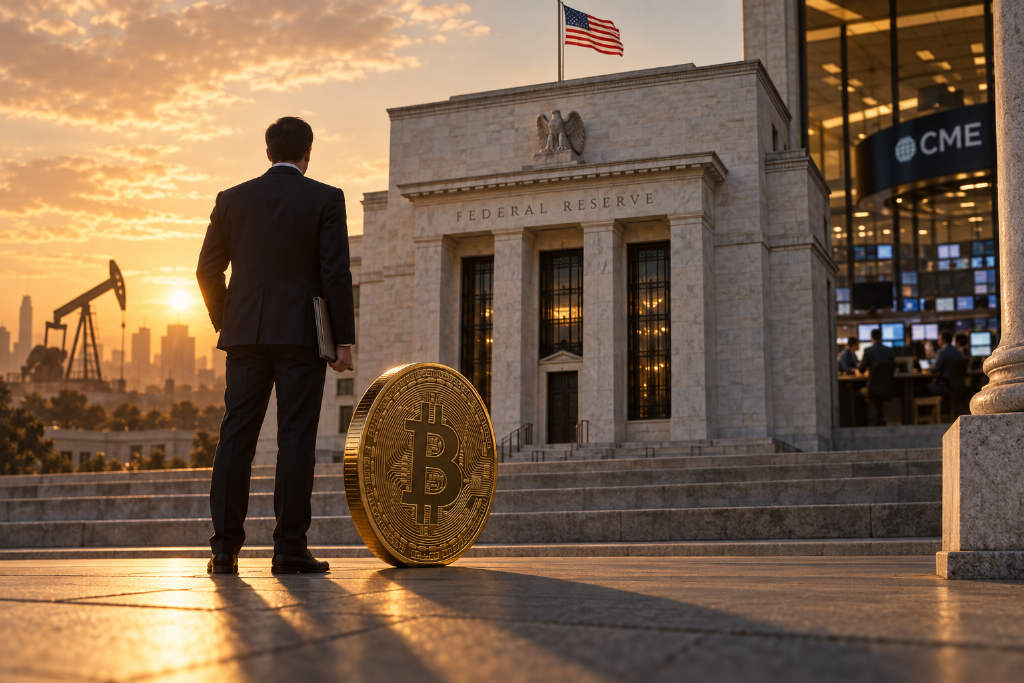
Bitcoin is walking into a huge policy week, and the market’s view on rates has flipped hard away from near-term cuts. Last month, the coin bounced as traders bet the U.S. Treasury might alter liquidity conditions. Now? Crypto is being priced through one thing again: the Federal Reserve.
Over the last month, Bitcoin is up about 20%. Some smaller tokens ran even hotter, with parts of the market toying with upside calls as extreme as 500%. But the mood still isn’t loose. Treasury Secretary Scott Bessent has put out a blunt warning, and billionaire investor Stanley Druckenmiller—described in the report as close to current Fed Chair Kevin Warsh—was reported saying rate cuts are not needed anymore.
That remark mattered for more than Druckenmiller’s name value. It hit because of where he sits in Washington’s monetary-policy orbit. The report says he has mentored both Warsh and Bessent. For traders, his comments have turned into a shorthand for the fight among three camps: a White House pushing for lower rates, a bond market demanding stability in long-end yields, and a Fed still staring at inflation. Who’s winning? Still hard to say.
Rate-cut hopes give way to hike pricing
Donald Trump has kept up the pressure on the Fed to cut rates. Markets usually take lower rates as cheaper funding and a friendlier setup for risk assets, and Bitcoin often gets lumped into that bucket. But crypto has a problem here. Pricing has moved the other way.
According to the Financial Times, citing anonymous sources, Druckenmiller told a private gathering of Wall Street executives this week: "Those Fed officials who are still saying the federal funds rate is restrictive are simply absurd." He also said: "I believe in common sense. Just look at global asset prices." The message was pretty direct: when financial assets and risk assets around the world are already richly valued, it is hard to defend rate cuts on the theory that policy is still too tight.
Druckenmiller also said he is no longer permitted to speak with Warsh, though he still described Warsh as one of his “closest friends” and “a great Federal Reserve chairman.” That pairing—personal closeness, but no private contact—shows just how politically sensitive the Fed chair role has become, at least as the report lays it out.
Earlier this month, Druckenmiller also signed onto a sharply worded Wall Street Journal opinion piece attacking his former protégé for trying to manipulate and drive down long-dated Treasury yields. On one side sit the White House and the Treasury, both wanting lower long-end rates to cut government financing costs. On the other side are old-school macro traders arguing that holding down long yields through unconventional methods can push up inflation expectations while also puffing up asset bubbles. Bitcoin sits right in the crossfire. It likes liquidity. But when rate hikes pull that liquidity out, it gets hurt too.
The Fed is not united
The Federal Open Market Committee is not acting as one unit. The report labels FOMC members Anna Paulson, Michael Barr and Lisa Cook as dovish for now. But Barr, earlier this month, still left open the possibility of a hike if incoming data show inflation is not cooling. So yes, dovish—but not automatically pro-cut. It can just mean waiting. Then moving fast if the data turn.
Markets are running out of patience for that waiting game. CME’s FedWatch tool shows traders putting the odds of a Fed rate hike next week at nearly 90%. For crypto, that is basically a directional signal. The near-term issue is no longer whether cuts are on the way. It is how much tightening may arrive, whether the dot plot gets firmer, and whether the tone after the meeting turns even more hawkish.
Inflation and oil constrain the policy window
Prices and energy costs are the obvious brake. A Bitget Wallet research analyst said in an email that August consumer price index data came in mixed and did not offer a clean dovish signal. “This report strengthened the case for a 25-basis-point rate hike on September 16,” she said.
The same analyst said Bitcoin needs three things to keep bouncing: stable Treasury yields, stable oil prices, and continued net inflows into spot ETFs. Miss one, and the move starts to look less like a new trend and more like an exit rally. On the chart side, she put near-term support in the $75,000 to $76,000 zone and called $80,000 the first major test above.
Other data tell the same story. Price pressures over the last few months have not eased as clearly as the market hoped. At the same time, the war between the United States and Iran is still ongoing, and oil has climbed back above $100 a barrel. High oil makes inflation expectations tougher to push lower and leaves the Fed with less room to ease first.
The report says Bitcoin’s gain over the past month came mainly from a bounce off earlier oversold levels and from liquidity hopes tied to Treasury-related trades. Now that cut expectations have faded, this week’s policy call may decide whether that move can stick.
A 200-basis-point shift in nine months
What has really changed the mood among macro traders is the size of the repricing. Analysts at the Kobeissi Letter wrote on X: “What we are seeing right now is a remarkable shift.” Their timeline showed the market’s base case has swung to four rate hikes by July 2027. Back at the start of 2026, pricing for that same stretch implied four rate cuts. That is a 200-basis-point swing in nine months.
For bonds, stocks and Bitcoin, that is no small tweak. It is a shift in the market’s whole pricing anchor. The Kobeissi Letter went further too, calling this the most aggressive policy outlook since the Fed started the current hiking cycle in March 2022. “The market believes ‘higher for longer’ is back, and inflation is not going away easily. Wednesday will be an exciting day,” the analysts wrote.
And that “exciting day” is about more than a possible 25-basis-point hike. Traders are also watching the Summary of Economic Projections—especially whether the dot plot and the forecasts for growth, inflation and unemployment all get revised higher at once.
Bitcoin approaches a major technical test
The basic framework crypto traders use here is simple. Lower rates increase the opportunity cost of holding cash and can shove money toward Bitcoin, growth stocks and riskier tech names. Higher rates—especially if they stay there—make cash and short-dated bonds look good again and force risk assets to show they can handle a steeper discount rate.
Bitcoin’s rise over the last month does not mean it somehow escaped that logic. It means the rally came before the repricing had fully finished.
Yuya Hasegawa, an analyst at Tokyo-based Bitbank, laid out one possible trading path for next week. He thinks Bitcoin may stay pinned near the top of its range while the market waits for the FOMC. If the Fed hikes, or if the updated Summary of Economic Projections shows more officials backing another increase this year, then rising short-end yields and a further flattening of the curve could add fresh pressure to Bitcoin.
He said traders should keep an eye on $75,500, the lower end of the recent range. If that level breaks decisively, the August gains could keep unwinding, and the next psychological marker would be $70,000.
The real issue is what comes after a hike
Put it all together and the picture is pretty plain. The White House wants cuts. The bond market wants lower long-end yields. Inflation and oil are not helping. Druckenmiller is openly saying policymakers should stop acting like rates are too restrictive. Futures markets have pushed the odds of a hike next week to nearly 90%. Macro researchers have shifted the coming year’s path from four cuts to four hikes. And Bitcoin, at the same time, has climbed to around $80,000—the first major test flagged in the report.
So the next question is not just whether the Fed hikes. It is how the statement and the dot plot frame what comes next. If officials sell it as a one-off move against inflation, Bitcoin may still treat $75,000 to $76,000 as the lower edge of a trading band. But if markets read it as the opening move in a renewed “higher for longer” phase, traders may start taking $70,000 very seriously and rethink how much of August’s rebound can really last.