
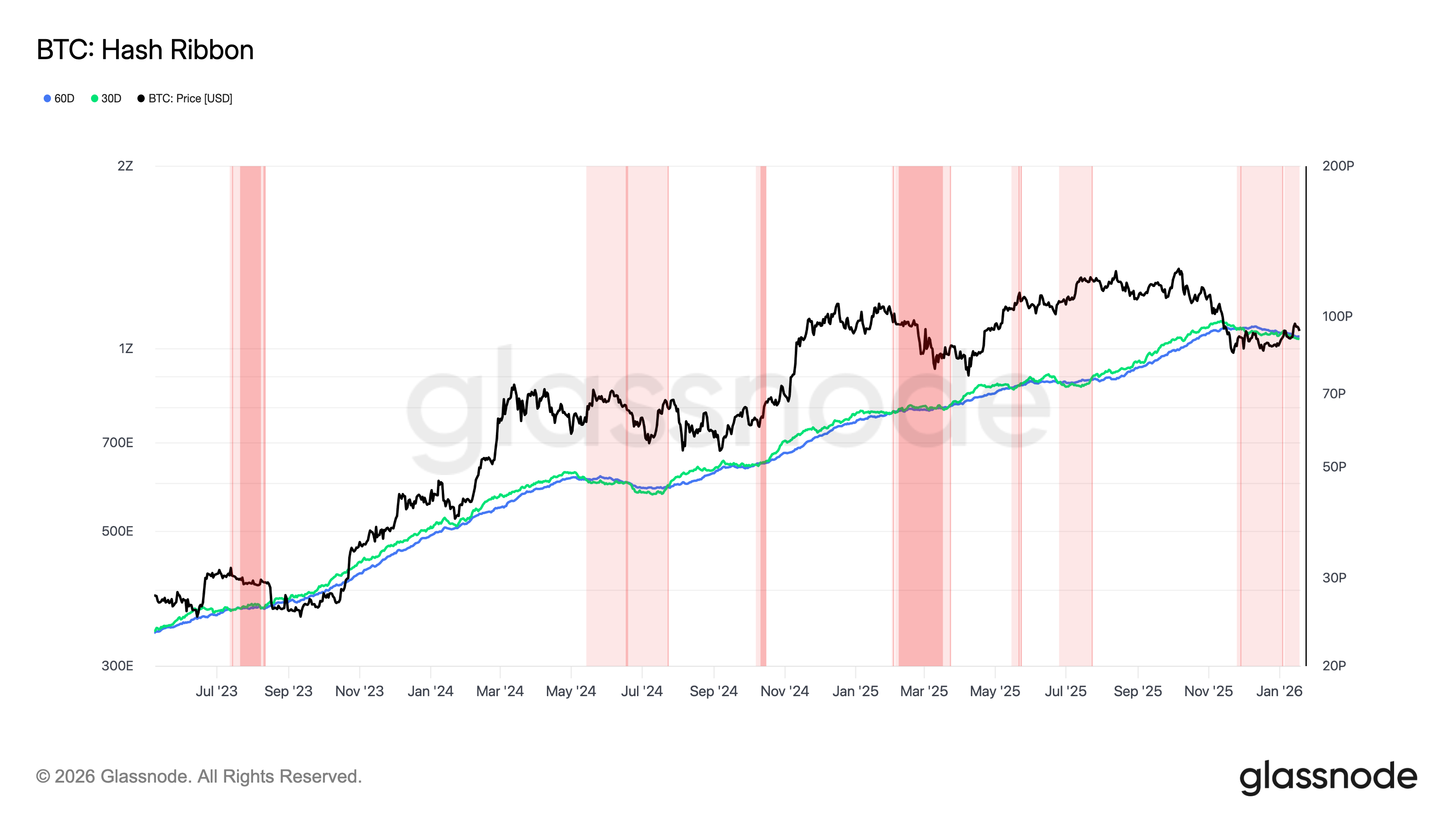
Bitcoin's network hashrate has dropped roughly 15% from its October peak, signaling growing stress among miners. The average computing power securing the network slipped from about 1.1 zettahashes per second (ZH/s) in October to around 977 exahashes per second (EH/s), indicating that miners are switching off machines as profitability deteriorates.
Hash Ribbon Inversion Signals Miner Capitulation
Glassnode's Hash Ribbon metric, which tracks miner capitulation by comparing short- and long-term hashrate trends, inverted on Nov. 29, shortly after bitcoin bottomed near $80,000. When inverted, miners are typically forced to sell bitcoin to fund operations, adding near-term supply pressure. Yet capitulation is also viewed as a contrarian signal.
VanEck notes that sustained miner stress has historically preceded renewed bitcoin price momentum as inefficient miners exit and selling pressure eventually exhausts. The worst of capitulation may be nearing an end once the 30-day moving average of hashrate moves back above the 60-day average, a setup often aligning with improving price action.
Repeated Negative Difficulty Adjustments Reinforce Pressure
Falling hashrate has triggered repeated negative difficulty adjustments. Bitcoin's mining difficulty is scheduled to drop 4% to around 139 trillion (T) on Jan. 22, marking the seventh negative adjustment in the past eight periods.
Additional selling pressure comes from miners pivoting toward AI and high-performance computing. Companies like Riot Platforms (RIOT) are selling bitcoin to fund capital-intensive AI and HPC investments, contributing to short-term price headwinds.