
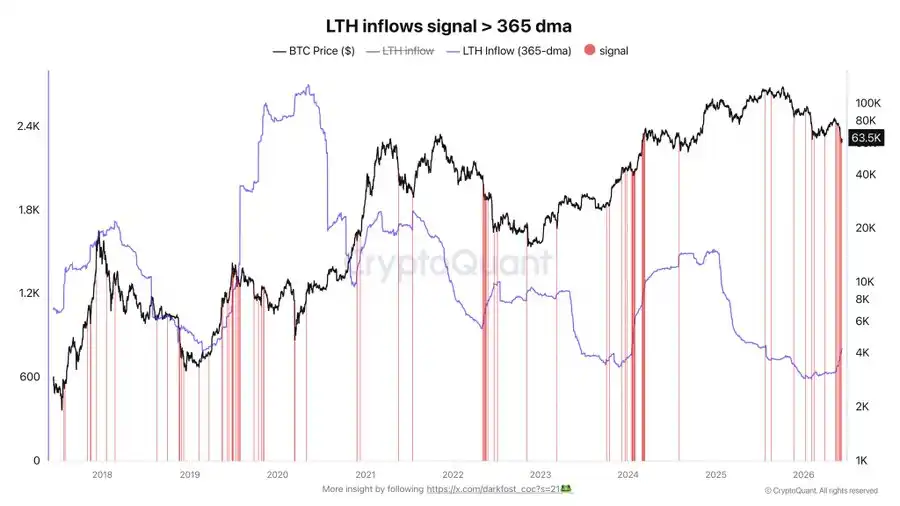
BlockBeats reported on June 14 that analyst Darkfost said Bitcoin long-term holders, or LTHs, are showing two features at the same time based on on-chain data: short-term activity and longer-term accumulation. In this context, LTH refers to holders whose coins have been held for more than six months. The analysis focuses on the amount of Bitcoin transferred by these holders to exchanges, because in most cases, when LTHs move BTC to trading platforms, it indicates that a sale is about to take place.
Short-term exchange inflows remain above normal
According to Darkfost, exchange inflows from Bitcoin long-term holders are still higher than normal over short timeframes. Recent data continues to show signals classified as “extreme selling events.” In the analysis, such an event is defined as a period when daily exchange inflows reach at least five times the annual average level. The continued appearance of these signals shows that LTHs still have the ability to move BTC to exchanges in concentrated bursts and create sudden selling pressure over short periods.
Annual average inflows remain near record lows since 2015
From a longer-term perspective, however, the annual average exchange inflow from LTHs has been trending downward. The indicator recently rebounded slightly from about 630 BTC per day in early May to more than 800 BTC per day, but it remains at the lowest level recorded since 2015. This shows that although concentrated exchange inflows can still occur in the short term, the overall scale of BTC being moved by long-term holders to trading platforms is far lower than in previous cycles.
Darkfost said the trend indicates that long-term holders are increasingly inclined to hold for the long run, and that it is also related to changes in holder structure after the launch of ETFs and the entry of institutional participants. The conclusion of the analysis is that while LTHs can still produce concentrated selling pressure in certain short-term phases, their market influence over medium- and long-term horizons has weakened substantially and is no longer as dominant as it was in past cycles.