


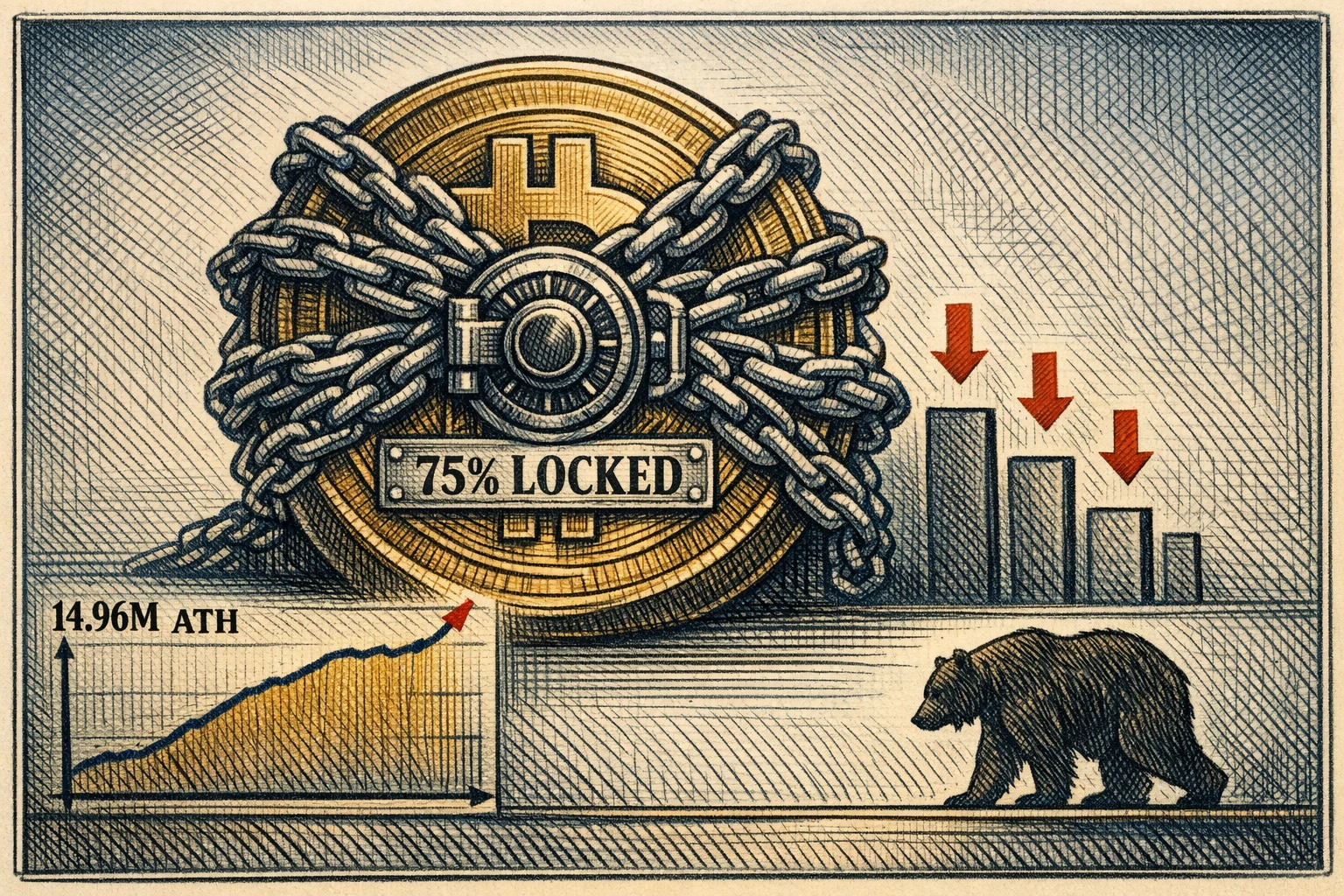
Bitcoin long-term holders held a net 14.96 million BTC as of June 17, about 20,000 BTC above the previous peak recorded on March 27. On-chain analyst Murphy said this marks the second record high in long-term holder net positioning since Bitcoin entered the current bear market, with roughly 75% of circulating supply now in the hands of long-term participants.
Murphy described long-term holders, or LTHs, as addresses that have held coins for more than 155 days and are less likely to trade actively. In his reading of the data, more BTC is moving away from short-term speculation and into wallets that rarely spend, tightening the liquid supply available to the market.
Net accumulation tends to rise before a market bottom
Murphy said a repeated pattern can be seen across prior bear cycles: market bottoms usually form after LTH net positions begin to recover. The sequence matters. First, long-term holders resume accumulation and the net position curve turns higher; only later does the price bottom take shape.
That is why fresh highs in LTH net holdings are often read by some on-chain analysts as a base-building signal rather than a warning of an immediate top. The behavior reflects a phase when sentiment is weak, trading activity slows, and long-term buyers quietly absorb supply.
Three prior highs were followed by three distribution waves
Murphy also cautioned that a new high in LTH net positioning does not automatically confirm a bottom. In the previous cycle, LTH net holdings reached new highs three times, and each episode was followed by a strong wave of distribution as long-term holders sold coins back into the market.
He linked those three waves to periods tied to the Federal Reserve signaling rate hikes, the Luna collapse, and the FTX failure. The point is simple: the same on-chain reading can carry different meaning depending on the scale of selling pressure around it.
The main signal is whether distribution keeps shrinking
For Murphy, the more useful indicator is not how many times LTH net holdings make a new high, but whether the size of each prior distribution wave is getting smaller. If the current round of distribution is below the last one, that would suggest fewer long-term holders are willing to sell into strength and that market selling pressure is fading.
His framework focuses on remaining supply pressure rather than counting record highs. With LTH holdings still climbing and their share of circulating Bitcoin reaching 75%, Murphy sees the current setup as one on-chain sign that the bear market may be building a base.