
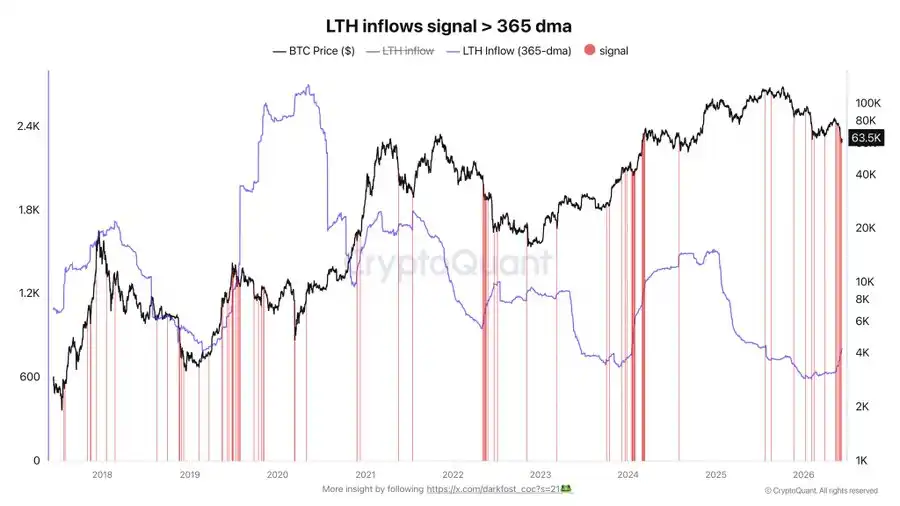
BlockBeats reported on June 14 that analyst Darkfost said Bitcoin long-term holders, or LTHs, are showing a dual pattern in on-chain data. LTHs are defined in the report as holders with positions older than six months. In the short term, their exchange inflows remain above normal levels, while over a longer horizon their overall tendency to send Bitcoin to trading platforms has continued to decline.
Darkfost noted that when long-term holders transfer Bitcoin to exchanges, it usually points to an upcoming sale. For that reason, exchange inflows from this cohort are often used as a signal for short-term selling pressure. Recent data still shows elevated activity, meaning LTHs retain the ability to generate abrupt sell-side pressure over shorter time frames.
In the framework cited by Darkfost, an “extreme selling event” is defined as a period when daily exchange inflows reach at least five times the annual average. Such signals have continued to appear recently. This indicates that holders with coins aged more than six months have not fully withdrawn from exchange-related activity and can still produce concentrated selling pressure when flows rise sharply in a single day.
At the same time, the longer-term trend is different. The annual average exchange inflow from LTHs has been moving downward. Although the figure recently rebounded slightly from about 630 BTC per day in early May to more than 800 BTC per day, it remains at the lowest level recorded since 2015. In other words, the recent rebound has not changed the broader decline in long-term holder exchange inflows.
Darkfost said the trend shows LTHs are increasingly inclined to hold for longer periods, and also listed the launch of ETFs and the entry of institutional participants as related factors in the changing holder structure. The conclusion of the analysis is that LTHs can still create episodic concentrated selling pressure in the short term, but their market influence over the medium and long term has been greatly reduced and is no longer as dominant as in previous cycles.