
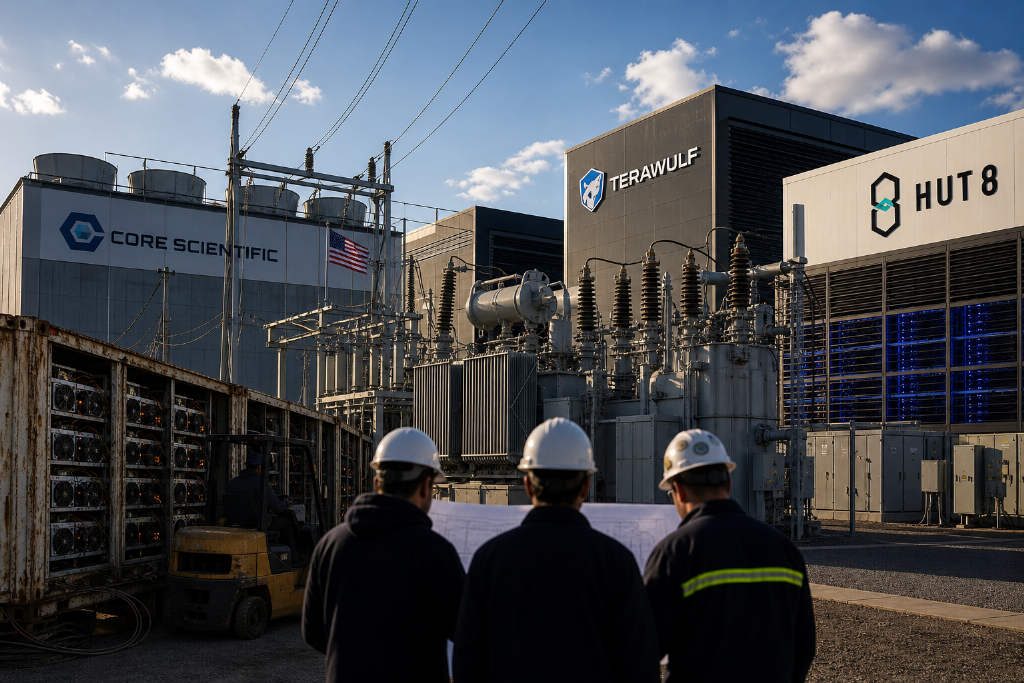
A growing group of publicly listed Bitcoin miners shifting into AI and high-performance computing, or HPC, is being valued on a different basis. The old formula centered on hash rate, daily Bitcoin output, and BTC held on the balance sheet. The new one is about megawatts and gigawatts: how much power a company controls, how much of it is already energized or backed by clear interconnection arrangements, how much has been leased to AI customers, and how much has actually been delivered and started billing.
Land, substations, transmission access, and long-term power arrangements that were once assembled for mining are now being treated as scarce AI infrastructure. Instead of monetizing electricity only through Bitcoin production, miners are starting to monetize power capacity through long-term data center leases, along with the construction and operating capabilities tied to those sites.
Mining economics weakened while data center demand kept rising
The backdrop is a widening gap between the economics of Bitcoin mining and the demand profile of AI data centers. Unit revenue in mining has remained under pressure, while power demand from data centers continues to climb.
The International Energy Agency, or IEA, said in an April 2026 update that global data center electricity consumption is expected to rise from about 485 TWh in 2025 to about 950 TWh in 2030, nearly doubling. The IEA had also previously estimated that US data centers would account for nearly half of incremental electricity demand from 2024 to 2030.
Mining moved in the opposite direction. After the 2024 Bitcoin halving, the block subsidy fell to 3.125 BTC. At the same time, network hash rate and mining difficulty kept trending higher, spreading revenue across more machines. VanEck data showed that by mid-July 2026, Bitcoin hashprice had fallen to about $30.6 per PH/s per day. Over the previous 30 days, miners across the network generated about $28.5 million in daily revenue on average, leaving less efficient machines near or below breakeven.
For mining companies, that means profit can shrink even without another major drop in Bitcoin’s price. Fleets have to be upgraded, electricity must stay cheap, and any outage, difficulty increase, or rise in financing costs can eat into margins quickly.
The old mining valuation model is breaking down
The move toward AI did not begin simply because the AI narrative is easier to tell. It started because traditional mining margins became tighter. Bitcoin mining remains a commoditized business. Machines from the same generation produce similar hash rate, companies have limited ability to command a durable premium through branding, and revenue changes constantly with Bitcoin’s price, transaction fees, and network difficulty.
AI data center infrastructure looks different. Once a company signs a long-term lease with a strong-credit tenant, it has a path to turning grid access, facility construction, and operations into cash flow with a longer duration and better visibility.
That is why miners have started to reassess what matters most on their balance sheets and at their sites. The most valuable asset may not be the ASIC machines in the building, or even the unsold Bitcoin treasury. It may be the power interconnection rights already secured behind the mining operation.
Core Scientific’s financial profile has already changed
Core Scientific offers one of the clearest examples. In the second quarter of 2026, the company reported total revenue of $164.2 million, up about 109% year over year. High-density hosting contributed $136.7 million, or about 83% of total revenue, versus just $10.6 million in the same period a year earlier.
Self-mining moved in the other direction. Revenue from that segment fell from $62.42 million a year earlier to $21.54 million, a decline of about 66% year over year. Segment costs were $33.70 million in the quarter, resulting in a gross loss of about $12.17 million and a gross margin of -56%. High-density hosting, by contrast, produced about $79.98 million in gross profit, with a 59% gross margin.
The same data center assets produced sharply different financial outcomes under two business models. By mid-July 2026, Core Scientific had 437 MW of customer power capacity already billing, equal to about $635 million in annualized hosting GAAP revenue. The company also had about 1.1 GW of contracted customer power capacity, representing more than $24 billion in potential contract revenue.
That does not mean the transition is complete. Capital expenditures reached $797.5 million in the second quarter, far above quarterly revenue, and a significant portion of contracted capacity had not started billing. Even so, the results show how quickly the financial center of gravity can move. Lower Bitcoin production no longer has to mean lower company revenue if mining capacity can be rebuilt into billable customer power capacity.
TeraWulf and Hut 8 show how leases can reprice infrastructure
Core Scientific illustrates the shift in revenue mix. TeraWulf and Hut 8 show how long-term contracts can reprice power capacity together with data center development and operating capability.
In July 2026, TeraWulf signed a 20-year data center lease with Anthropic. The agreement covers its Justified Data campus in Hawesville, Kentucky, and is designed to provide about 401 MW of critical IT capacity for AI workloads. Delivery is expected to begin in the second half of 2027, with full operations planned for early 2028. TeraWulf said the contract is expected to generate about $19 billion of contract revenue over the initial term and is expected to receive investment-grade credit support.
That same month, Hut 8 announced a second 15-year lease at its Beacon Point campus in Texas. The deal added 352 MW of IT capacity and carried a value of $9.8 billion, bringing the same customer’s contracted footprint at the site to 704 MW. Beacon Point’s base-term contract value rose to $19.6 billion. The first phase-two data hall is not expected to start delivery until the second quarter of 2028.
These deals point to a new constraint in the market. For AI customers, the hardest thing to secure may not be GPUs, but large-scale power that can come online on a known schedule. Chips can be bought and servers can be installed. Transmission lines, substations, land permits, and grid access often take years.
Bitcoin miners happened to spend the last decade solving part of that problem. In pursuit of low-cost energy, they accumulated sites near generation sources with large-load capability and room for fast construction. Those same assets once kept tens of thousands of ASIC machines running. In an AI market constrained by power, they now have another route to monetization.
Why the same electricity can earn a higher premium in AI
The transition is not as simple as unplugging ASICs and plugging in GPUs. Bitcoin mining can tolerate relatively high interruption rates. Operators can curtail when power prices rise or the grid is under stress, and they can move equipment from one site to another. AI training and inference loads require much more from a facility: stable power, more network bandwidth, stronger cooling systems, and more redundancy. High-density GPU racks place demands on data center design that are far above those of a traditional mining site.
The premium is not created by reselling the same kilowatt-hour at a higher price. It comes from converting power capacity into reliable critical IT load. What earns the premium is a combination of four capabilities: power that is already energized or backed by clear interconnection arrangements, the engineering ability to complete construction on time, the financing capacity to absorb heavy upfront investment, and the tenant quality needed to secure long-term leases.
Those long-term leases also change risk exposure. Mining revenue depends on Bitcoin prices, network difficulty, and transaction fees, and can move almost daily. AI hosting revenue depends more on contract length, project delivery, and tenant performance. One model looks like commodity production. The other starts to resemble a data center developer or infrastructure asset operator.
That is also why the market now cares about who the tenant is. A long-term lease supported by an investment-grade hyperscale cloud customer can help a miner raise project financing on better terms. The same 100 MW can be valued very differently if the tenant is smaller, the lease term is shorter, or the credit profile is weaker.
Wall Street is starting to price MW rather than BTC
In a June 2026 valuation framework for miners’ AI infrastructure, VanEck used Gross Energized Power as a primary measure for comparing enterprise value across companies. Based on data through June 4, 2026, VanEck said companies that had already signed AI or HPC leases generally traded at valuation multiples above 10x on that basis. Companies with little contracted capacity and mostly forward-looking power inventories were closer to 2x to 6x. These were not P/E, EV/revenue, or EV/EBITDA multiples.
The distinction matters because the market is separating different stages of capacity. Planned capacity is still in the pipeline or at the concept stage. Secured power capacity has power agreements or interconnection arrangements in place, but may not yet be energized. Energized capacity is physically able to deliver electricity. Delivered and billing capacity has already been handed over to customers and is producing revenue. These categories are not interchangeable.
As more projects move into operation, the benchmarks are likely to keep shifting. The market first rewards miners that control power resources, then miners that sign contracts, and eventually returns to more conventional questions: whether projects are delivered on time and on budget, how much cash flow each MW produces, and whether returns on capital cover financing costs.
That process is also splitting the sector. Core Scientific, TeraWulf, Hut 8, and Cipher are moving closer to data center development and operating platforms. MARA and CleanSpark still retain greater exposure to Bitcoin mining. The label “mining stock” may no longer describe a group that can be valued with one framework.
The biggest risk is treating a power blueprint like current revenue
The AI pivot can raise valuation ceilings, but it also comes with execution demands well above those of traditional mining. Based on data through June 4, 2026, VanEck estimated that the companies in this group had delivered only about 25% of their leased capacity and faced a near-term funding gap of about $50 billion between capital expenditure needs and cash on hand. That estimate did not include future operating cash flow or funds that could be raised by selling or pledging BTC.
VanEck also estimated long-term capital expenditure needs at nearly $221 billion, though it did not define that figure as a long-term funding gap. Many of the gigawatts and headline contract values cited in press releases still map to construction schedules stretching into 2027 or even 2028 and beyond.
A multibillion-dollar contract, then, cannot be treated as current revenue of the same size. Projects can still be delayed or repriced by grid upgrades, equipment deliveries, construction costs, financing terms, regulatory approvals, and community opposition. For miners without deep experience in high-density data center construction, any delay or cost overrun can hurt both cash flow and market value at the same time.
Customer concentration is another risk. Long-term leases improve revenue visibility, but they can also leave a single tenant in a position to shape the future of an entire campus or even a whole company. If AI infrastructure spending cools, if tenants cut capital expenditures, or if a new generation of chips changes data center design, miners may be left with heavy assets built for a specific customer and difficult to repurpose quickly.
The transition also requires large amounts of capital. Miners can raise funds through equity issuance, convertible bonds, project loans, and customer prepayments, but those choices may bring dilution, higher leverage, and more complex financing constraints. Control of power resources is only the entry ticket. Returns will depend on whether those resources can be turned into revenue-producing assets at a reasonable cost.
Miners are moving toward power infrastructure businesses
Bitcoin mining has not lost its economic role. It can still monetize electricity quickly and provide highly elastic upside when Bitcoin prices rise. Unlike a traditional data center, a mining site can also curtail load and participate in grid demand response, creating transitional revenue from power capacity that has not yet been leased.
But for a number of listed miners, Bitcoin is shifting from the sole core business to one monetization path within a broader power infrastructure strategy. Machines can be replaced, and mined Bitcoin can be sold. What is harder to replicate is already-secured land, interconnection rights, transmission infrastructure, and large-scale power arrangements.
That is why the phrase “the most valuable asset is power” needs a qualifier. It does not mean gigawatts on a planning slide, or simply cheap electricity. It means power infrastructure that can be energized on schedule, financed, built into high-density data centers, and leased long term to reliable customers.
Miners once searched for cheap power to produce more Bitcoin. Now some of them are using data center leases to monetize scarce grid access and the time value embedded in infrastructure. The sector is reaching a new fork: some companies will continue to lean on Bitcoin price cycles and hash rate economics, while others may end up shedding the miner label and operating more like power-linked real estate and infrastructure platforms for the AI era.