
Bitcoin miners are no longer talking like miners
Over the past year, leading listed Bitcoin miners have been rewriting their identity. They are no longer presenting themselves simply as mining companies. Instead, they now call themselves energy infrastructure platforms, vertically integrated AI cloud providers or digital infrastructure businesses built on power, land and compute.
The rebrand reflects a real shift in revenue mix, and market values have moved beyond what these companies were worth when they were seen only as Bitcoin miners.
On the surface, the story looks simple: distressed miners are seizing a new opportunity in AI inference demand. But the article says that, by moving away from Bitcoin mining entirely, they are also giving up something important.
Halving, price swings and rising costs pushed miners to a fork in the road
According to the article, Bitcoin’s April 2024 block reward halving forced miners to choose between two paths. They could keep mining and hold the coins until prices improved, or they could retrofit their hardware and diversify into high-performance computing, or HPC.
That choice became more attractive for some miners after Bitcoin climbed from below $70,000 in October 2024 to a peak of $124,000 in October 2025. A separate market liquidation event on October 10 then erased $19 billion in crypto market value within 24 hours and started a downturn that has not fully recovered.
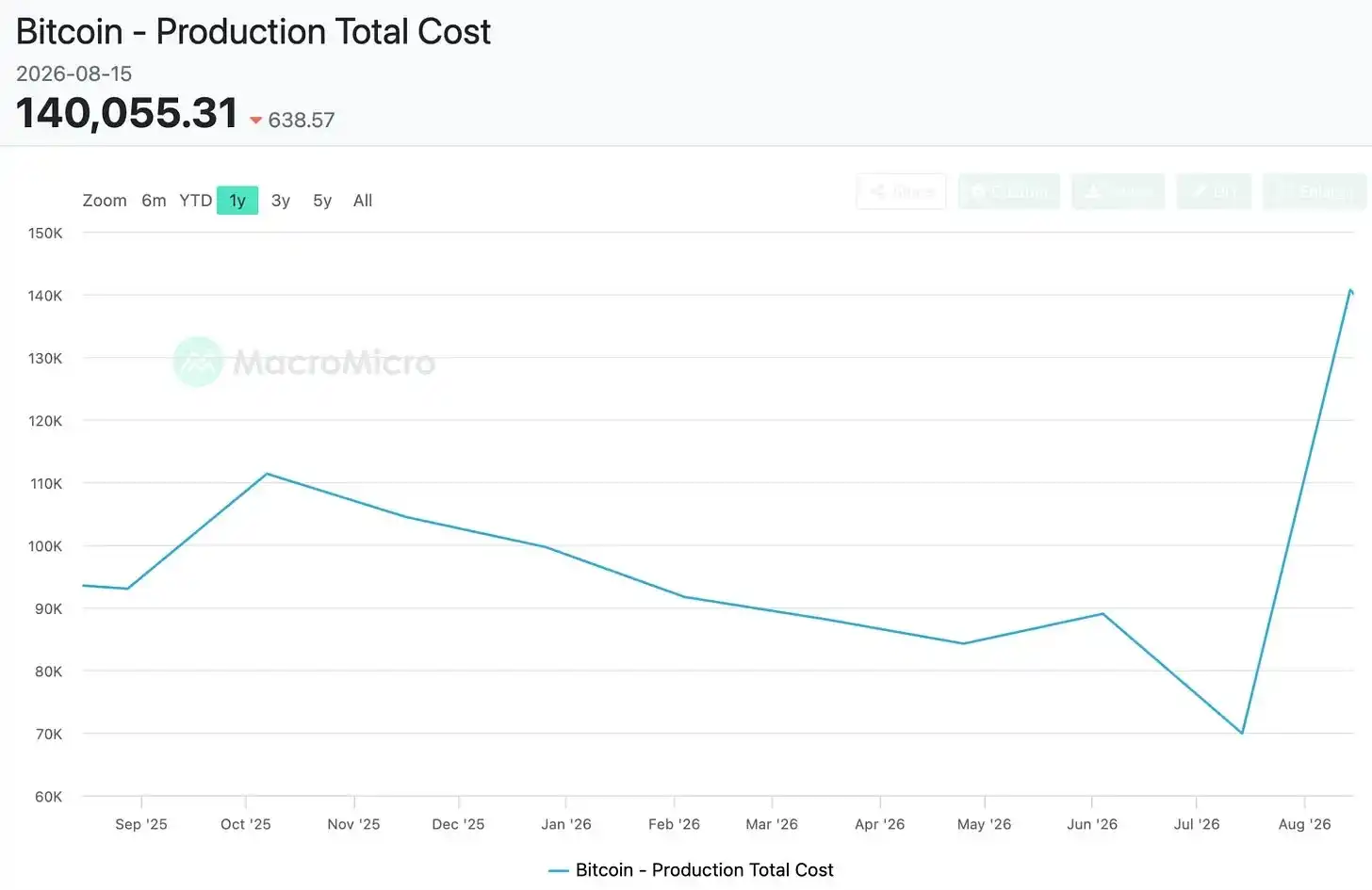
Bitcoin is now about $63,000, almost half of last October’s high. At that level, selling freshly mined coins is close to unprofitable. Mining costs have also risen sharply, driven by electricity prices and rising network difficulty. The article says all-in mining costs climbed from about $40,000 in February 2024 to $90,000-$110,000 in the October 2025-July 2026 window, before hitting a record $140,000 in August this year.
Source: MacroMicro
AI demand offered miners an easier entry than starting from scratch
While Bitcoin mining was getting harder, capital was flooding into AI inference. The article notes that miners were not starting from zero. Bitcoin mining relies on ASIC chips running complex algorithms, and that hardware base overlaps heavily with the infrastructure needed for HPC and AI inference.
That made the pivot more practical than it might have looked. Existing sites, power access and hardware could be repurposed for AI hosting, lowering the entry barrier for miners looking for a profitable alternative.
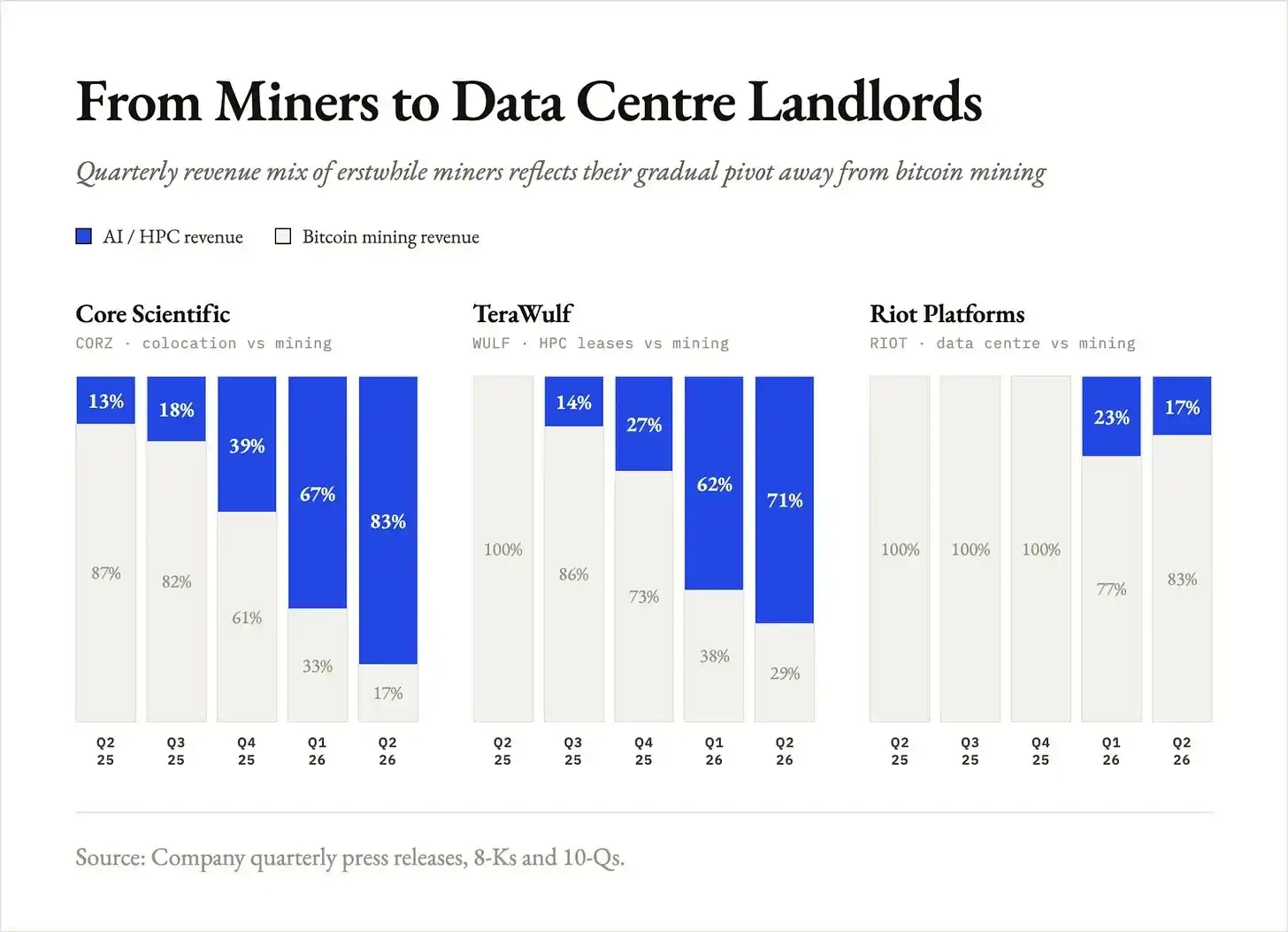
The shift is already visible in the listed mining sector. Core Scientific is one example. In the second quarter of 2025, its data center hosting business for AI and HPC brought in just $10.6 million, while mining and coin sales generated $62.4 million. Twelve months later, the picture had flipped. In Q2 2026, hosting revenue rose to $136.7 million, while mining revenue fell 65% to $21.5 million. Hosting went from 14% of total revenue last year to 83%.
TeraWulf has gone even further. Its HPC leasing revenue now makes up 71% of total revenue. The business had no such revenue a year earlier, but reached $32 million in Q2 2026, while crypto mining revenue fell about 75% to $13 million.
Many miners are also converting existing mining facilities and hardware into AI and HPC capacity.
Power, land and long contracts have become the new battleground
The pivot from Bitcoin mining to AI compute has turned into a scramble for power and land. Beyond reallocating current capacity, former miners are signing large demand-side contracts, with executed deals now reaching hundreds of billions of dollars in aggregate.
Core Scientific has committed up to 2.5GW of available compute capacity to AMD and CoreWeave, with more than $24 billion in potential contract revenue over the life of the agreements. Hut 8 has 949MW of contracted capacity, a $26.6 billion base contract value and $7.5 billion in new project financing. TeraWulf signed a 20-year leasing deal with Anthropic worth about $19 billion and bought a Kentucky campus with gigawatt-scale capacity to support demand. Over the past six months, Riot Platforms completed several leases totaling 241MW, worth about $10 billion in contracts.
Just last week, IREN delivered its first AI cloud deployment nodes to Microsoft under a five-year contract worth $9.7 billion. It also agreed to a 5GW partnership with Nvidia and keeps acquiring power sites in Texas and Spain to meet demand.
These deals have fueled enthusiasm because long leases with major cloud companies can look more stable than mining revenue. After a year of losses, locking in 15- to 20-year contracts may seem like the practical choice.
AI compute has no built-in self-correcting mechanism
The article warns that many market commentators are missing a key difference. Bitcoin mining has a self-correcting mechanism; AI hosting does not.
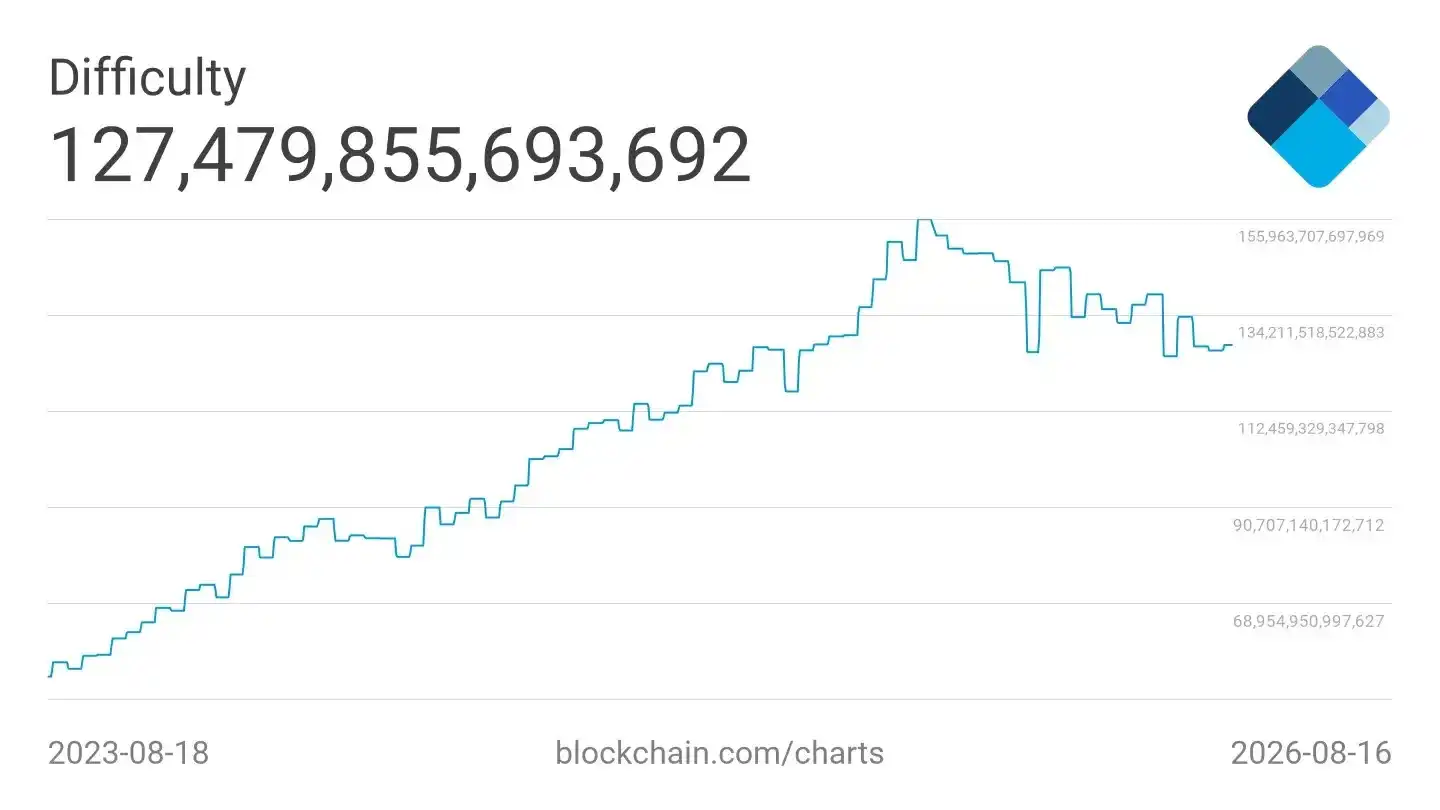
When mining is unprofitable, miners shut machines down. As more miners exit, Bitcoin network difficulty falls automatically. The remaining miners earn more with the same equipment and the same power cost. As miners have moved into AI, Bitcoin network difficulty has already fallen from a 2025 peak of about 156 trillion to 127.5 trillion. Every miner that leaves makes mining more attractive for those who stay.
AI compute works differently. If too many players enter and supply outruns demand, prices get pushed lower. The article says several AI companies have already cut pricing. In the early days, scarce hardware and related resources allowed providers to charge a premium. Now cloud companies around the world are competing for megawatt-scale power, while miners and data center operators keep expanding capacity. Once the new supply fills the gap, compute prices could fall quickly.
That would make today’s 15- to 20-year leases look expensive in hindsight.
The shift is also hard to reverse. Converting a mining site into an AI campus is relatively easy because the power infrastructure is already there. But once ASIC miners are replaced with H100 GPUs and a 20-year lease is signed, the company is tied to that contract for decades.
If the market turns and Bitcoin moves back above the $60,000 range while network difficulty keeps falling, mining could become profitable again. By then, fully converted miners would be stuck. If AI compute revenues also disappoint, the pressure would be even worse.
Not every miner chose to bet everything on AI
The article does not argue that miners should simply wait for the mining cycle to turn. For most firms, the pivot is a survival response. With all-in mining costs at $140,000 and Bitcoin at $63,000, staying in mining is not a viable business model. AI is the only immediate lifeline.
But the real danger lies with the miners that go all in on AI. Under pressure, they abandon Bitcoin mining entirely, scrap or replace their ASIC fleets and lock themselves into decades-long contracts in a young industry that will almost certainly go through pricing resets.
Some miners, however, are taking a more cautious route.
Marathon Digital, which holds the largest Bitcoin treasury among listed miners, chose that path. In Q2 2026, it sold 30% of its Bitcoin holdings to reduce debt, but it did not give up its mining equipment. Instead, it used a different structure to fund AI expansion. MARA borrowed $150 million through a 2026 credit facility backed by its remaining Bitcoin. As of June 30, it still held more than 35,000 BTC and maintained a mining business with flexible load management.
Hut 8 also kept mining. It spun out its Bitcoin mining business into a new subsidiary, American Bitcoin Corp, which remains fully controlled by the parent company, while the parent shifted its focus to HPC and AI infrastructure.
Keeping the machines running and the Bitcoin inventory on the balance sheet gives these companies an option that fully converted miners no longer have. If mining becomes profitable again, they can switch power load back to Bitcoin. Firms locked into long AI contracts can only watch.
Treating the old mining business as a burden and betting everything on AI compute is a wager on a future that has not yet been proven. History suggests that as technologies such as chips, computers and smartphones mature, prices fall. AI compute is already showing signs of that same pressure.
Marathon and Hut 8 have not missed the AI opportunity. They did not liquidate everything to buy GPUs. Instead, they kept part of their mining capacity and Bitcoin holdings, treating AI as diversification rather than a full replacement for an industry that is still young and likely to be repriced. As long as the ASICs remain in place, they can switch back to mining when mining economics improve and AI premiums fade.
At a broader level, these companies are really power operators, with ASIC miners or H100 GPUs sitting on top of the same electricity infrastructure. The firms that can move power between mining and AI compute, depending on which business earns more, are the ones least likely to be trapped by market cycles or market narratives.