Bitcoin eases after touching levels not seen in months
Bitcoin fell to around $83,600 on Friday, down roughly 1% from the prior close, as the week’s rally lost some steam. Earlier in the session, BTC had climbed to nearly $87,000, a level it had not reached in months, after breaking out of the $75,000 to $81,000 range that had held it back for weeks.
That retreat has not yet changed the broader chart picture described in the report. Bitcoin’s daily setup still looks bullish, with the 50-day moving average above the 200-day moving average in what traders call a golden cross.
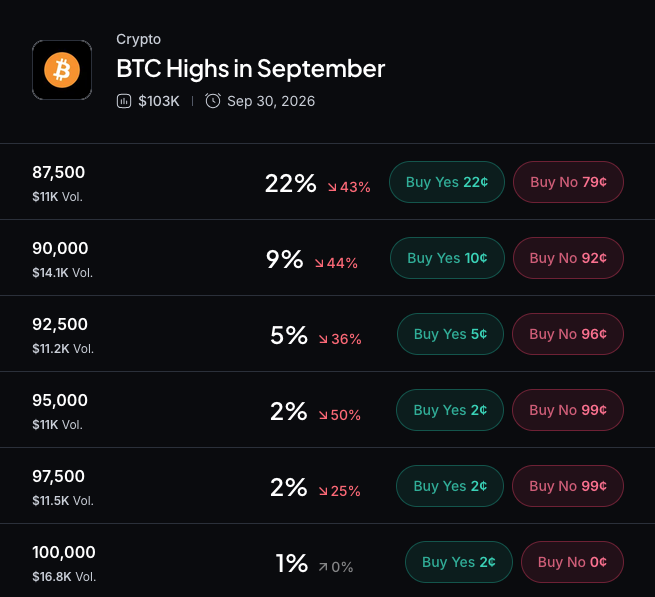
The article also included a Myriad prompt asking readers: “How high will Bitcoin go? Click to make your prediction.”
$15.6 billion in Deribit options expired as derivatives activity cooled
Part of Friday’s weakness may have had a mechanical driver. Bitcoin options worth $15.6 billion expired on Deribit, and dealers often unwind hedges once that flow clears. The report described that as a routine event that can move price without necessarily changing the underlying trend.
Other derivatives metrics moved lower as well. Open interest dropped 14.39% and 24-hour trading volume fell 13.68%. Liquidations were relatively even over the past day, with $161.96 million in long positions liquidated and $156.1 million in shorts. In the article’s framing, that pattern looks more like leverage being reset than a one-directional flush.
Fed expectations shifted again after the September meeting
Macro conditions are still part of the setup for risk assets. According to the report, the Federal Reserve raised rates by 25 basis points on September 16, bringing the target range to 3.75% to 4% in its first hike since 2023. At the same time, it kept buying short-term Treasury bills to maintain bank reserves, a mix that softened the hawkish read and helped support risk appetite.
That relief faded later. Federal Reserve Chair Kevin Warsh’s post-meeting dot plot showed a median rate of only 4.1% through the end of 2027, pointing to just one more hike as the likely path. Then, on September 23, Fed Governor Michael Barr said that “further policy adjustments are likely needed,” a remark that arrived alongside a report showing core PCE inflation at 3.4%, near a four-year high.
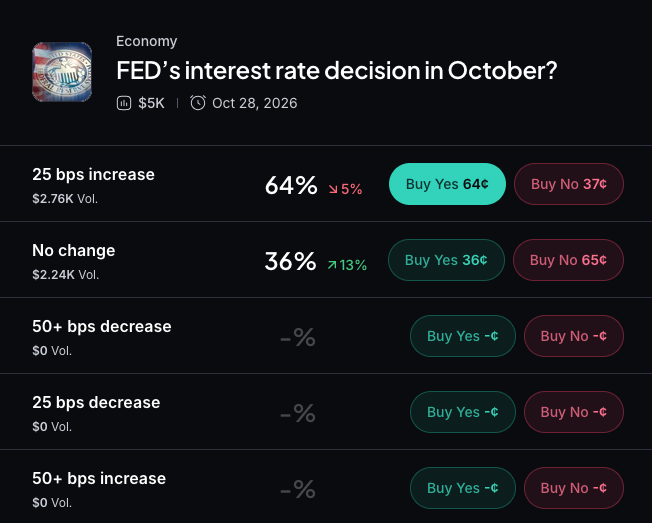
Since then, expectations for another move in October have increased. The probability of an October hike rose to roughly 75% on CME’s FedWatch tool and 68.5% on Myriad Markets, reversing the immediate post-meeting mood.
The article also carried another Myriad line: “What will the Fed do next? Click to make your prediction.”
ETF inflows continued, but at a slower pace
Spot Bitcoin ETFs recorded another $299.09 million in inflows on Friday. That figure was smaller than the single-day totals seen earlier in the week, which the report read as a sign that the first burst of buying was cooling rather than picking up speed.
Total crypto market capitalization stood at $2.87 trillion, down from the more than $3 trillion level reached earlier in the week. The Fear and Greed Index eased to 72 from a peak of 79. It remained in greed territory, but the level of enthusiasm was lower.
Most large-cap tokens tracked Bitcoin lower, with XRP and Solana standing out
Across the top 10 cryptocurrencies, most names moved lower with Bitcoin over the past 24 hours. Ethereum was roughly flat, BNB fell 0.81%, and both Tron and Hyperliquid traded in the red. XRP and Solana were the exceptions highlighted in the report.
XRP gained 4.37% over 24 hours and 15.45% over the past week, trading near $1.58 with a market capitalization of about $99 billion. The article said XRP ETFs posted a nine-day inflow streak worth $1.6 billion in late August, and that inflows have continued since then as institutional interest appears to be building.
Solana rose 3.36% on the day and 9.33% over seven days, changing hands at around $119.84 with a market capitalization of roughly $70 billion.
Solana upgrade progress and upcoming U.S. data are now in focus
The report said Solana’s Alpenglow upgrade would reduce transaction finality to roughly 150 milliseconds. The proposal has already passed a validator governance vote with overwhelming support, though the date for mainnet activation is still tentative. At the same time, spot Solana ETFs from Fidelity, Grayscale, and VanEck, launched in November 2025, continue to record inflows as attention on the upgrade story builds.
Bitcoin’s next macro test is close. September Personal Consumption Expenditures inflation data is due on September 30, followed by the September jobs report on October 2. According to the article, both releases could reset interest-rate expectations heading into the fourth quarter.