
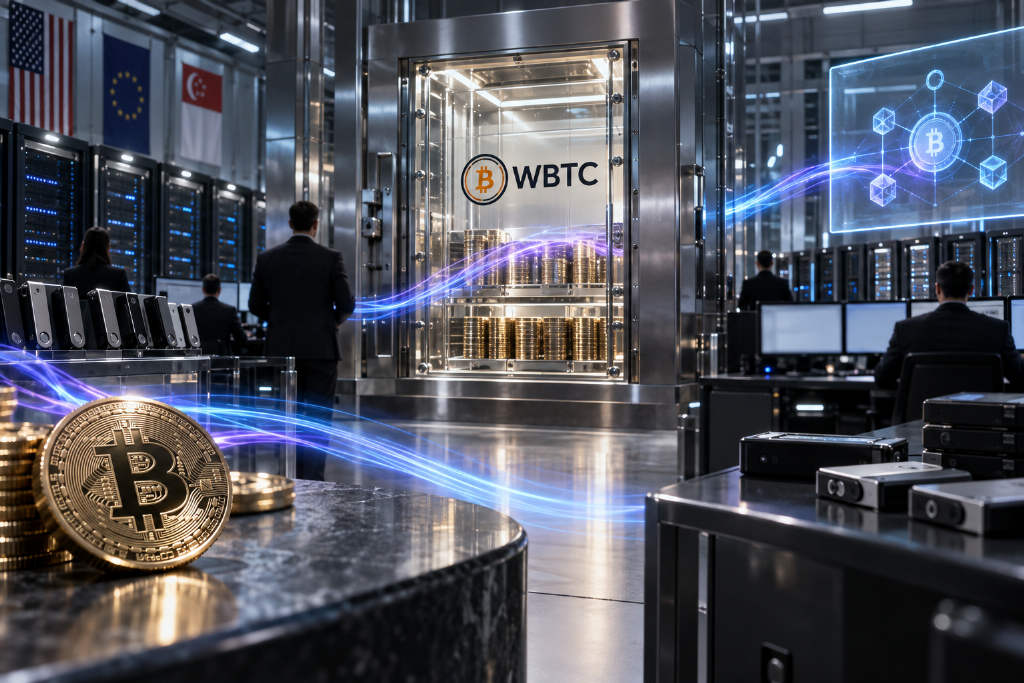
Quantum computing is starting to reshape how the market thinks about Bitcoin’s long-term security. The challenge, as laid out in the article, is no longer limited to the cryptographic integrity of the Bitcoin network itself. It extends to the wider financial infrastructure built around Bitcoin, and whether that infrastructure can evolve at the same pace if the underlying security model changes.
In theory, a sufficiently powerful quantum computer could break the digital signatures used to secure Bitcoin transactions, leaving some Bitcoin exposed if their public keys have already been revealed. No publicly demonstrated quantum computer can carry out such an attack at scale today. Even so, the article says the possible impact now reaches far beyond Bitcoin alone.
That broader exposure becomes clearer as tokenized Bitcoin products such as Wrapped Bitcoin, or WBTC, bring Bitcoin deeper into decentralized finance. Under that setup, a future shift in cryptography would not only affect the Bitcoin network. It would also affect the financial systems that rely on Bitcoin-linked assets.
The upgrade challenge goes beyond a new signature scheme
The article says a move toward quantum-resistant cryptography would involve much more than introducing a replacement for Bitcoin’s current digital signature model. Wallet providers, exchanges, custodians, and other infrastructure operators would need to update their own systems. Existing Bitcoin holdings might also need to be moved to addresses using new security standards.
Proposals such as BIP-360 show that developers are still exploring what Bitcoin’s future cryptographic architecture could look like. Coordinating an upgrade across a decentralized ecosystem, however, may take years.
For tokenized Bitcoin, the problem is even more layered. Even if Bitcoin itself adopts quantum-resistant cryptography, the custody systems, smart contracts, and underlying blockchains that support tokenized assets would still need separate security reviews. A security upgrade at the Bitcoin network level does not automatically protect every layer built on top of it.
WBTC shows the scale of the infrastructure question
WBTC is presented as an example of how large and complex Bitcoin security becomes once it operates across multiple financial ecosystems.
The token currently has a circulating supply of 116,000 WBTC, representing about $9.5 billion in Bitcoin-backed reserves. That infrastructure supplies Bitcoin liquidity to lending protocols, decentralized exchanges, and other DeFi applications across multiple blockchain networks.
WBTC is backed 1:1 by custodied Bitcoin reserves. Its long-term resilience depends not just on the strength of Bitcoin’s base-layer cryptography, but also on reserve security, custody operations, and the infrastructure that supports minting and redemption.
If Bitcoin eventually moves toward quantum-resistant cryptography, custodians may need to reassess key management systems, migrate underlying Bitcoin reserves, and keep related business processes running smoothly through the transition.
Address migration and multi-custodian plans are not a substitute for quantum resistance
Against that backdrop, WBTC is planning to migrate to new Custodian Bitcoin Deposit Addresses, abbreviated as CBDAs, as part of its custody infrastructure management. The article says Bitcoin address management is closely tied to long-term security because public key exposure can affect how vulnerable assets may be under a future quantum attack.
Still, the specific security effect depends on address type and transaction history. Moving addresses alone does not create quantum-resistant protection.
The article also notes that WBTC previously announced that it is exploring a multi-custodian reserve model. The stated aim is to reduce custody concentration risk and improve overall operational resilience. That model does not directly solve the cryptographic risks associated with quantum computing, but depending on how it is implemented, it could give operators more flexibility in adapting to future security standards.
Both steps point to the same issue: the security management of Bitcoin reserves and the resilience of the systems around them matter alongside any future cryptographic upgrade. Neither measure replaces actual quantum-resistant cryptography, but both reflect the practical challenges Bitcoin-linked financial infrastructure would face in preparing for technological change.
Preparing for Bitcoin’s next phase remains a long-term task
There is still no clear answer on when quantum computing might become a real threat to Bitcoin. What the article makes clear is that preparing for a possible cryptographic shift will be a long-term task for the broader Bitcoin ecosystem.
For WBTC, that means thinking through how custody architecture, reserve management, and related blockchain infrastructure can continue to adapt as Bitcoin’s security standards evolve. Bitcoin’s quantum transition may begin with cryptography, but whether it can move into its next phase will also depend on the resilience of the infrastructure that connects Bitcoin to the wider financial system.
The original article also included a disclaimer saying the content is for reference only and does not constitute financial or investment advice, adding that participation in DeFi involves risk and requires independent research and careful assessment.